Local SEO for roofing companies is the process of optimizing a website and Google Business Profile for one or more service locations.
The practice centers on two connected but distinct goals: ranking in Google’s Local Map 3-Pack and ranking in traditional organic search for city- and service-specific queries. It also includes business citations on directories like Yelp and Angi.
The following guide outlines how local SEO works for roofing companies, the best practices, and what we’ve observed over 16+ years of local optimization here at Roofing Webmasters.
Key Takeaways
NAP (name, address, phone) consistency matters less as a standalone factor than it used to, though citations still support how search engines validate a business.
A Google Business Profile (GBP) is required to appear in Google’s Local Map 3-Pack. There is no workaround.
Google Maps and Google’s organic search results run on separate algorithms with different ranking factors.
Review signals account for roughly 20% of local pack ranking weight as of 2026, up from 16% in prior years.
Google Maps vs. Organic Search
Google Maps and traditional organic search use different algorithms, even though both factor in location. The table below breaks down what each system weighs.
This comparison assumes a roofing company wants visibility with homeowners actively searching Google. A contractor operating primarily through referrals, long-term commercial contracts, or GC-subcontracted work has less reason to invest in either system.
Directly influences ranking (proximity to searcher)
Indirect; city/location references matter more than a physical address
Reviews
Direct ranking factor for Maps prominence
Indirect; reviews build trust signals referenced by content
Result types shown
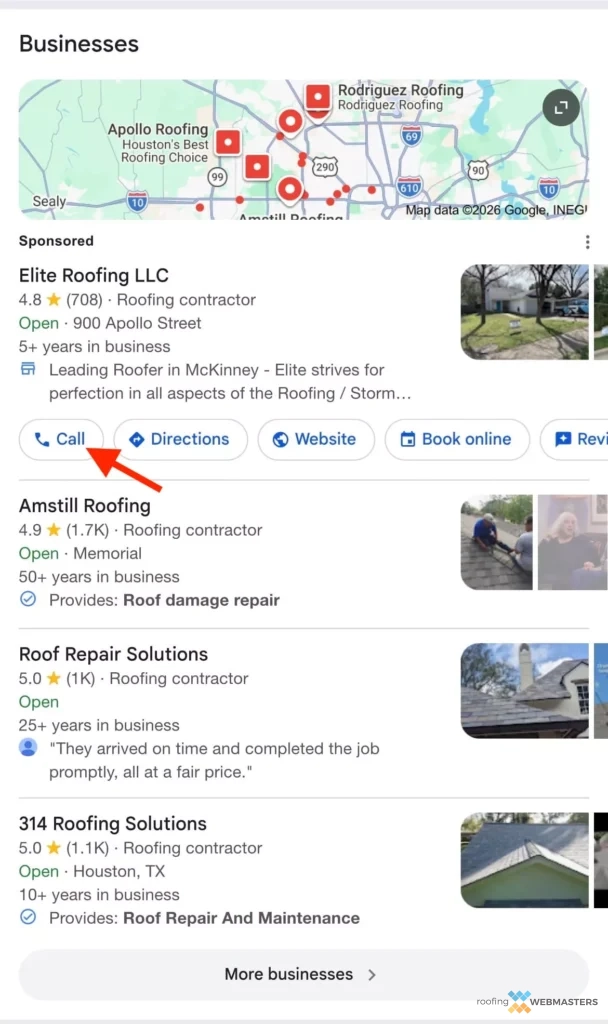
Three business listings plus a map
Directory lists, official websites, location pages
A roofing company can rank well in one system and miss the other entirely. A location page optimized for “Frisco roof replacement” competes in organic search, while a complete, review-active Google Business Profile competes in the Map 3-Pack.
Google Business Profile Is Mandatory
Only businesses with a registered Google Business Profile are eligible to appear in Google Maps or the Map 3-Pack. This makes a GBP a baseline requirement, not an optional upgrade.
This requirement applies to any roofing business with a physical location or defined service area that wants to appear in Google Maps results. It doesn’t apply to manufacturers, wholesale suppliers, or roofing businesses that operate purely as subcontractors to general contractors with no direct-to-homeowner presence; those businesses have little to gain from Map 3-Pack visibility.
Additional optimizations, such as unique photos, up-to-date information, and regular Google Posts, improve a listing beyond that baseline. The most consequential single addition is the website URL field, which ties the listing to a location’s on-site content.
Jobsite Check-Ins and Documentation
Most roofing companies work across multiple cities near a single home office, which complicates local SEO because Google weighs proximity to the searcher.
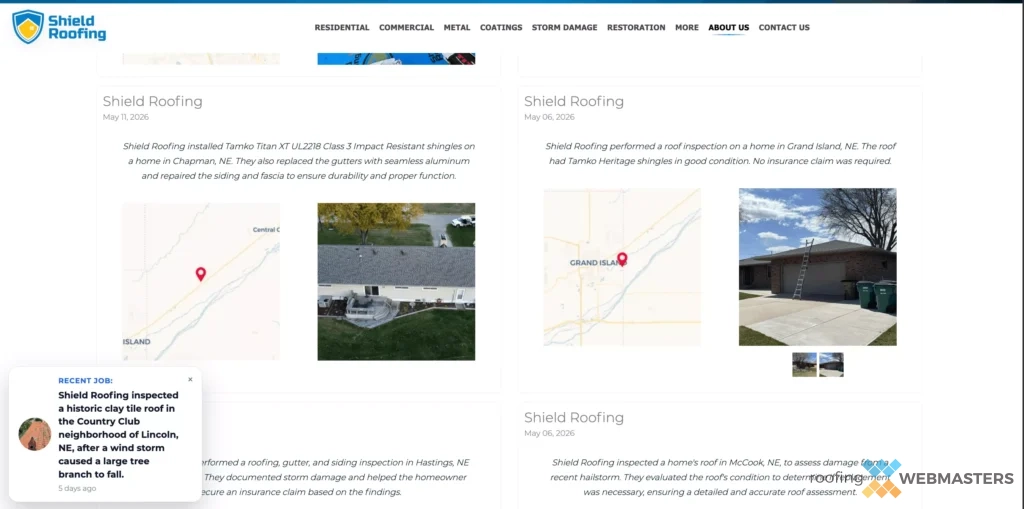
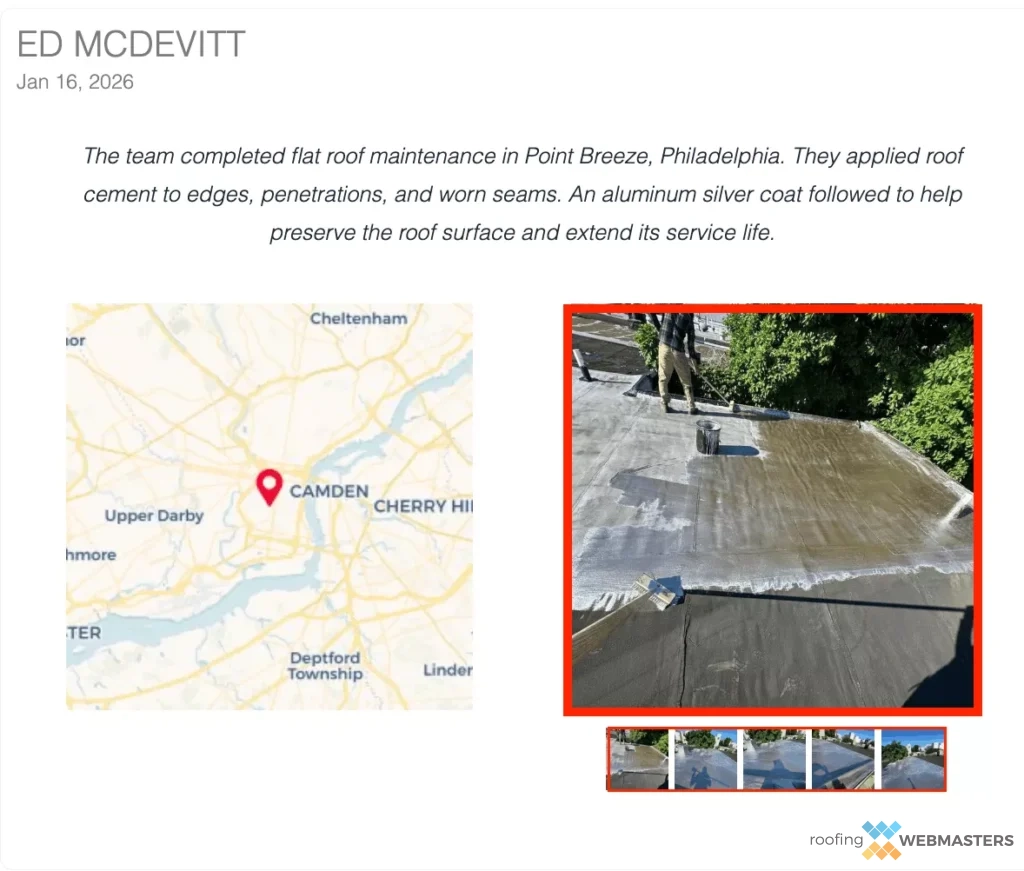
Roofers can address this by combining jobsite check-ins with mini-maps, schema markup, geo-coordinates, original photos, and taggable job captions for each completed project.
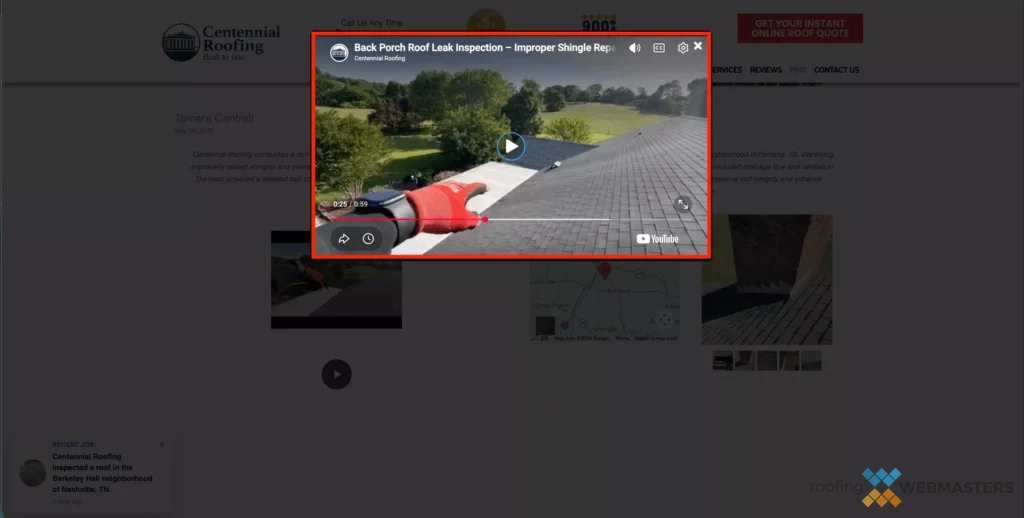
These check-ins give a roofing company dated, location-specific evidence of work performed in a given service area, which supports both organic relevance and review generation.
NAP Citations and Business Directories
NAP stands for name, address, and phone number. Citation consistency across directories still supports how Google and other search engines validate a business, though its influence as a standalone ranking factor has declined relative to review signals and Google Business Profile completeness.
This matters less when a business has few directory listings to begin with. It matters more for companies with a longer history of citations across changed addresses or rebrands, where inconsistency can accumulate.
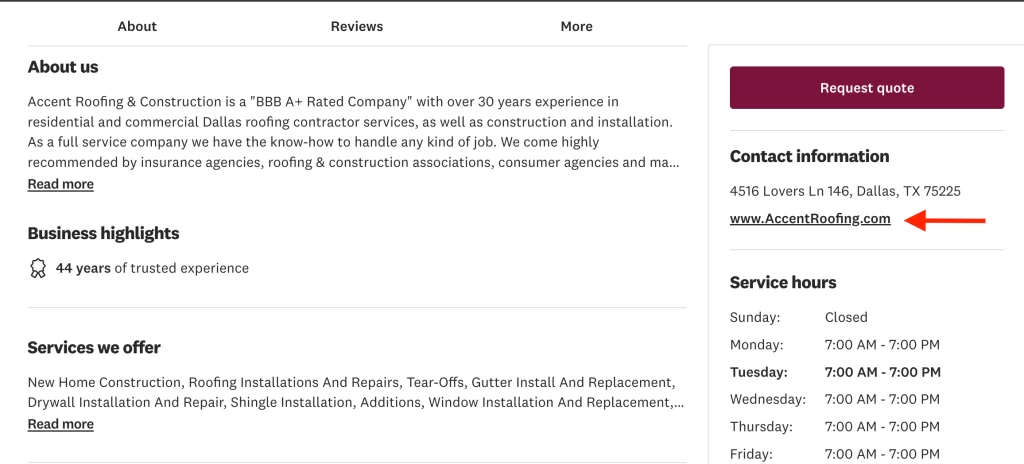
The most common citation sources for roofing companies are Yelp, Facebook, Better Business Bureau, and Angi. Linking the business website from each listing helps search engines associate the citation with the correct site.
Reviews
Review signals make up roughly 20% of local pack ranking weight as of the 2026 Whitespark Local Search Ranking Factors survey, up from a 16% weighting in earlier years. This makes consistent review generation one of the highest-leverage activities available to a roofing company.
Consumer tolerance for imperfect ratings is higher than many contractors assume. A Roofing Webmasters consumer survey found most consumers will consider a contractor rated below a perfect 5 stars, with acceptance concentrated between 4.0 and 4.9 stars.
The same survey found roughly half of consumers check more than one review platform before choosing a contractor, which is why diversifying review requests across Google, Facebook, and directory sites outperforms concentrating on a single platform.
This emphasis on review volume applies to businesses that directly take on new residential customers. It matters less for subcontractors who never interact with the homeowner directly and whose next job comes through a general contractor relationship rather than a Google search.
Local Keyword Research
Keyword research for local roofing companies differs from national keyword research. Tools like SEMrush, Ahrefs, and Moz measure national search volume accurately but are less precise for hyper-local terms.
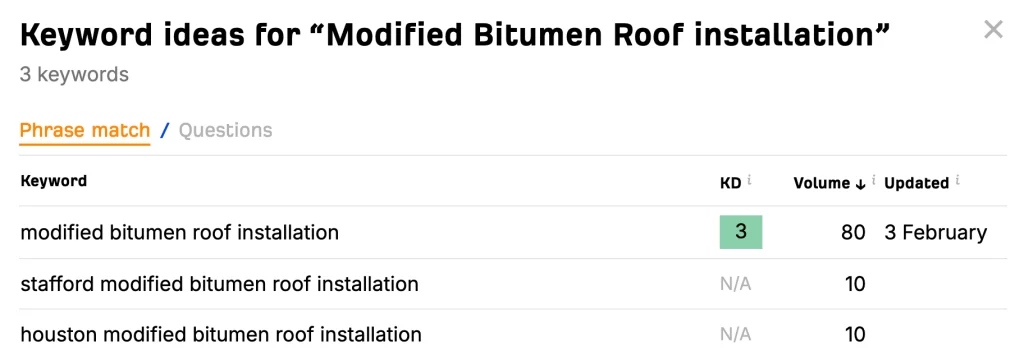
A long-tail keyword is three or more words and highly specific. A moderate long-tail example for roofers would be “modified bitumen roof installation,” which registers an 80 search volume nationally, making it a workable local target even at that volume.
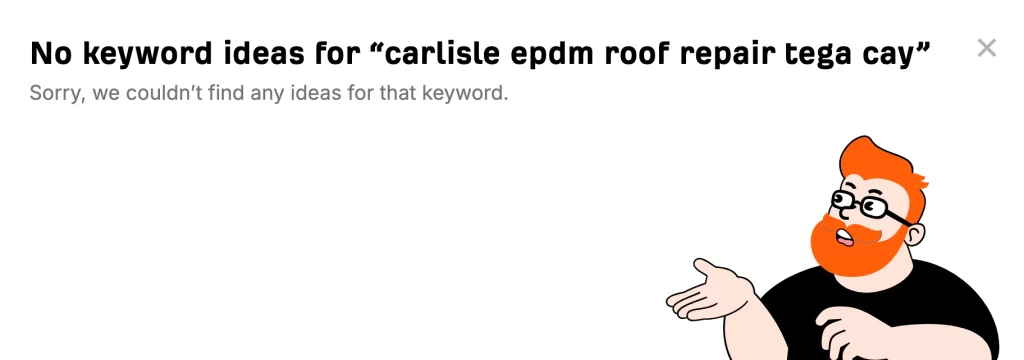
Based on client campaigns, many local searches combine a specific product or service term with a brand name and a city (for example, a specific roofing material paired with a nearby town), and these combinations often don’t register in standard keyword tools at all.
This doesn’t mean the tools are broken; it means keyword research for a single-location or multi-city roofing business benefits from reviewing actual Google Search Console query data alongside any third-party tool.
It’s also a best practice to build pages that meet your customer’s intent without necessarily building out a page or post for every single roofing keyword your website visitors might search.
In many cases, similar phrases share the same intent, meaning they can be answered on a single page rather than on multiple variations of a page.
Deploying an intentional page-intent strategy is especially beneficial under Google’s Helpful Content Update and subsequent core updates, which deprioritize thin and narrowly scoped pages.
Experience, Expertise, Authoritativeness, and Trustworthiness (E-E-A-T)
Google’s own documentation states plainly that E-E-A-T itself isn’t a specific ranking factor, but that Google’s automated systems use a mix of measurable factors to identify content that demonstrates it.
In practice, this means there’s no “E-E-A-T score” to optimize for directly, but the underlying signals (expertise displayed on a page, verifiable credentials, customer-facing trust indicators) do influence how content is evaluated.
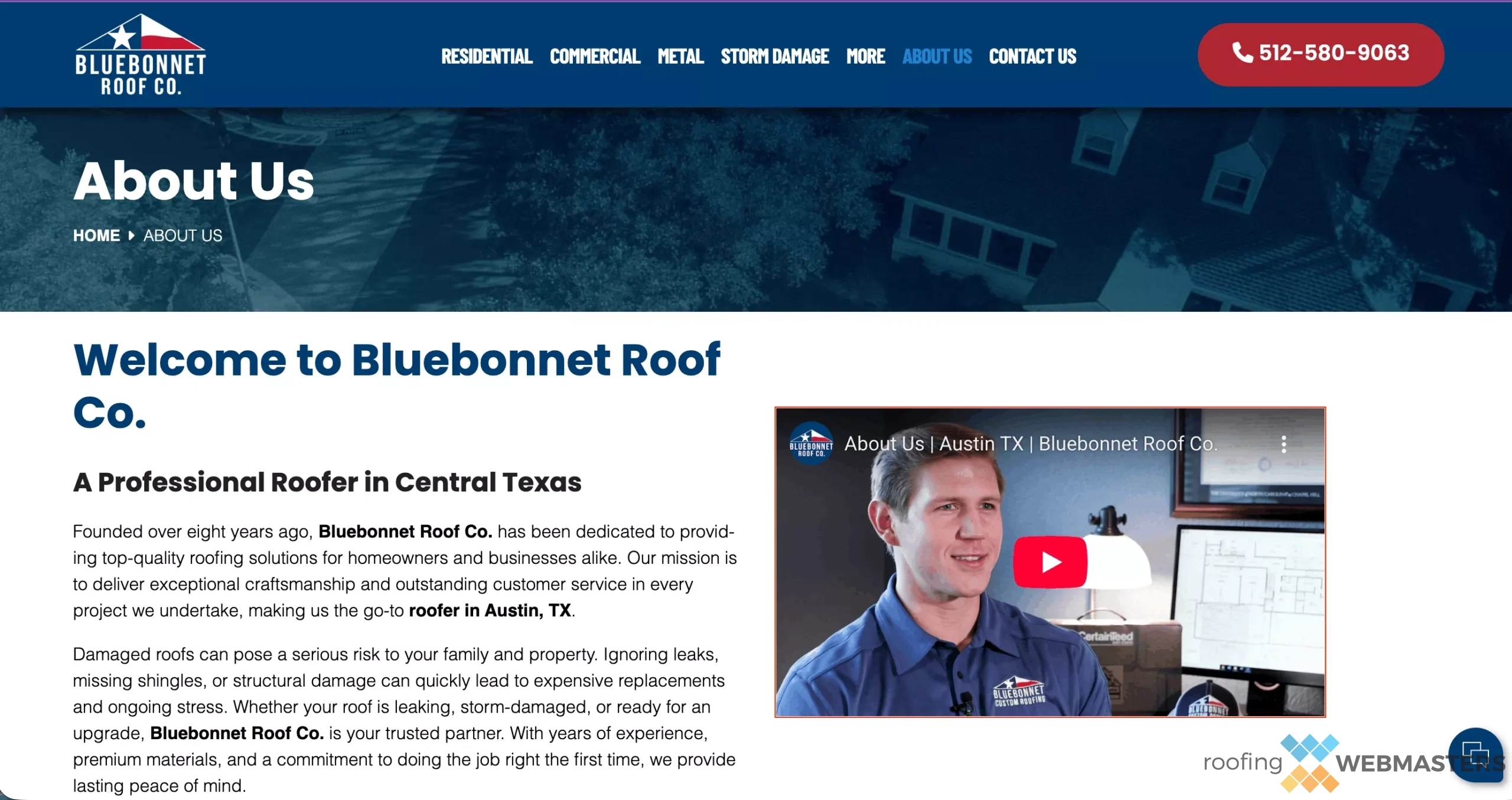
About Us Page
An About Us page that details an owner’s or team’s experience and credentials gives Google’s raters something concrete to evaluate against the E-E-A-T framework described above.
A page listing licenses, certifications, and specific project history performs better here than generic company language.
Badges and Awards
Fewer than 2% of roofing contractors nationwide hold GAF’s Master Elite certification, which makes it a genuine differentiator when displayed with the certifying body named.
The same applies to other named, verifiable credentials; an unnamed or unverifiable “award” carries little weight for either readers or Google’s raters.
Social Proof
An embedded review display pulling from an actual review platform, paired with a documented jobsite history (photos, geo-tags, dates), gives both users and Google’s systems a way to verify claims of experience rather than take them at face value.
Closing Summary
A roofing company’s local SEO strategy rests on three foundations that don’t substitute for one another: a fully claimed Google Business Profile for Map 3-Pack eligibility, consistent review generation across platforms, and content built around genuine credentials and documented work rather than unverifiable claims.
Companies that treat these as a single combined effort, rather than three separate checklists, are best positioned as Google’s local algorithms continue to weight review signals and profile completeness more heavily each year.
Author: Nolen Walker
Nolen Walker is the founder of Roofing Webmasters and the creator of DataPins™, a Local SEO platform for roofing companies. He has over 16 years of experience helping roofing businesses grow through organic search, Google Maps, and AI-driven visibility.
Google’s Local Services Ads (LSA) is Google’s pay-per-lead advertising platform for verified roofing contractors and other local businesses. Only roofing companies that pass Google’s screening and verification process are eligible to run these ads.
To participate, businesses must pass a verification process that varies by category and location.
According to Google’s official documentation, this process may include a business entity check, business owner background check, field worker background check, license verification, and insurance verification.
On average, screening and verification take three to four weeks to complete once documents are submitted, though some advertisers qualify for accelerated badging while finishing the remaining steps.
Once verified, roofers pay only for leads generated through the ad rather than paying per click, as with traditional Google Ads. Local Services Ads appear above traditional paid advertisements for people performing a local search for roofing services in their area.
The following guide breaks down how roofing companies can maximize the impact of LSA.
Key Takeaways
Local Services Ads (LSA) is Google’s pay-per-lead advertising platform for verified roofing contractors, distinct from traditional Google Ads PPC.
Businesses earn the Google Verified badge by passing entity, license, insurance, and background checks. Google discontinued the separate Money Back Guarantee program tied to the older “Google Guaranteed” name; verification and trust signals now run through the single Google Verified badge.
LSA availability and cost vary significantly by zip code, trade, and competition level. There is no single national price that applies evenly across markets.
Downsides include unpredictable lead quality, dependency on Google’s verification status, and the risk of suspension or revocation, which can be appealed but isn’t guaranteed to be resolved quickly.
LSA works best as one channel within a broader strategy that includes SEO, website conversion, and reputation management, rather than as a standalone lead source.
The Google Verified Badge
The Google Verified badge is a single trust badge that Google now issues to all qualifying Local Services Ads advertisers.
It replaced the prior two-tier badging system, and Google has discontinued the Money Back Guarantee that was previously tied to the older program name. Existing advertisers who had already completed verification automatically received the new badge with no action required; new advertisers earn it by completing the standard screening and verification process.
The badge signals to consumers that a business has passed Google’s checks, but it does not function as a consumer reimbursement program the way the prior structure did.
Roofing companies should not represent the badge to customers as including a money-back guarantee, since that mechanism no longer exists in its earlier form.
How Local Services Ads Work
Local Services Ads operate on a pay-per-lead model, where you only pay after the customer contacts you through the ad. This differs from standard PPC ads, which charge the advertiser per click regardless of whether the user contacts the business.
Users who click on your ad can contact you in one of three ways: a phone call, which Google records and lets you mark as qualified or junk; a direct message through the LSA platform; or a booking through your connected calendar.
A pay-per-lead model shifts more of the risk to the platform, since users who weren’t seriously considering a service tend to filter themselves out before contacting the business, unlike with click-based PPC.
Channel
Pricing Model
Best For
Limitation
Local Services Ads
Pay per lead
Verified businesses wanting top-of-page placement with minimal click waste
Availability and cost vary by market; less control over lead source
Google Ads PPC
Pay per click
Businesses wanting precise keyword and landing page control
Pay regardless of whether the click converts to contact
SEO / organic search
No direct cost per lead
Long-term, sustainable visibility independent of ad spend
Slower to build; requires ongoing content and technical investment
Leads often shared with competing contractors bidding for the same job
Local Services Ads, traditional SEO, and third-party lead platforms tend to work best as complementary channels rather than substitutes for one another.
A roofing company that relies on only one is more exposed to that channel’s specific risks, whether that’s rising LSA costs, algorithm shifts affecting organic rankings, or platform fees on third-party sites.
LSA Eligibility for Roofing Companies
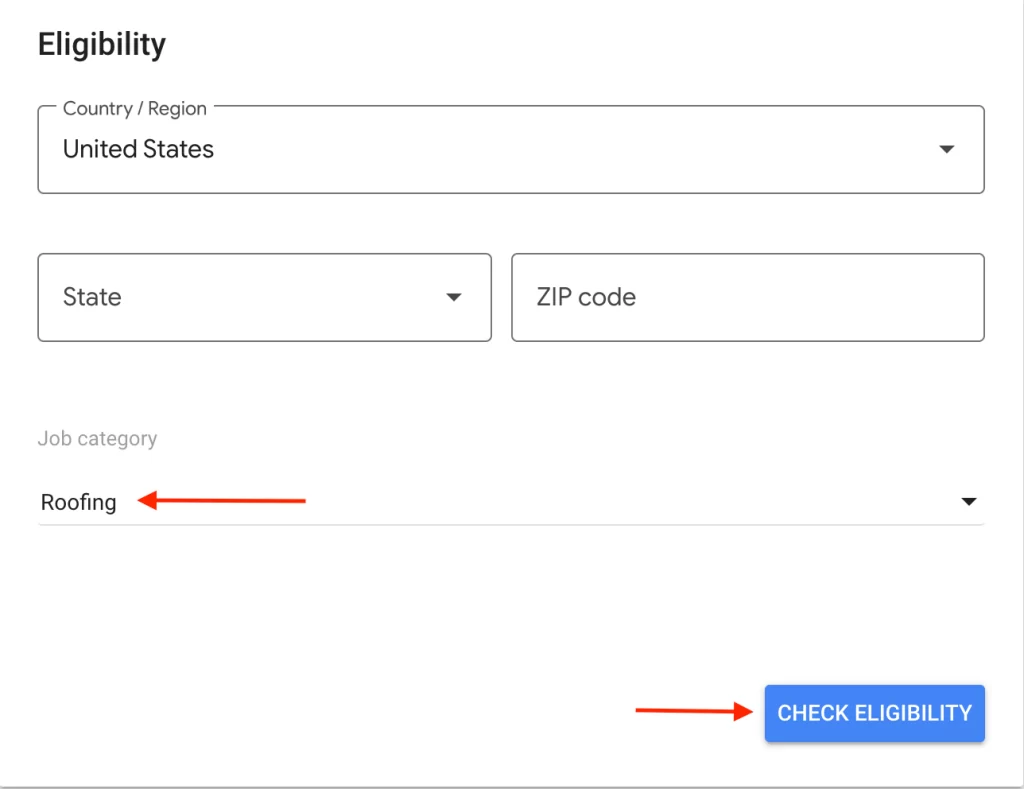
LSA is not available in every location, and availability depends on your specific service area and licensing status.
Google’s targeting system lets advertisers define service areas by city, zip code, or county, and Google’s own guidance favors city or town-level targeting for the most accurate ad matching.
For roofing companies in rural or lower-density markets, this means service-area coverage can be inconsistent even within counties that technically qualify, since LSA’s availability is built around population and competition density rather than a simple in-or-out designation by state.
Roofers in these markets should check eligibility directly through Google’s service area tool rather than assuming availability based on neighboring cities.
Licensing is also a gating factor. Google verifies that advertisers and their workers hold applicable state and local licenses, and in some border regions, a license valid in one state may not extend coverage into a neighboring service area even if both fall within your intended footprint.
Roofing companies expanding into new territories should confirm licensing coverage before assuming LSA eligibility follows automatically.
New or low-review roofing companies face a separate consideration. Verification through Google does not require an established review history to begin running ads, but ranking and visibility within LSA’s results are influenced by review volume and quality over time.
A newly verified roofer with the Google Verified badge but few reviews will likely see lower visibility than an established competitor with the same badge, even in the same service area.
LSA Cost Considerations
LSA cost per lead varies substantially by zip code, trade, and local competition, and there is no single national figure that applies evenly across markets.
Roofing is generally among the more competitive and higher-cost categories within home services, since storm-driven demand spikes and high job values both push bidding activity upward in affected markets. Roofers can check their own market-specific estimate using Google’s built-in cost estimator tool, which reflects current conditions for a given zip code rather than a fixed published rate.
Based on agency experience managing LSA alongside organic search campaigns, organic leads typically carry a meaningfully lower long-run cost per acquisition than paid LSA leads, though the size of that gap depends heavily on market competition, a company’s existing search visibility, and how long it has invested in organic strategy.
Roofing companies evaluating LSA should treat it as one input in a broader cost-per-acquisition comparison rather than relying on a single industry-wide percentage difference.
Potential Downsides to LSA for Roofing Companies
LSA functions as a pay-per-lead advertising model, and pay-per-lead channels carry structural risks that roofing companies should weigh before relying on them as a primary lead source.
Lead quality and disputes
Roofers can mark fake or clearly invalid leads as junk to avoid paying for them, and Google continues to refine its spam filtering for LSA leads. However, the filtering system isn’t perfect, and some leads that appear legitimate at first still fail to convert into a sale.
In those cases, the roofing company pays for a lead that never produces revenue. Invalid leads can be formally disputed through Google’s dispute process, though dispute resolution timelines vary.
Google dependency
With LSA, Google controls verification status, badge eligibility, and the cost per lead. Google can suspend an account for policy violations under its Local Services and Google Ads terms, and a suspended account cannot run ads while the suspension is active, though the business can still access its reports.
If Advanced Verification is denied, an appeal can be submitted once, and Google’s appeal review typically takes about two weeks. By contrast, SEO campaigns still depend on Google’s search algorithm, but the relationship functions more like an ongoing partnership than a platform that can revoke access outright.
Wasted spend on unconverted leads
Because LSA charges per lead rather than per click, the financial risk shifts from impressions to contacts. A roofing company that doesn’t track which leads convert into booked jobs, beyond simply tracking cost per lead, risks misjudging whether the channel is actually profitable.
Moving Forward with Google LSA
LSA can be a useful component of a broader digital marketing strategy that includes SEO, website conversion optimization, and reputation management.
Relying solely on LSA as a primary lead source carries risk, since cost per lead is market-dependent and can rise without warning, and the channel remains fully subject to Google’s verification and policy decisions.
Roofing companies considering LSA should weigh it against their specific market’s competition level, their licensing footprint if they operate across state lines, and their existing review base before treating it as a primary growth channel rather than one option among several.
Author: Nolen Walker
Nolen Walker is the founder of Roofing Webmasters and the creator of DataPins™, a Local SEO platform for roofing companies. He has over 16 years of experience helping roofing businesses grow through organic search, Google Maps, and AI-driven visibility.
Commercial roofing marketing requires a different strategy than residential marketing, not simply a different audience. The stakes, the buyers, the search behavior, and the sales timeline all operate differently.
Understanding those differences determines whether a marketing investment in the commercial space returns results or stalls.
Based on our experience at Roofing Webmasters, working with companies across both sectors, commercial roofing contracts are substantially larger than residential jobs. The higher contract value has a direct consequence: the sales cycle is proportionally longer.
For commercial roofing, where project scopes, building assessments, and multi-stakeholder approvals are standard, a timeline of 6 months to a year before a contract is signed aligns with that benchmark and reflects what commercial-focused contractors routinely report.
Key Takeaways
Commercial roofing marketing requires a fundamentally different strategy than residential, not just a different audience
The sales cycle for high-value commercial contracts regularly runs six months to a year before a contract is signed
Building a portfolio of smaller, non-GC projects (churches, standalone retail, strip malls) is the most reliable entry point for companies without prior commercial history
Commercial buyers search by material type and system specification; optimizing for technical, long-tail terms is more effective than broad local search
Preventive maintenance programs (asset management) are the most accessible entry point with building managers and convert to high-ticket reroof contracts over time
Commercial roofing marketing is not the right move for every company at every stage; capacity and portfolio gaps are disqualifying before marketing can help
Build Your Portfolio With Smaller Commercial Jobs
Commercial roofing companies need documented project experience before general contractors (GCs) will consider them for large-scale work.
Residential roofing history does not translate into commercial credibility, and no marketing investment can substitute for a verifiable project record.
The most effective entry point is targeting commercial projects that do not involve a GC: churches, standalone retail buildings, and strip malls are common examples.
These property types are owner-managed or managed by small property companies, which means a roofing contractor can pursue the relationship directly without competing in a GC’s bid process.
Steps for Entering Commercial Roofing Marketing
Identify non-GC commercial property types in your service area (churches, standalone retail, small strip malls, self-storage)
Build service pages and project content targeting those property types with specific, technical terms (material type, roof system, square footage class)
Document every completed job with photos, scope details, system specifications, and square footage
Use completed projects to create case studies that demonstrate system knowledge, not just aesthetics
Once 5 to 10 documented commercial jobs exist, begin targeting GC relationships directly; based on work with commercial roofing clients, that portfolio threshold is typically when contractors become competitive in GC conversations
Commercial buyers search differently than residential buyers. Homeowners typically use broad, location-based terms (“roofer near me,” “roof replacement”).
Commercial searchers, including facility managers, property managers, and building owners, use material- and system-specific terminology, such as TPO, PVC, EPDM, GAF coatings, modified bitumen, and related terms.
This difference in search behavior has a direct structural implication. Local Services Ads, which perform well for residential contractors because they match high-volume, low-specificity queries, are poorly suited to commercial search intent.
Commercial roofing marketing is better served by long-tail content that targets the specific systems and project types a contractor actually installs.
The commercial section of a roofing website should be organized around system types and project categories, not generic service descriptions.
A page titled “TPO Roofing for Commercial Properties” serves a different and more qualified searcher than a page titled “Commercial Roofing Services.”
Trust Signals by Buyer Type
For commercial buyers, credentialed expertise carries more weight than convenience signals. The table below reflects how trust signals differ across buyer types.
Residential Trust Signals
Commercial Trust Signals
Five-star Google reviews
Case studies with system type, square footage, and project scope
Family owned and operated
Manufacturer certifications and approved applicator status
Free estimates
NDL warranty capability
Same-day service
Roof Condition Reports (RCR)
Photos of completed work
OSHA compliance record and safety documentation
NDL warranty (No Dollar Limit)
A manufacturer-backed total system warranty covering the full cost of qualifying repairs with no monetary cap.
Issuing an NDL warranty requires that the installing contractor be manufacturer-certified and that the completed roof pass a manufacturer inspection.
Not every contractor qualifies. For commercial buyers managing capital assets, NDL capability is a procurement filter, not just a marketing point.
Roof Condition Report (RCR)
A documented assessment of a commercial roof’s current condition, observed deficiencies, estimated remaining service life, and recommended remediation.
RCRs are used by building managers for capital planning and by property owners during acquisition due diligence.
Offering a professional RCR positions a roofing contractor as a building asset advisor rather than a reactive repair vendor.
Know Your Buyer: Property Managers vs. Building Owners
Commercial roofing has two distinct types of decision-makers with different authority, concerns, and entry points.
Building owners
Building owners have capital authority and make final decisions on reroof projects and major system replacements.
They are primarily motivated by asset value protection, warranty coverage, and long-term cost of ownership. Marketing to building owners should emphasize system longevity, manufacturer credentials, and NDL warranty capability.
Property managers
Property managers are responsible for building operations but typically do not control capital budgets. They are motivated by the need to prevent operational disruption and manage maintenance obligations.
Property managers are more accessible than building owners and are the more effective initial contact for preventive maintenance programs.
Converting a property manager relationship into a reroof contract typically requires demonstrating value over multiple maintenance cycles before a capital project is proposed.
Treating these two personas as a single audience results in messaging that does not serve either effectively.
Asset Management as a Marketing Entry Point
Preventive roof maintenance, marketed as asset management, is the most accessible commercial roofing service for contractors who do not yet have an established commercial portfolio.
A building manager who will not authorize a six-figure reroof will often agree to a low-cost maintenance inspection or thermal imaging assessment.
According to Roofing Contractor Magazine, a proactively maintained commercial roof averages approximately 21 years of service life, compared to 13 years for a reactively maintained roof.
That eight-year gap represents substantial deferred capital expenditure for building owners and is a concrete value proposition for maintenance program marketing.
Thermal imaging and roof health diagnostic pages are effective marketing assets for this entry point.
A page explaining how thermal imaging detects subsurface moisture before visible damage occurs gives a building manager a low-commitment reason to engage.
Direct mail and canvassing can extend reach to building managers who are not actively searching online, since the barrier to a diagnostic evaluation is lower than the barrier to a reroof conversation.
A sustained maintenance relationship produces three outcomes that compound over time: the contractor develops documented knowledge of the building’s roof condition, competitors are effectively excluded from the relationship, and the contractor is positioned as the natural choice when the reroof conversation eventually begins.
Commercial Marketing Channel Comparison
Channel
Best Use Case
Limitation
Organic search (long-tail)
Reaching technically-informed buyers actively researching systems or project types
Requires sustained content investment; results are not immediate
Direct mail and canvassing
Reaching property managers not actively searching; maintenance program outreach
Low response rate; works best combined with a low-stakes offer (free inspection, diagnostic)
GC relationship development
High-value project pipeline once portfolio is established
Requires documented commercial project history before GCs engage seriously
Paid search
Limited utility for commercial; high-value commercial buyers rarely convert through paid ads
Commercial search intent is fragmented and low-volume; cost per lead is high relative to residential
When Commercial Roofing Marketing Does Not Apply
Commercial roofing marketing is not the right investment for every company at every stage. Several conditions make the approach premature.
Companies without any documented commercial project experience will find that marketing creates interest they cannot convert.
A building manager or GC who investigates a company and finds only residential portfolio content will not proceed, regardless of how well the marketing performs.
Companies without sufficient crew capacity to take on commercial projects should not market for them. Commercial jobs require consistent crew availability across longer project timelines.
Marketing ahead of operational capacity results in missed opportunities and reputational damage when jobs cannot be delivered.
Companies in markets with very thin GC networks (rural and low-density areas) may find that the GC relationship pathway is not viable and will need to rely more heavily on direct-to-owner outreach, which requires a different content and outreach strategy than the one described here.
For companies that do not yet meet these conditions, building the commercial portfolio through non-GC projects first, before investing in commercial-specific marketing, is the more efficient path.
Author: Nolen Walker
Nolen Walker is the founder of Roofing Webmasters and the creator of DataPins™, a Local SEO platform for roofing companies. He has over 16 years of experience helping roofing businesses grow through organic search, Google Maps, and AI-driven visibility.
Social media now directly influences how homeowners find and vet roofing companies. As of BrightLocal’s 2025 Local Consumer Review Survey, more than three-quarters of US consumers watch video content when researching local businesses, and the single most-consumed format is video that the business posted about its own products or services.
For roofing companies, this changes the role of social channels. Social content is no longer a branding side project; it feeds the same discovery and trust signals that determine visibility in Google Search, AI Overviews, and AI Mode.
The following post outlines 9 social media marketing tips and ideas from Roofing Webmasters.
Key Takeaways
Video content from platforms like YouTube and TikTok is eligible to appear in Google Search results and AI features, according to Google’s search documentation.
More than 75% of US consumers consume video when researching local businesses (BrightLocal, 2025).
The sameAs schema property is Google’s documented method for linking a roofing company’s social profiles to its website as one business entity.
The 80/20 rule, 80% educational and entertainment content, 20% promotional content, applies to both your content library and individual posts.
Organic social builds search visibility and trust; paid social (Meta Ads) and Google Local Services Ads are the channels for direct lead generation.
Social media marketing has clear limits: commercial roofers, rural service areas, and solo operators with no delegable time need a modified approach.
1) Leverage Social Media to Rank on Google SERPs
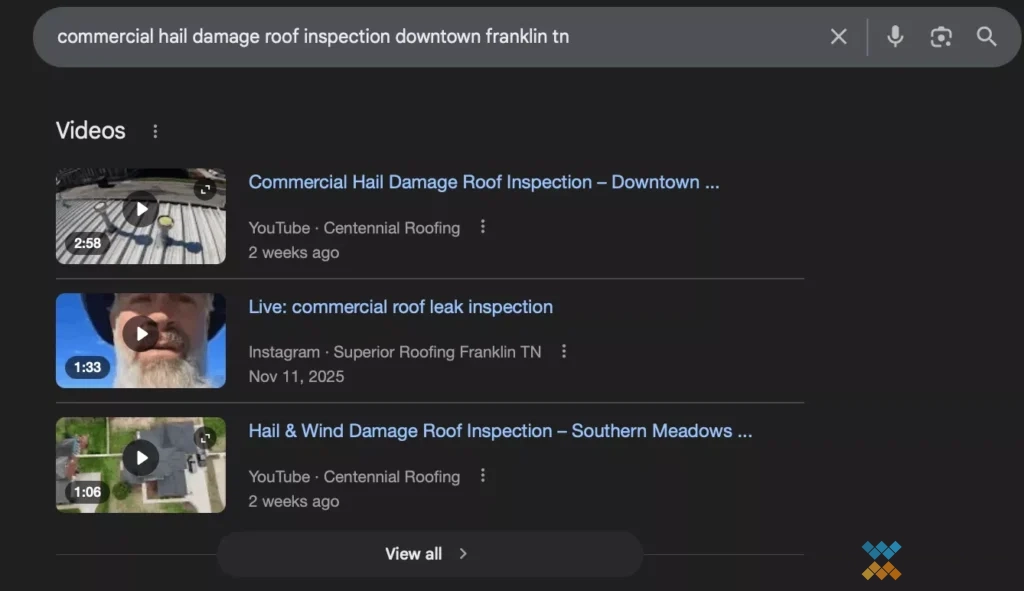
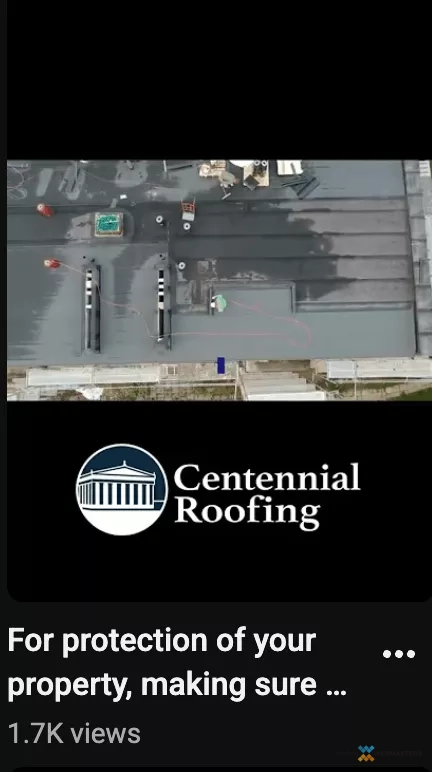
Publish video content answering common roofing questions, roof replacement cost, storm damage assessment, and material comparisons, because video from social platforms is eligible to appear directly in Google Search results and AI features.
Google’s search documentation confirms this eligibility. As of Google Search Central’s current guidance on generative AI features, Google’s AI search experiences “can bring in relevant images and video,” and following standard video SEO documentation is the stated path to qualifying; no special AI-specific optimization is required.
When homeowners search for the cost of roof replacement or a less common roofing service, Google frequently serves them a video from someone who can provide a real-world perspective. A roofing contractor who films a two-minute answer to a question homeowners actually search is competing for those video placements.
To maximize eligibility, add timestamped chapters to your videos. Google’s video documentation states that timestamps and labels in a YouTube description, or Clip and SeekToAction structured data for videos embedded on your own site, enable the key moments feature, which lets Google link searchers directly to the segment that answers their question.
2) Master Short-Form Videos
Short-form video on Instagram and TikTok reaches the age groups that include nearly all first-time homebuyers. According to the Pew Research Center’s November 2025 social media report, 80% of US adults ages 18–29 use Instagram, 37% of all US adults use TikTok, and roughly half of adults under 30 open TikTok at least once a day.
Reaching these homeowners requires the skill to produce and optimize short-form videos on these platforms, or a deliberate decision to delegate the work.
Use these criteria to decide between in-house and agency production:
Keep it in-house if a crew member or office staffer can reliably film and post during normal work weeks; the raw, unpolished style performs well for contractors (see Tip 4).
Hire an agency or freelancer if no one on staff can sustain a posting schedule, or if your market requires paid social management alongside organic content.
The deciding factor is consistency rather than production quality.
In storm-prone markets, short-form video has a specific high-intent use case: 15-second before-and-after videos and quick roof damage assessment tips posted in the days after a major hailstorm, when homeowner search activity in your service area spikes.
Platform Comparison for Roofing Companies
Platform
Audience (US adults)
Best content format
Production effort
Primary role for roofers
Facebook
71% of adults use it; daily use highest among ages 30–64 (Pew, 2025)
Job photos, community posts, reviews, paid ads
Low
Local trust, reviews, and paid lead generation
Instagram
50% of adults; 80% of ages 18–29 (Pew, 2025)
Reels, before/after photos, Stories
Medium
Reaching younger homeowners; visual proof of work
YouTube
84% of adults, the most-used platform (Pew, 2025)
Shorts plus longer explainers
Medium–High
Search visibility: videos eligible for Google SERPs and AI features
TikTok
37% of adults; ~half of under-30s use it daily (Pew, 2025)
Short-form video only
Medium
Reach and brand familiarity with the youngest homeowner cohort
If you can only sustain one platform, choose based on your market: Facebook for established suburban markets where homeowners skew 35+, YouTube if your goal is search visibility, and Instagram or TikTok if your service area skews toward first-time buyers.
3) Integrate Social Media With Your Website
Connecting your social profiles to your website helps Google recognize them as part of one business entity, a process practitioners call entity reconciliation.
Google’s documented mechanism for this is Organization structured data. Google Search Central’s Organization markup documentation lists sameAs as a recommended property and states that Organization markup helps Google understand a business and surface its details in features like knowledge panels and brand profiles.
Using the “sameAs” schema attribute within your website’s code, you can explicitly tell Google that specific social media profiles belong to your roofing company and its official website.
Your Google Business Profile is the second place to declare these links. Google’s Business Profile documentation states that businesses can add one link per social platform under Edit profile → Contact → Social profiles, which controls the social icons shown on your profile in Google Search and Maps.
Note that Google lists this feature as available in select regions. Set both: schema markup on your website and the links in your GBP dashboard.
4) Humanize Your Roofing Brand
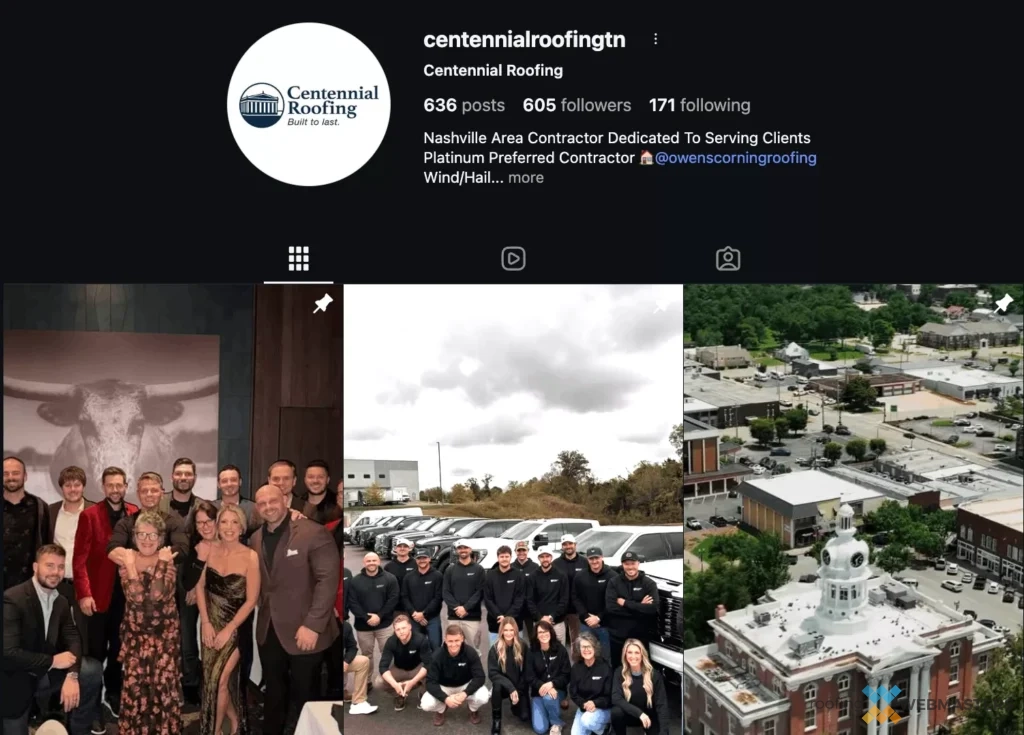
Homeowners trust people, not corporations. That’s why humanizing your brand through relatable social media content, such as why you started your business, is more effective than relying on elite production values.
Based on work with roofing clients at Roofing Webmasters, an “in the truck” series is a reliable starting format: a crew member films the drive to a roofing job, the arrival at the site, and the work in progress, so the consumer can envision your day-to-day routine.
Filming your staff at local events, a high school football game, or a community fundraiser serves the same purpose. Community presence content builds the familiarity and rapport that homeowners weigh when choosing among contractors with similar reviews.
5) Use AI for Content Brainstorming
Use AI tools to brainstorm post ideas and draft scripts, but do not use AI to generate the videos themselves.
The reason is the trust mechanism described in Tip 4. The value of contractor social content comes from homeowners seeing real people doing real work in their community; AI-generated footage removes the very authenticity the content is meant to demonstrate.
Platforms and viewers increasingly flag synthetic content, and a roofing brand caught passing off AI-generated jobs as real work damages the trust it was trying to build.
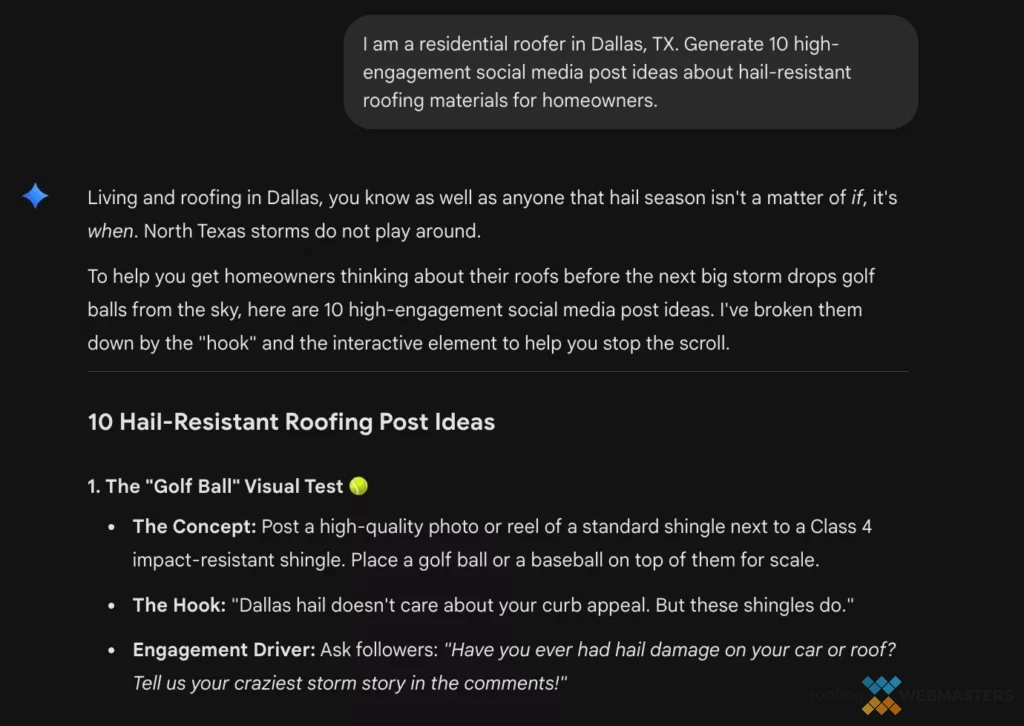
For brainstorming, open ChatGPT or Gemini and paste the following prompt:
“I am a residential roofer in Dallas, TX. Generate 10 high-engagement social media post ideas about hail-resistant roofing materials for homeowners.”
You can adjust this prompt to fit your primary services, which should give you tons of content ideas to fill your social media content schedule.
6) Abide By The 80/20 Rule
Homeowners use social media to be educated and entertained, not to be sold to. That’s why you should abide by the 80/20 rule: 80% educational and entertainment content, 20% promotional content.
Any content featuring educational tips, job showcases, and community involvement counts toward your 80%, while content highlighting special offers or financing counts toward the 20%.
The 80/20 rule applies at two levels: across your entire content library, and within a single piece of content. A call to action at the end of a YouTube Short, for example, should occupy 20% or less of the total video.
7) Localize Social Media
Social media marketing works best for roofers when the content is localized to the company’s defined service area, the same principle that governs local SEO.
The goal of your content is to say to homeowners, we are active and trusted in your community, something you can only achieve by talking about and showcasing the areas you serve.
City-specific job showcases (a completed roof in a named neighborhood, storm repair work in a specific suburb) are the most direct format for this.
In our practitioner experience at Roofing Webmasters, in tight-knit communities, hyper-local tags (like naming a specific town) often generate higher engagement and shares than generic regional marketing, because neighbors instantly recognize the properties you are working on.
8) Maintain Visual Consistency
Consistent branding across social platforms reinforces the same entity signals described in Tip 3: when your business name, logo, and contact information match everywhere, both homeowners and search engines can confidently connect your profiles to one company.
NAP stands for name, address, and phone number, but your consistency should expand beyond that as well, including your brand voice, which is the style and tone of the content you distribute.
Whether your videos portray a no-nonsense roofing expert or a friendly neighborhood helper, it’s essential that the theme appears across Facebook, Instagram, YouTube, and TikTok.
9) Distinguish Organic from Paid
Organic social media posts build search visibility and long-term trust while paid channels generate direct leads.
Based on campaign analysis across the Roofing Webmasters client network, organic posts rarely generate immediate job inquiries on the platform itself; their value appears in branded search, profile visits, and homeowner familiarity at decision time.
If you’re targeting immediate lead generation, you have two primary paid options, and they charge differently:
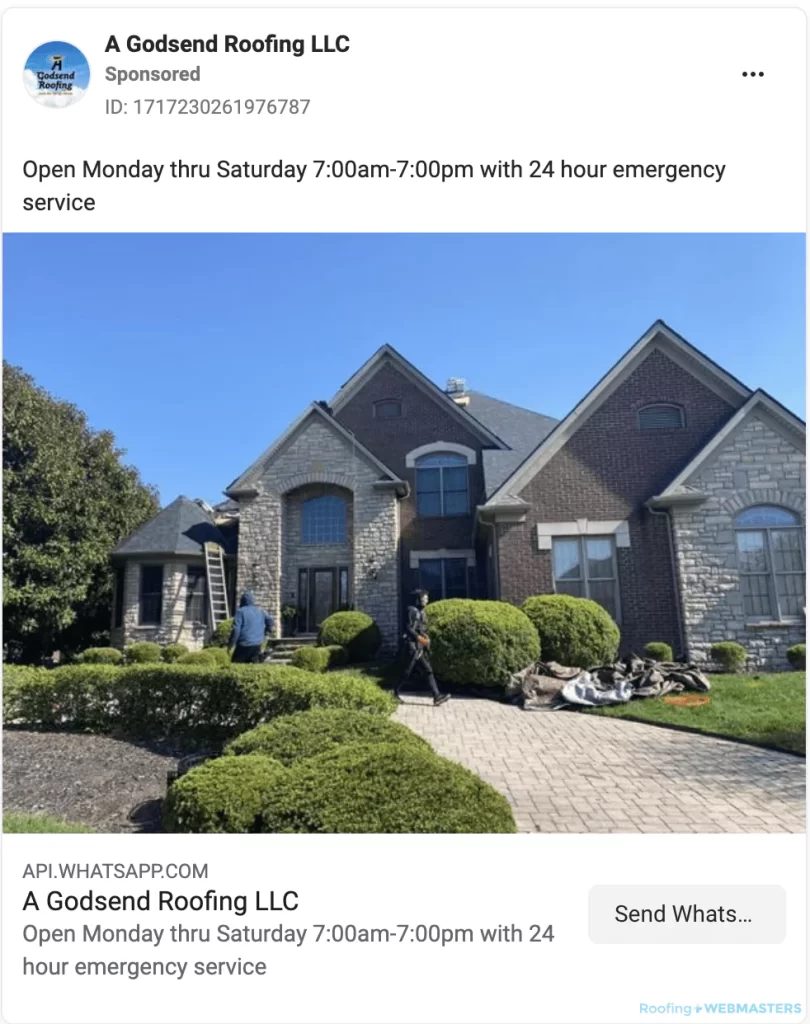
Meta Ads run on an auction model; you pay for impressions or campaign objectives, and you can target homeowners in specific cities and even neighborhoods with your best offers.
Google Local Services Ads (LSA) charge per valid lead. Google’s Local Services documentation states that you pay only when a potential customer contacts you through the ad, and leads judged invalid or low quality are not charged or are credited.
The practical difference: Meta Ads cost money whether or not anyone contacts you, but offer creative control and neighborhood-level targeting for offer-driven campaigns.
LSA spend maps directly to inquiries, which makes budgeting more predictable for service businesses. Roofers running both typically use LSA to capture active searchers and Meta Ads to generate demand after storms or for seasonal offers.
How Often Should a Roofing Company Post?
There is no platform-documented posting quota, and no published study establishes a posting frequency benchmark specifically for roofing contractors.
The cadence below reflects Roofing Webmasters’ working recommendation for clients, calibrated to what a typical residential roofing operation can sustain; consistency over months matters more than volume in any single week.
A sustainable weekly baseline:
2–3 short-form videos (job showcases, quick tips, in-the-truck clips) posted to Instagram Reels, TikTok, and YouTube Shorts, film once, post to all three
1–2 Facebook posts (completed job photos with city named, community involvement, review highlights)
1 longer YouTube video per month answering a question homeowners search (replacement cost factors, insurance claim process, material comparisons)
Storm response: in storm-prone markets, add damage-assessment and availability posts within 48 hours of a major weather event; this is the highest-intent window on the calendar
In terms of cost, the organic baseline above is primarily a time investment: a few hours per week of filming and posting, handled by an owner or a designated staff member.
Paid budgets (Meta Ads, LSA) are separate and scale with lead targets; see Tip 9 for how each channel charges.
When Social Media Doesn’t Work for Roofing Companies
Social media marketing has real limits, and recognizing them saves wasted effort.
Commercial and Industrial Roofing Contractors
Commercial roofers should not expect homeowner-style social tactics to transfer. The tips in this article target residential buyers researching contractors on consumer platforms.
Commercial roofing decisions are made by property managers, facility directors, and general contractors, a buyer pool that is reached more effectively through a LinkedIn presence, case-study content on your website, and direct relationships than through TikTok or Instagram.
Solo Operators With No Delegable Time
Solo operators face an honest tradeoff. If you are running crews, quoting jobs, and handling the books yourself, a half-maintained social presence, last post eight months ago, can look worse to a researching homeowner than no presence at all.
In that situation, prioritize your Google Business Profile and review responses first; add one platform only when you can sustain it.
Rural and Low-Density Service Areas
Rural service areas can break the localization model. City-specific content assumes enough jobs and recognizable landmarks to post about regularly.
Most roofers serving wide rural territories should focus their efforts on Google Business Profile, LSA, and word-of-mouth amplification (sharing customer reviews) rather than neighborhood-level social content.
If Your Posts Get No Engagement
The most common causes of low or zero engagement, in order:
promotional content exceeding the 80/20 ratio (homeowners scroll past sales posts),
generic content with no local markers (a roof photo that could be anywhere earns no recognition),
Inconsistent posting (platform feeds deprioritize accounts that post sporadically).
Fix the ratio and the local specificity before concluding the channel doesn’t work.
Moving Forward With Social Media Marketing
Social media content now feeds the same systems that determine roofing companies’ search visibility.
Video from social platforms is eligible to appear in Google results and AI features, per Google’s documentation, and a majority of consumers consume video when researching local businesses (BrightLocal, 2025).
A workable roofing social strategy has four components: short-form video on the platforms your homeowners use, an 80/20 ratio of value content to promotion, localized job showcases tied to your service area, and sameAs schema connecting your profiles to your website.
Paid social and Local Services Ads remain the direct lead-generation channels, while organic social builds the visibility and trust that make those leads cheaper to convert.
Author: Nolen Walker
Nolen Walker is the founder of Roofing Webmasters and the creator of DataPins™, a Local SEO platform for roofing companies. He has over 16 years of experience helping roofing businesses grow through organic search, Google Maps, and AI-driven visibility.
Roofing SEO is the process of optimizing your website, Google Business Profile, and broader web presence so that your company appears prominently in search results when potential customers search for roofing services in your area.
Optimization tasks include editing title tags, refining keyword placement, building internal and external links, improving site speed, and maintaining accurate business listings across directories. Any activity that increases your organic search rankings, impressions, or clicks qualifies as a form of SEO.
SEO applies across multiple surfaces: your company website in traditional organic search results, your Google Business Profile listing in the Local Map Pack, and, increasingly, AI-generated answers on platforms like Google Gemini, ChatGPT, and Perplexity.
TL;DR: Key Findings:
Roofing SEO increases organic visibility on Google Search, Google Maps, Google AI Overviews, and AI platforms like ChatGPT Search and Perplexity without paying for ads on a per-click basis.
Local SEO, specifically Google Business Profile optimization and NAP consistency, is the highest-leverage starting point for most residential roofers.
Google operates exclusively on mobile-first indexing as of July 2024, meaning your mobile site is the version Google uses to rank you.
Google’s official performance benchmark for page loading (Largest Contentful Paint) is 2.5 seconds or less. Pages that miss this threshold are at a ranking disadvantage.
AI-sourced website traffic grew 527% year-over-year between January and May 2025, according to the Previsible AI Traffic Report, but AI platforms still represent a small fraction of total search traffic. Organic search remains the primary channel and should anchor your strategy.
The December 2025, March 2026, and May 2026 Core Updates have consistently rewarded content demonstrating genuine, first-hand experience. Mass-produced content without authentic experience signals has lost rankings across all three update cycles.
Most roofing-focused SEO agencies charge between $1,500 and $5,000 per month. Services under $1,000/month rarely include the scope required to move rankings in competitive roofing markets.
SEO typically requires 6–12 months before producing significant ranking movement. Campaigns that show no measurable progress after 12 months warrant a full strategy review.
Why SEO Matters for Roofing Companies
Ranking at the top of search results for terms like “roof repair in [your city]” or “roofing company near me” places your business in front of homeowners and property managers at the exact moment they are looking for a roofer.
That timing is the core advantage of organic search over other marketing channels; you are not interrupting someone; you are answering a need they have already expressed.
Higher rankings produce more clicks, more calls, and more booked jobs. The conversion funnel begins the moment a potential customer sees your business name, address, and phone number in a search result, before they have visited your website at all.
Google’s search results page now surfaces roofing businesses across multiple formats: traditional organic links, the Local Map Pack (Google Maps listings), Google AI Overviews (automatically generated AI summaries that appear above organic results for qualifying queries), and, for users who select it, Google AI Mode, a fully conversational search interface powered by Gemini.
Appearing consistently across these surfaces, rather than in only one, is the direction SEO strategy is moving for roofing companies in 2026.
This applies most directly to: established residential roofers serving a defined geographic area who already have a website and some digital presence.
This applies differently to: new roofing companies with no domain history, commercial roofing specialists targeting B2B buyers, and multi-location operators, each of which requires a modified approach covered in the relevant sections below.
Creating an SEO Strategy
A roofing SEO strategy requires decisions made before any optimization work begins. Keyword research, URL structure, and content planning must be established first; changes made later are significantly more expensive to implement than getting these decisions right at the outset.
New vs. Established Roofing Companies: Different Starting Points
The appropriate SEO strategy depends heavily on where your business is starting from.
If your roofing company has been operating for more than two years and has an existing website, your primary levers are: fixing technical issues that suppress existing pages, improving on-page optimization for service and location pages, and building citations and reviews to strengthen your Google Business Profile.
If your roofing company is new or has no established web presence, your first 6–12 months should focus on a narrower set of priorities:
Build and verify your Google Business Profile before anything else; it produces ranking results faster than a new website in most local markets.
Target long-tail, low-competition service keywords rather than broad terms like “roofing company.” A new domain cannot compete for broad terms against established local competitors immediately.
Prioritize review generation from your first completed jobs. Review quantity and recency are among the most heavily weighted factors in the Local Map Pack, according to Whitespark’s 2026 Local Search Ranking Factors report.
Invest in one well-optimized homepage and two to three service pages before creating additional content. Thin content spread across many pages is harder to rank than a smaller number of thorough, well-structured pages.
Keyword Research
Keyword research provides the foundation for every subsequent SEO decision: your URL structure, your page content, your title tags, and your city pages all flow from the keyword choices made at this stage.
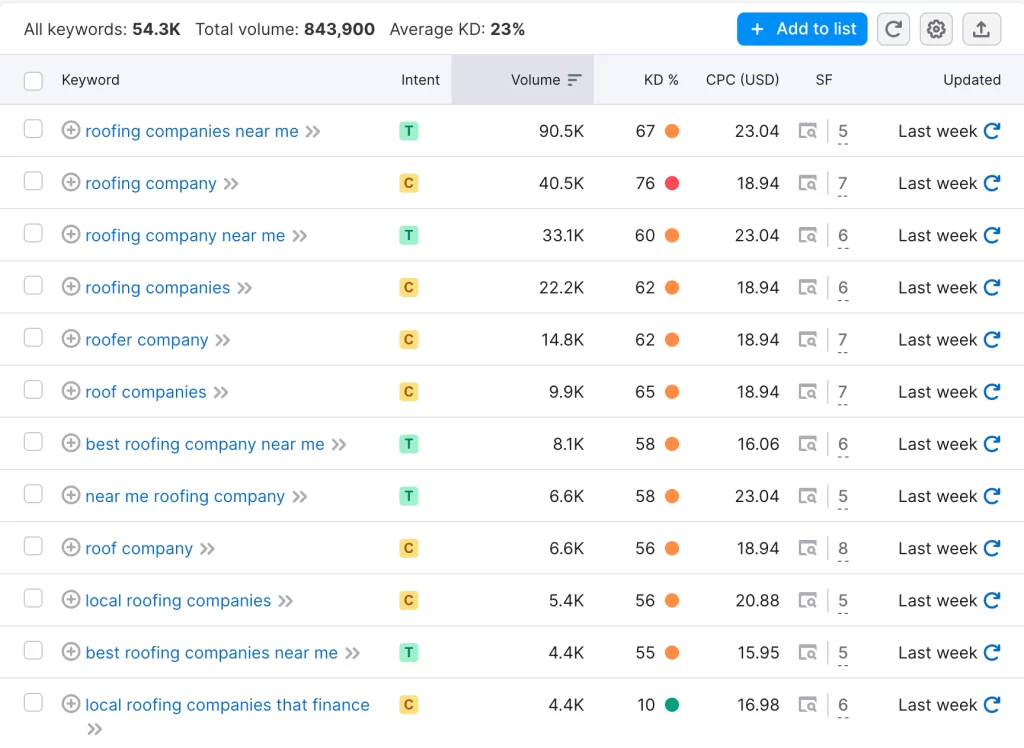
Your business should identify the keywords that attract the most relevant customers and note each term’s search volume and competition level. Tools including Moz, SEMrush, and Ahrefs provide volume and difficulty metrics for both national and local terms.
National Keywords
High-volume terms like “roofing company,” “roofer,” and “roofing services” garner significant search volume nationally but function as location-dependent queries.
Google adjusts results based on the searcher’s location, so a roofer in Phoenix is not competing nationally for these terms.
These broad keywords form the conceptual backbone of your strategy and inspire the long-tail variations that will drive the majority of your targetable traffic.
Local Keywords
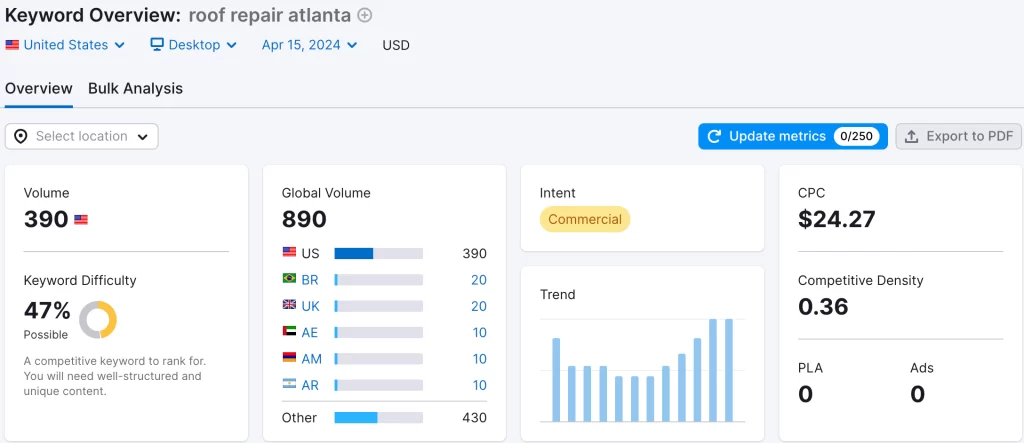
The most actionable keywords for a roofing company combine a service term with a specific location. “Roof repair” is a nationally competitive term. “Roof repair Atlanta” is a local keyword with defined, measurable volume and a realistic path to ranking.
According to SEMRush data, “roof repair Atlanta” has a monthly search volume of 390, while the closer variation “Atlanta roof repair” has a monthly search volume of 320.
Using the city name rather than “near me” targets explicit queries over implicit ones, which can improve rankings relative to competitors that rely on implicit location signals.
Service Keywords
Interior service pages perform best when they target specific services combined with a location modifier.
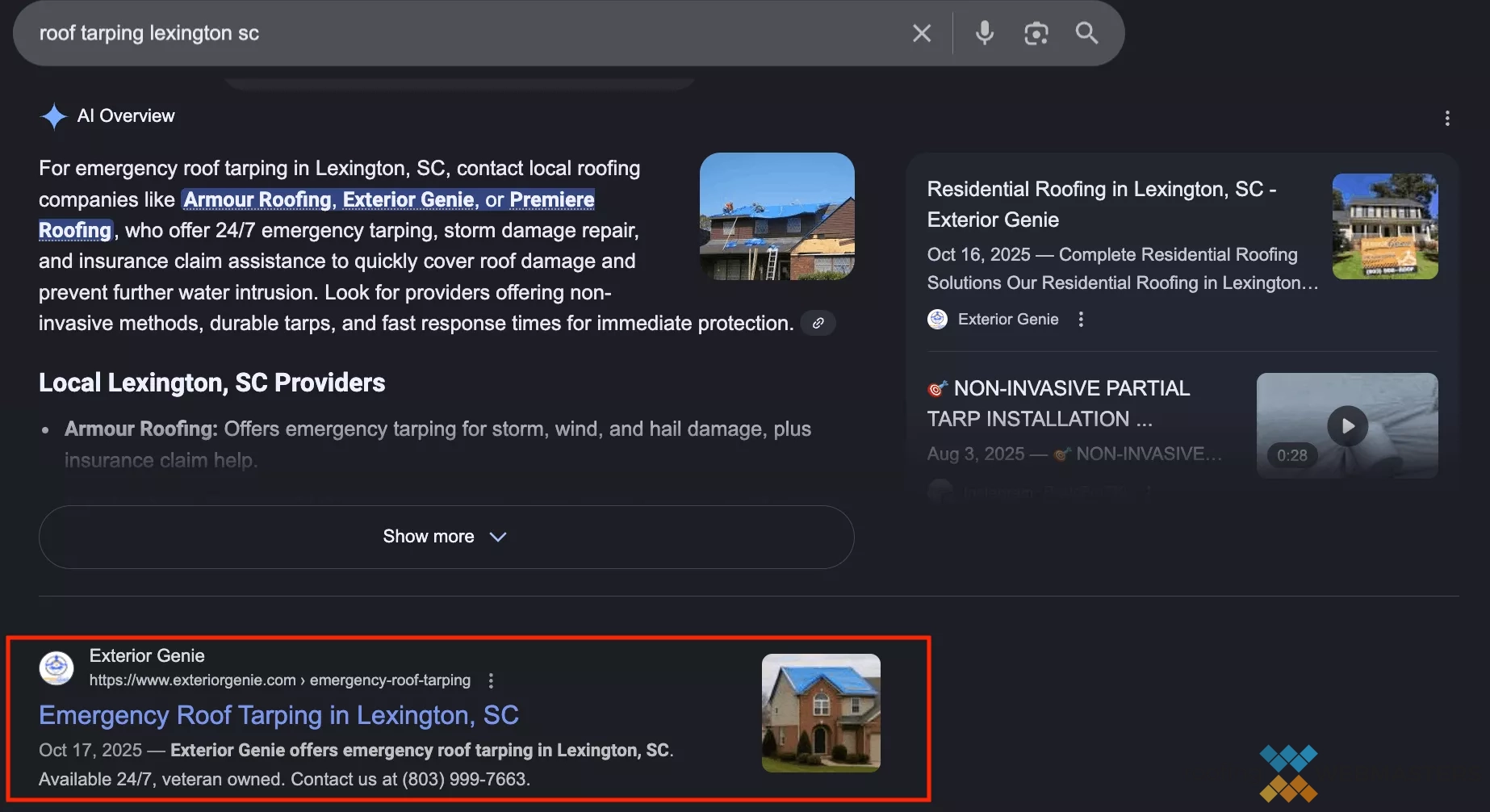
A roofing company in Lexington, SC, offering emergency roof tarping should target “emergency roof tarping lexington sc” rather than the broader “roof tarping.”
Long-tail service keywords carry lower competition and higher purchase intent; a visitor searching for that specific a term is closer to a buying decision than someone searching “roofing company.”
Competitor Gap Analysis
Before finalizing your keyword list, identify which of your direct local competitors are ranking for keywords you are not. This gap analysis shapes where you focus content creation first.
The process has three steps:
Enter your top two or three local competitors’ domains into SEMrush, Ahrefs, or Moz.
Pull their top-ranking pages and the keywords driving traffic to those pages.
Identify terms where competitors rank in positions 4–20; these represent achievable targets where the ranking is not yet locked up, and where a well-optimized page on your site can realistically compete.
Competitor gap analysis is particularly useful for identifying service pages you have not yet built and location-based terms your competitors are capturing from surrounding cities.
URL Structure and Hierarchy
Your URL structure should reflect your keyword strategy and be established before you build or significantly expand your website.
Changing URLs after pages are indexed requires 301 redirects and carries ranking risk during the transition period.
How to structure a roofing website URL hierarchy:
Start with your homepage as the root: www.yourroofingwebsite.com
Create top-level parent pages for your primary service categories: www.yourroofingwebsite.com/residential-roofing/ and www.yourroofingwebsite.com/commercial-roofing/
Add child pages for specific services beneath each parent: www.yourroofingwebsite.com/residential-roofing/residential-roof-replacement/
Add sub-level pages only where a service has enough content depth to justify a dedicated page: www.yourroofingwebsite.com/commercial-roofing/flat-roofing/modified-bitumen/
Stop at three levels deep. URLs beyond three levels are harder for Google to crawl and less likely to rank well in search results.
Parent pages are top-level service categories (Residential Roofing, Commercial Roofing). Child pages are specific services nested beneath a parent (Roof Replacement, Roof Repair, Roof Inspection).
A well-structured URL hierarchy makes it easier for Google to understand your site’s topical organization and for visitors to navigate between related services.
On-Page SEO for Roofing
On-page SEO is the set of optimizations applied directly to your website’s pages: title tags, meta descriptions, header tags, URL slugs, body content, and image alt text.
These are the most frequently discussed SEO tasks and the ones with the most direct, measurable connection to keyword rankings.
Pages optimized correctly today continue earning rankings for years as they accumulate authority and trust. Precision at this stage compounds over time; a well-optimized service page built now becomes progressively more valuable as it ages.
Keyword Placement
Your target keyword should appear in four locations on each page: the title tag, the H1 header, the meta description, and naturally within the body content. Placement at the left-hand side of each element carries the most weight.
For a roofing company targeting “roof replacement in [city]”:
Title tag: Roof Replacement in [City] | [Company Name]
H1: Roof Replacement Services in [City]
Meta description: [Company Name] provides roof replacement in [City, State]. Call [###-###-####] to schedule your inspection today.
This achieves three instances of the keyword across distinct on-page elements without any of them reading as keyword-stuffed or misleading.
Apply the same logic to H2 and H3 tags, image alt text, and paragraph content, but only where the keyword fits naturally. Forced keyword insertion reduces readability and can trigger over-optimization signals.
Title Tags
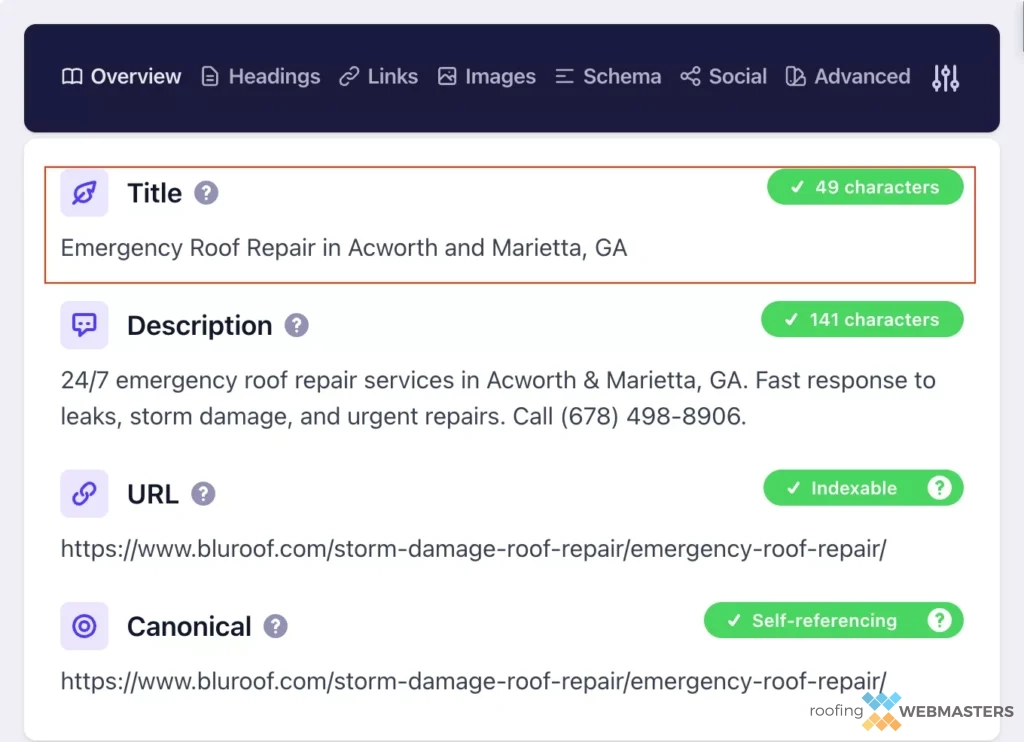
A title tag is the clickable headline displayed in search results. It should include your primary keyword and a reason to click, but it must accurately represent what the visitor will find on the page. Misleading title tags increase bounce rates, which signals to Google that searchers did not find what they expected.
For local roofers, a functional title tag follows this pattern: “[Service] in [City, State] | [Company Name]” or “[Service], Schedule Your Free Inspection Today.” Use Moz’s title tag preview tool to confirm your title falls within the character limit for full display in search results.
Meta Descriptions
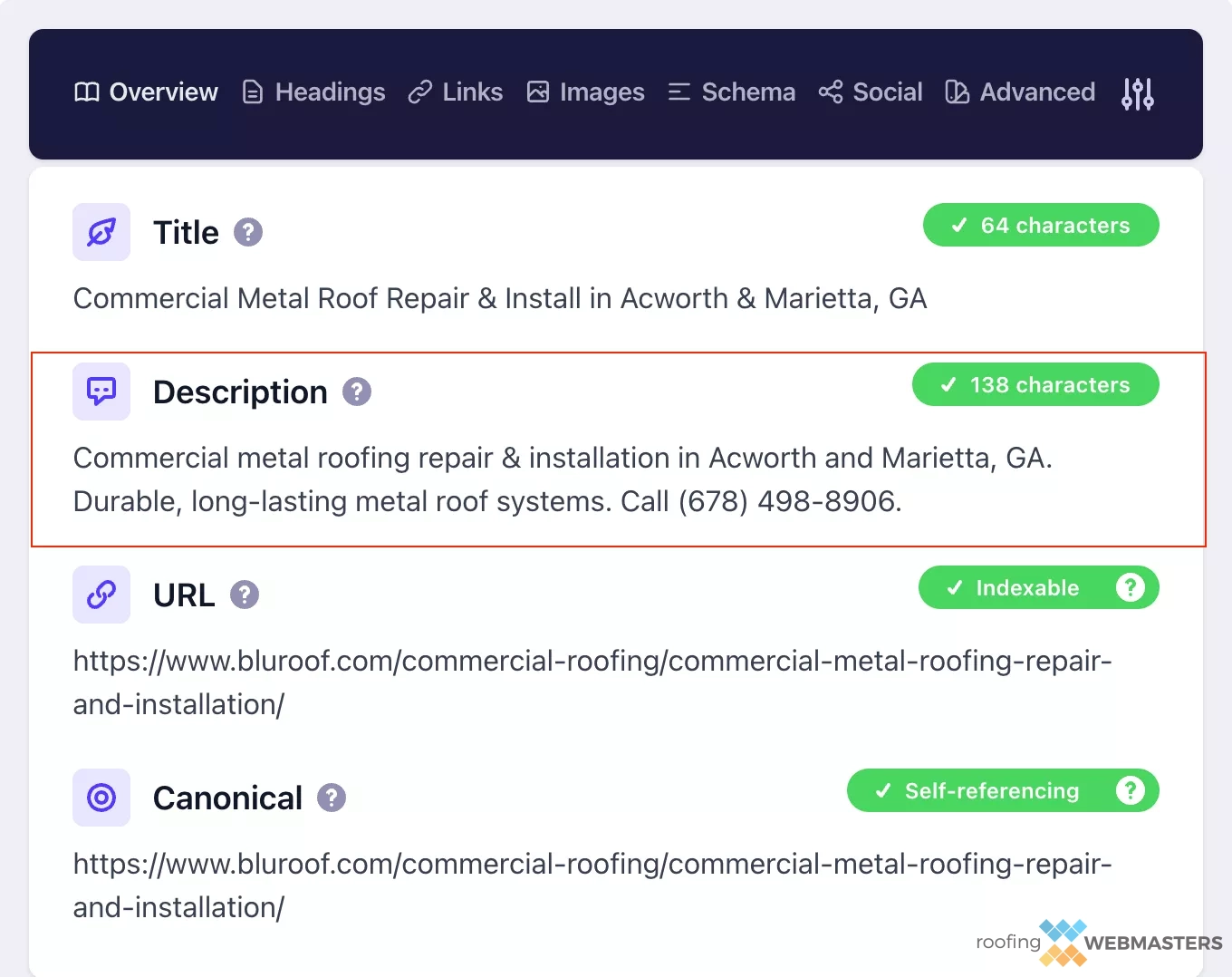
The meta description is the 130–160-character block of text displayed beneath the title tag in search results. It is not a direct ranking factor, but it influences click-through rate.
Include one instance of your target keyword and an accurate summary of the page’s content. A phone number or call to action in the meta description can improve click-through for mobile searchers
Header Tags
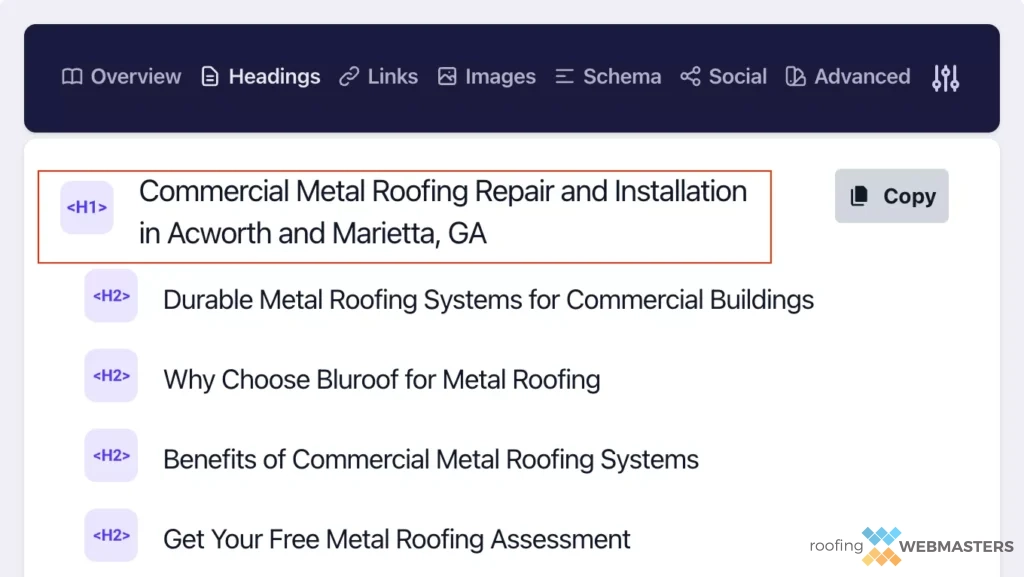
The H1 is the most important header for on-page SEO; it functions as the page’s primary subject declaration and should include your target keyword. Each page should have exactly one H1.
H2 and H3 tags organize the body content into sections. They matter primarily for readability and crawlability rather than direct keyword ranking, but a well-structured header hierarchy makes it easier for Google to parse the page’s topical structure and for visitors to navigate long pages.
URL Slugs
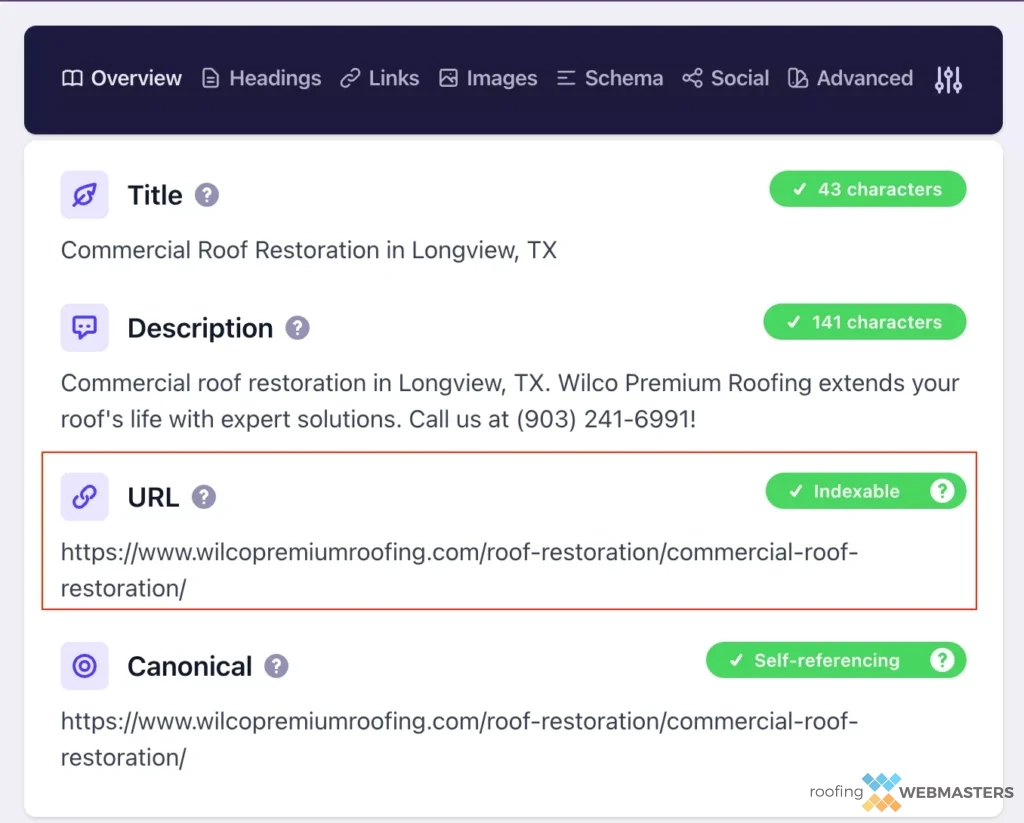
The URL slug is the portion of the web address to the right of your domain. For a residential roof repair page, a well-formed slug is:
The first version is cleaner, less redundant, and easier for both search engines and visitors to read. URL slugs are permanent.
If you need to retire a page, implement a 301 redirect rather than deleting it outright. The original URL will remain indexed until the redirect has been in place long enough for Google to process the change.
Image Alt Text
Image alt text is a short description of each image embedded in your page. It serves two purposes: it tells Google what the image depicts (contributing to image search rankings), and it provides a text alternative for screen readers.
Name image files in lowercase with hyphens before uploading: company-name-roofing-truck.jpg. Write alt text that describes the image plainly: “Company Name roofing truck at job site.” This is a small task with a cumulative SEO benefit across a site with many images.
Custom Design and Trust Signals
A visitor forms an impression of your roofing company within moments of landing on your website. That impression determines whether they stay to read your content or return to the search results and call a competitor.
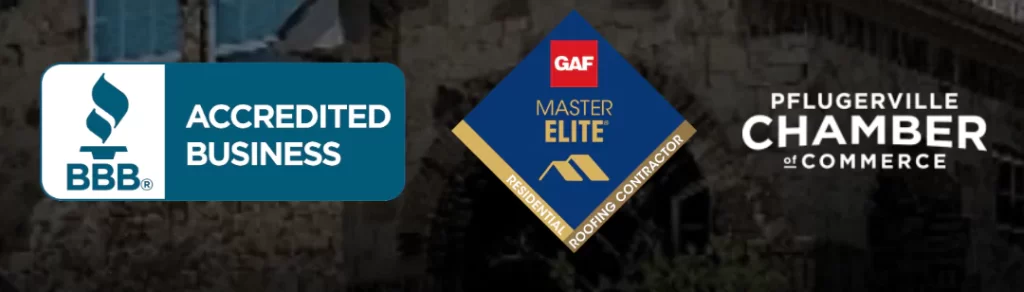
The trust signals that most reliably keep visitors on roofing websites are: original photographs of your crew and completed jobs, clearly visible contact information, recognizable certification badges (Better Business Bureau, manufacturer certifications, local Chamber of Commerce), and customer reviews displayed on the page.
Websites with outdated designs, broken layouts, or misaligned mobile formatting are more likely to be perceived as inactive or untrustworthy, increasing bounce rates and, over time, suppressing rankings.
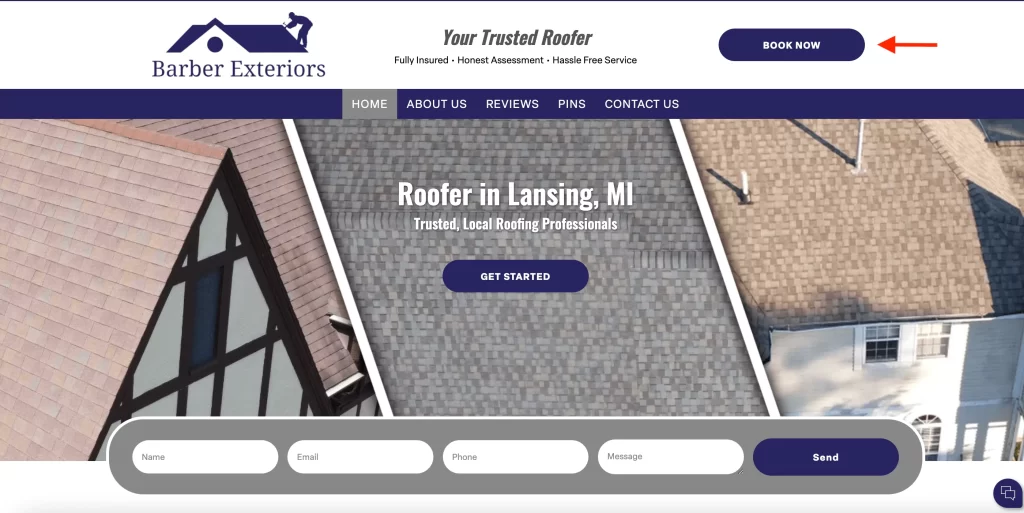
Call to Action
A call to action (CTA) is any element on your page that prompts a visitor to take a specific step, such as calling your office, submitting a contact form, or requesting an estimate.
Effective CTAs for roofing websites are specific and low-friction. A clickable phone number button is the highest-converting CTA for mobile visitors because it requires one tap. A “Request a Free Estimate” form works better for visitors who are not yet ready to call.
CTAs serve different stages of the decision funnel. Phone number links close visitors who are ready to hire now. Estimate request forms capture visitors who are still comparing options.
Images and Videos
Original photos and videos serve two functions: they improve the user experience for visitors and provide trust signals that distinguish your site from competitors that use generic stock imagery.
The most effective images for a roofing website are photographs of your actual crew, trucks, equipment, and completed jobs, particularly before-and-after shots. Stock photos are recognizable as generic and do not build the same credibility with visitors evaluating whether to call you.
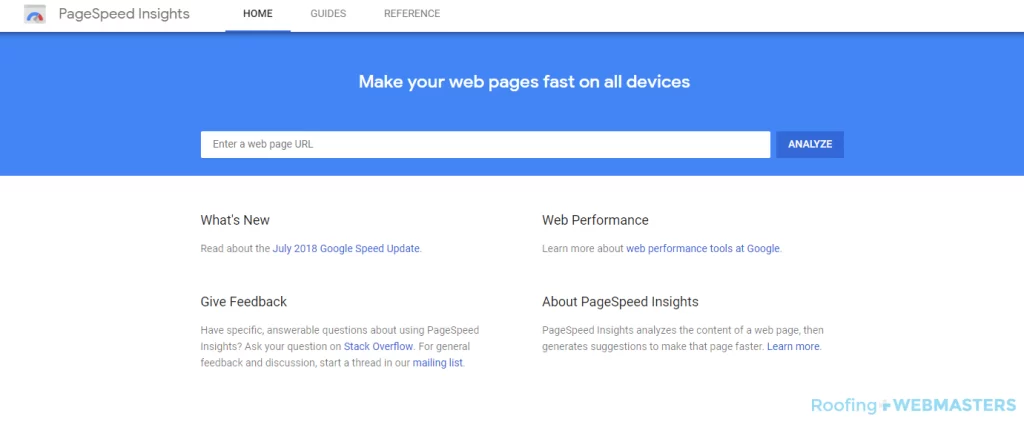
Compress images using the WebP file format to maintain fast load times. You can test your image loading performance using Google PageSpeed Insights.
Video is underused on roofing websites. Job footage, including before-and-after sequences, shot on a smartphone, is sufficient. The most efficient workflow is to upload a video to YouTube and embed it on your website using WordPress’s YouTube embed block.
This approach allows your content to appear in both YouTube search results and Google’s video carousel, extending its reach without duplicating hosting costs.
Badges, Accolades, and Testimonials
Certifications from national organizations like the Better Business Bureau, manufacturer programs, or local business associations come with digital badges you can display on your website. These serve as third-party trust signals that help visitors confirm your company’s legitimacy before calling.
Displaying customer reviews directly on your homepage adds user-generated content to your site, which Google values as a freshness and relevance signal. Several reputation management plugins can pull your Google reviews onto your website automatically.
Technical SEO for Roofing Contractors
Technical SEO refers to the optimizations applied to your website’s underlying code and architecture, the elements visitors do not see, but that directly affect how Google crawls, indexes, and ranks your pages.
For roofers without a programming background, the practical priority is this: technical SEO issues are often invisible until they cause a ranking problem.
A site that loads slowly, lacks an SSL certificate, has broken redirects, or is missing a sitemap can underperform in search results even when its content and on-page optimization are strong.
An annual technical audit, using tools like Google Search Console, Screaming Frog, or Ahrefs, is the minimum maintenance standard.
301 Redirects
When a webpage is no longer useful to visitors because a service has been discontinued or a page has been consolidated, redirect it to the most relevant active page rather than deleting it.
Deleting a page outright removes it from Google’s index and breaks any inbound links pointing to it, both of which damage your rankings.
A 301 redirect preserves the destination URL in Google’s index and routes both visitors and search engine crawlers to the replacement page without them noticing the transition.
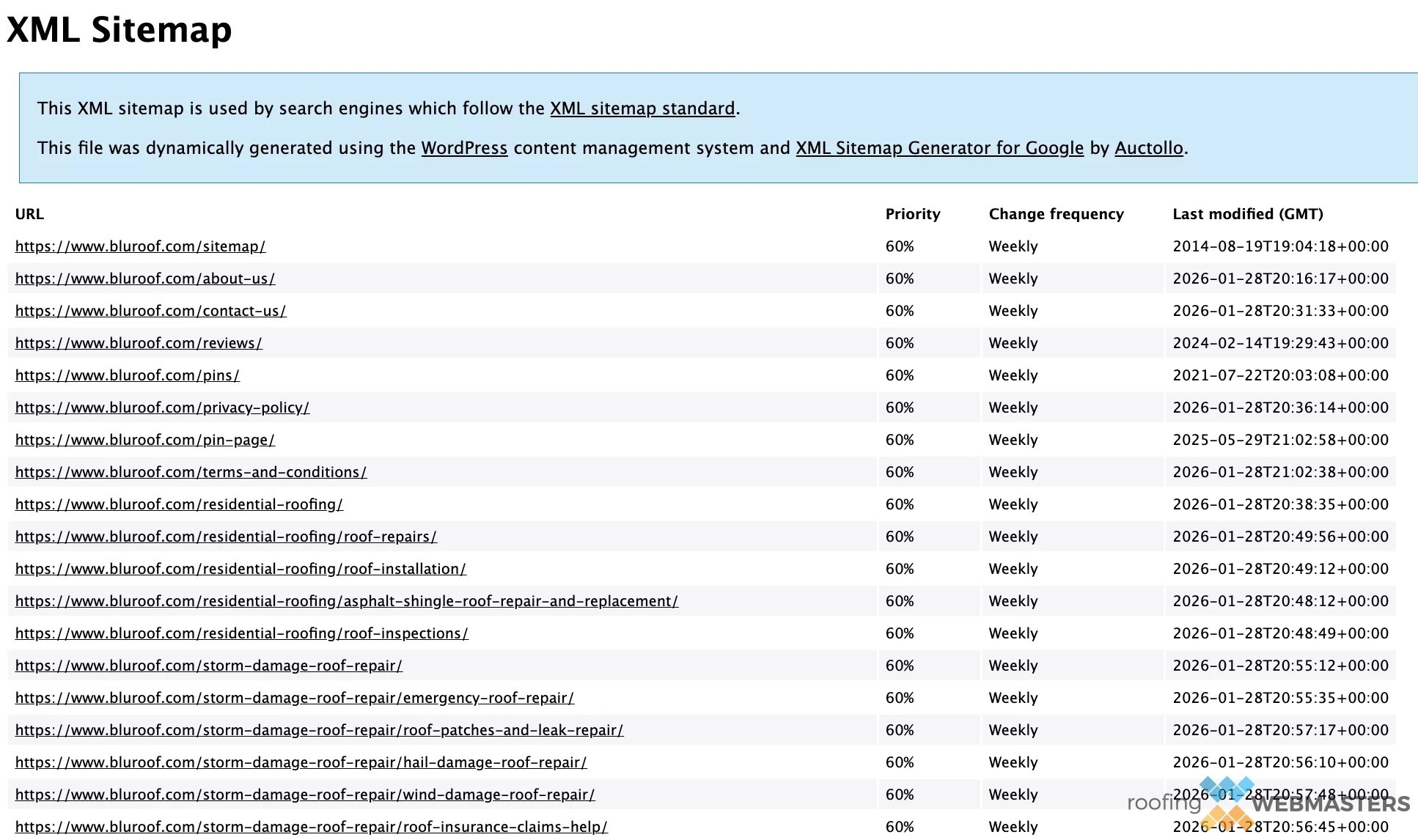
XML Sitemaps
Every roofing website should have an XML sitemap submitted to Google Search Console.
The sitemap tells Google which pages exist on your site and prompts it to crawl pages that may not be easily reachable through internal links, particularly important for larger sites with many service or city pages.
Site Speed Optimization
Page loading speed is a confirmed Google ranking factor and a direct driver of visitor behavior. According to Google’s Core Web Vitals documentation on web.dev, pages should achieve a Largest Contentful Paint of 2.5 seconds or less to meet the “good” threshold.
Pages that load more slowly see higher abandonment rates; visitors return to the search results and contact a competitor instead.
Common speed improvements for roofing websites include compressing images to WebP format, reducing JavaScript that blocks page rendering, and enabling browser caching. A professional developer can audit and address these issues systematically.
SSL (Secure Sockets Layer) is the security protocol that makes your website address display as https:// rather than http://. Major browsers flag non-HTTPS sites with a “Not Secure” warning, which is visible to visitors before they interact with your content.
Sites with SSL enabled are https:// addresses. For a roofing company, the practical SEO implication is that a “Not Secure” warning reduces visitor trust, increases bounce rates, and sends negative behavioral signals to Google, making SSL a meaningful indirect ranking factor even for businesses that do not process payments online.
Schema Markup for Roofing Websites
Schema markup tells Google explicitly what your business is and what your pages cover. For roofing companies, the most applicable schema types are:
LocalBusiness schema: Declares your company name, address, phone number, service area, and hours. Reinforces NAP consistency signals.
Service schema: Describes individual services (roof repair, roof replacement, TPO installation) with associated descriptions and service areas.
Review schema: Marks up customer reviews so Google can display star ratings in search results.
FAQPage schema: Marks up question-and-answer content so Google can display it as an expandable FAQ in search results, particularly valuable for AI-generated answers that pull from structured content.
Schema markup does not guarantee enhanced search result features, but it gives Google the structured data it needs to display them when appropriate.
Mobile Optimization
Google operates exclusively on mobile-first indexing. The mobile version of your website is the version Google uses to crawl, index, and rank your pages, for every website, without exception, as of July 5, 2024, per Google Search Central.
If your mobile site has missing content, slow load times, or broken navigation, those deficiencies directly affect your rankings regardless of how well your desktop site performs.
Mobile optimization priorities for roofing websites:
Responsive design that adapts to any screen size
Clickable phone number buttons (tap-to-call)
Navigation menus that collapse cleanly on small screens
Images sized for mobile bandwidth
LCP under 2.5 seconds on mobile (test with Google PageSpeed Insights)
Consider the mobile user’s situation specifically: they are likely standing in a driveway, looking at a damaged roof, searching for someone to call. Friction at any point in that mobile experience, slow loading, hard-to-tap buttons, buried phone numbers, loses the lead.
Google Analytics Tracking
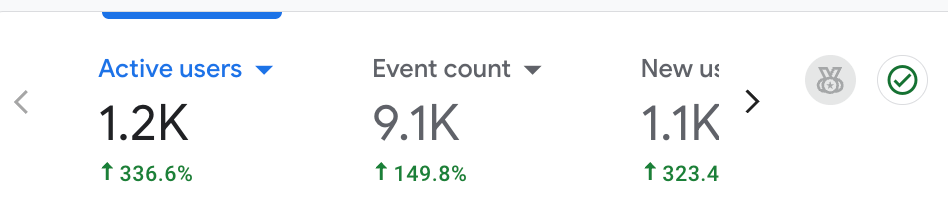
Google Analytics 4 (GA4) is the standard tool for tracking SEO performance on roofing websites. The Acquisition Report in GA4 shows how many visits your site receives daily, weekly, monthly, and annually, broken down by traffic source, organic search, direct, referral, and others.
Tracking your organic traffic baseline before making SEO changes is essential. Without a baseline, there is no reliable way to distinguish SEO-driven growth from seasonal variation in roofing demand (which is significant in most U.S. markets).
Sudden drops in organic traffic visible in GA4 are often the first detectable signal of a technical issue, a Google algorithm update, or a competitor gaining ground on a key keyword.
Local SEO for Roofing Companies
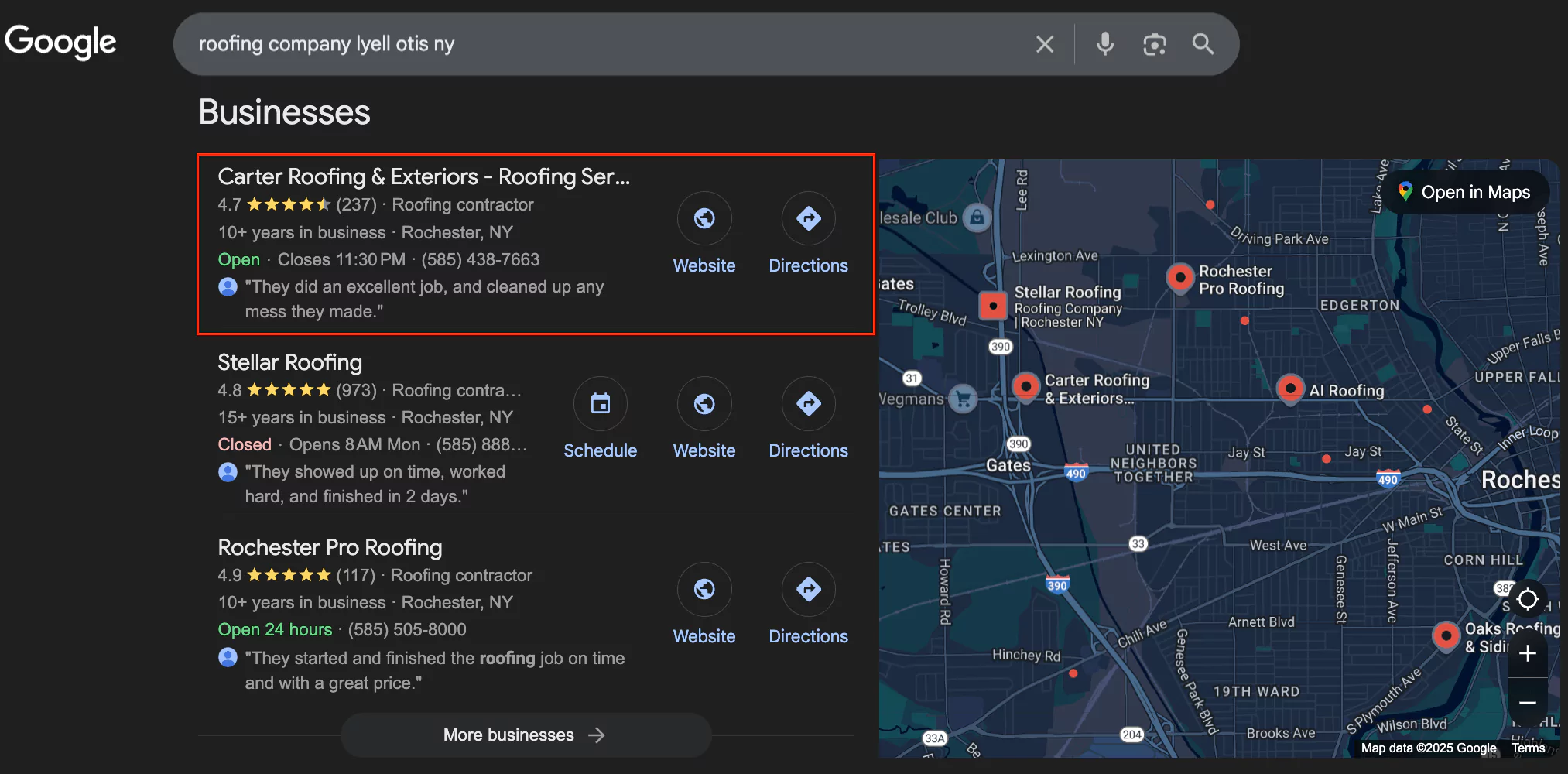
Local SEO determines how your roofing company appears in Google Maps, the Local Map Pack (the three listings shown above organic results for location-based queries), and local organic results. For most residential roofers, this is the highest-leverage part of their SEO strategy.
Google Business Profile Optimization
A Google Business Profile is the most critical aspect of a roofing company’s Local SEO.
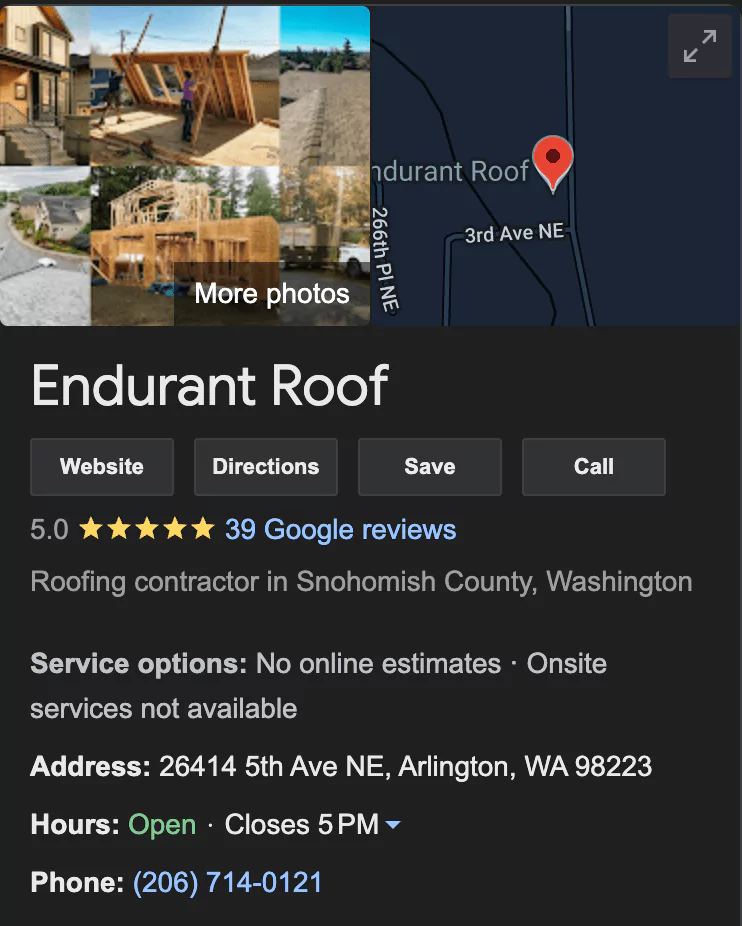
Your GBP listing is the primary data source Google uses to place your business in the Local Map Pack. It must be claimed, verified, and actively maintained, not set up once and forgotten.
GBP optimization checklist for roofing companies:
Claim and verify your listing through Google’s video verification process.
Select your primary business category as “Roofing Contractor.” Add secondary categories for any specialty services (e.g., “Siding Contractor”).
Add your complete NAP (name, address, phone number), exactly matching the NAP on your website.
Write a business description that includes your primary service terms and service area cities.
Add photos: exterior of your office or vehicles, crew photos, and completed job photos (before-and-after, where possible). Listings with photos receive significantly more direction requests and website clicks than those without.
Enable the “Call Now” button so mobile users can contact you directly from the listing.
Add your service area cities if you are a service-area business operating without a public-facing storefront.
Publish Google Posts at least twice per month, job updates, seasonal offers, or recent reviews. Post activity is a behavioral signal that your business is active.
Respond to every review, positive and negative. Review response cadence is listed as a ranking signal in Google’s own local ranking documentation.
Use the Q&A feature to populate common questions (service area, emergency availability, insurance acceptance) before customers ask them.
Service Area Businesses (SAB): No Physical Storefront
Roofing companies that operate from a home address or prefer not to display a physical location publicly can designate their listing as a Service Area Business (SAB) in Google Business Profile.
The SAB designation hides your address from public view while still allowing you to rank for searches in your defined service area.
To verify an SAB listing, Google requires evidence that the business is legitimate and operating: a vehicle with business branding, a business license, and utility bills in the business name are commonly requested during verification.
Once verified, you define your service area by the cities or ZIP codes you serve rather than a pin on a map.
Important: SAB listings rank within the service area you define, but proximity to the searcher still matters. A roofing company listed as serving 20 cities will rank more strongly for searches in cities closest to its actual operating location. Expanding your defined service area beyond your realistic working radius does not proportionally improve your rankings.
Local Business Citations
A citation is any online mention of your business’s name, address, and phone number, on directories like Angi, Yelp, the Better Business Bureau, and hundreds of niche and general-purpose platforms.
The goal is to claim all available high-leverage citations and ensure their accuracy. Local business data is constantly compiled automatically by major data aggregators, such as Data Axle and Neustar Localeze, which pull information from public records, utility bills, and commercial registries before distributing it to mapping services and directory platforms.
Because these auto-generated profiles rely on legacy records, they are frequently inaccurate or outdated, creating conflicting data signals that can quietly suppress your local search rankings.
Tools, including Whitespark and Moz Local, help identify, claim, and correct citations across multiple directories from a single interface, particularly useful for businesses that have operated under different addresses or phone numbers over the years.
NAP Consistency
NAP stands for name, address, and phone number. That information should be clearly evident on each website page, particularly the homepage, and must be identical across every directory listing, social profile, and your Google Business Profile.
Even minor inconsistencies, “St.” versus “Street,” a missing suite number, an old phone number on a forgotten directory, create conflicting signals that can suppress local rankings.
Choose a single, authoritative version of your NAP and apply it uniformly everywhere. Tools like Whitespark and Moz Local can audit inconsistencies across hundreds of citations for established businesses with long histories.
Entity authority in 2026: NAP consistency is one component of a broader signal that Google and AI platforms use to verify that your business is a legitimate, established entity. In addition to consistent NAP data, entity authority is built through: your business name appearing consistently across third-party sources (manufacturer directories, Chamber of Commerce listings, industry associations, local press), a complete and active Google Business Profile, and review volume that confirms real customer interactions.
AI platforms, in particular, cross-reference multiple data sources when deciding whether to cite or recommend a local business. A roofing company with consistent NAP data, active third-party mentions, and a verified GBP is significantly more likely to be cited in an AI-generated recommendation than one whose information is scattered or inconsistent.
City Pages
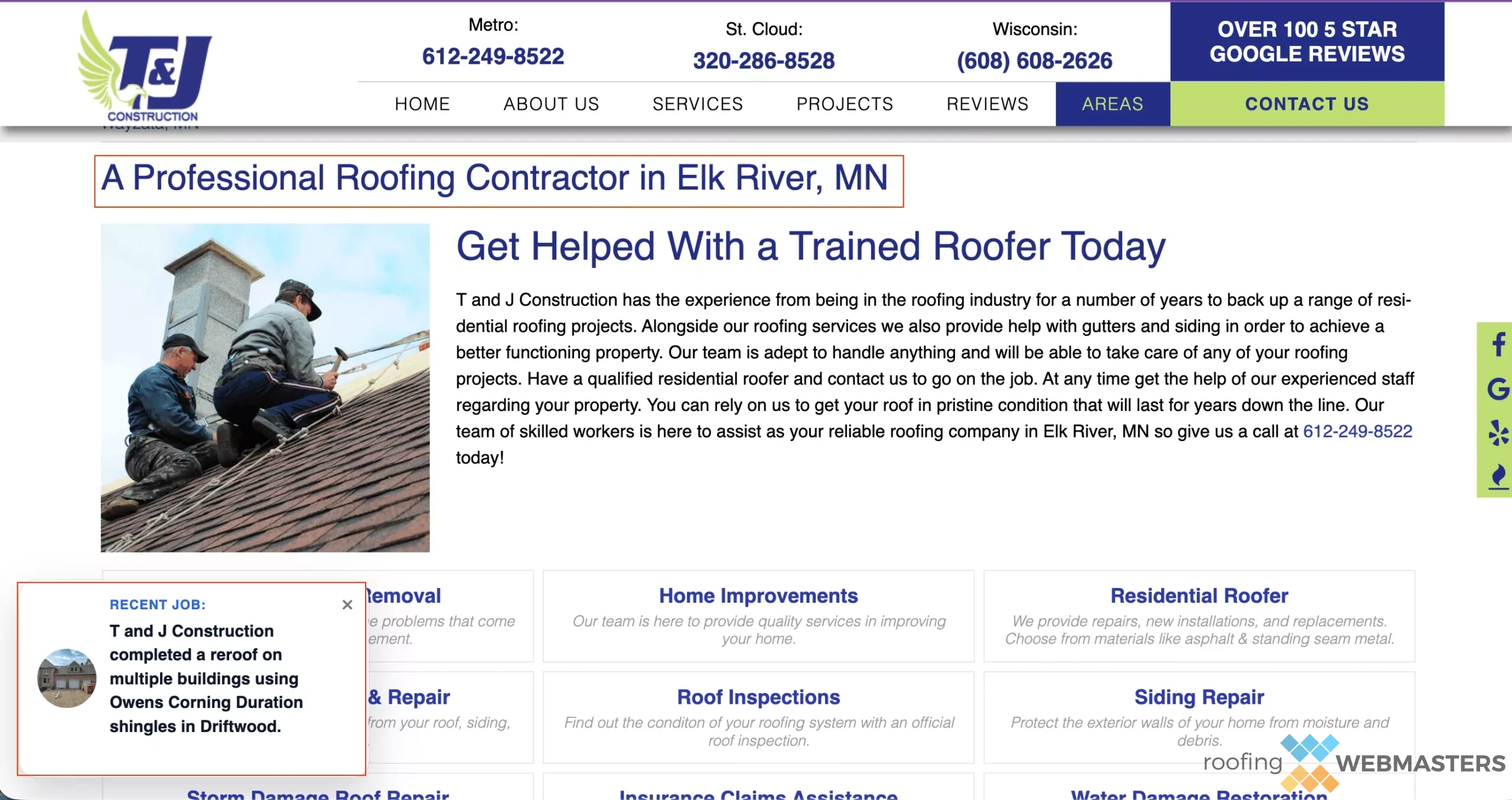
Roofers serving multiple cities within a radius often create individual city pages to capture location-specific search traffic, a page targeting “roof repair in Naperville” rather than relying on the homepage to rank for that query.
City pages are effective when they are genuinely unique to each location: specific to local neighborhoods, local building codes or permit requirements, recent jobs completed in that area, or customer reviews from that city.
Google’s guidelines explicitly prohibit doorway pages, pages created solely to rank for a location keyword with no meaningful unique content. Mass-produced city pages that use duplicate ycontent with only the city name swapped out risk being classified as doorway pages and suppressed or penalized.
The use of AI to generate city pages at scale introduces additional risk. Pages that contain genuinely location-specific information, such as local permit requirements, neighborhood references, and specific job details from that area, are less likely to be classified as doorway pages than pages where only the city name changes between otherwise identical templates.
Off-Site SEO for Roofing
Off-site SEO encompasses all ranking signals that originate outside your own website, inbound links from other domains, brand mentions, social media activity, and directory citations. Google evaluates these external signals to assess your overall authority and relevance within your market.
Social Media
Social media platforms, Facebook, Instagram, YouTube, LinkedIn, and others, function as off-site entities that expand your brand’s presence beyond your main website. Publishing job photos, before-and-after content, and customer reviews on social platforms builds brand awareness and drives referral traffic.
Social engagement (likes, shares, comments, and brand mentions) has been formally recognized as a measurable local search ranking factor for the first time in Whitespark’s 2026 Local Search Ranking Factors report.
Google itself has not confirmed social signals as a direct ranking factor, but the indirect mechanisms are well-documented: social activity drives branded searches, increases brand mention frequency, and generates referral traffic, all of which feed into local ranking signals.
For roofing companies, Facebook and YouTube are the highest-return platforms. Facebook drives local referral traffic and review activity. YouTube job videos can appear directly in Google search results, compounding their SEO value beyond the platform itself.
Link Building
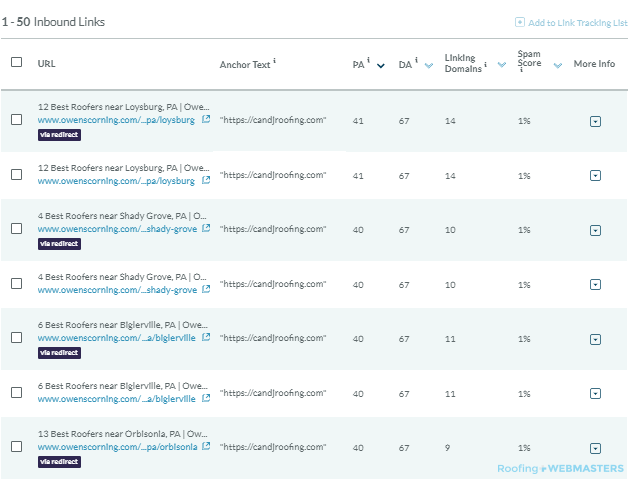
Inbound links from other websites remain one of the most influential ranking factors in both local and organic search.
For a roofing company, the most valuable links come from locally and topically relevant sources: local news coverage, Chamber of Commerce listings, home services directories, manufacturer partner pages, and supplier or distributor websites.
Tactics that produce durable, relevant links for roofing companies:
Digital PR: Pitching local home improvement publications, news outlets, or regional business journals for coverage of a completed project, community initiative, or expert commentary on storm season roofing demand. Coverage that earns a named link to your website is the highest-quality link a local roofing company can acquire.
Manufacturer and supplier listings: Many roofing product manufacturers maintain contractor directories or “find a pro” pages. Being listed on a GAF, Owens Corning, or CertainTeed contractor page produces a relevant, authoritative inbound link.
Chamber of Commerce and trade associations: Memberships that include a directory listing on the organization’s website produce locally relevant links that reinforce geographic authority.
Earning links through genuinely useful content and legitimate local relationships remains the most durable strategy. Purchased links from blog networks or low-quality directories carry zero-sum value at best and ranking risk at worst.
Google’s link spam detection has improved substantially since the original Penguin update and continues to be refined in core updates.
Targeting Specialized Roofing Services With SEO
Competing for broad terms like “roofing company” or “roofing services” is unrealistic for most roofing companies in their first one to two years of SEO; established competitors with years of domain authority have a structural advantage on those terms.
Targeting a specific roofing system or service narrows the competitive field and creates a faster path to ranking.
This approach works best for: newer companies building their first rankings, established companies entering a new service category, and operators in densely competitive markets where broad terms are locked up by large regional players.
Metal Roofing
Metal roofing is a high-intent, lower-competition keyword cluster relative to generic roofing terms in most local markets.
Building a dedicated metal roofing page, optimized for terms like “metal roofing company [city]” and “metal roof repair [city]”, targets homeowners who have already decided on the material and are selecting a contractor.
Including “metal” in your company’s legal business name has produced ranking advantages on both Google Maps and Google Search for metal roofing queries in practitioner observation across local search campaigns.
Commercial Roofing
Commercial roofing SEO targets a fundamentally different buyer than residential SEO. The customer is a property manager, facilities director, or business owner evaluating a higher-ticket project with a longer decision cycle.
The search behavior reflects this: commercial roofing queries tend to be more specific (“TPO roofing contractor [city],” “EPDM flat roof replacement [city]”) and less impulsive than residential emergency repair searches.
An effective commercial roofing SEO strategy requires:
Dedicated sub-pages for each commercial system you install: TPO, EPDM, modified bitumen, built-up roofing, and roof coatings should each have their own optimized page rather than being bundled onto a single commercial roofing page.
Content that addresses B2B buyer concerns: Warranty terms, project timelines, compliance with commercial building codes, and experience with multi-unit or multi-building properties are the information commercial buyers are looking for, not the same content that converts residential homeowners.
Case studies or project summaries: Commercial buyers evaluate contractors differently from homeowners. A documented project summary, square footage, system installed, location type, timeline, and provide the evidence a commercial buyer needs to include you in a shortlist. Even a brief, anonymized project description is more useful than generic claims about commercial experience.
Including “commercial” in your business name has shown the same pattern observed in metal roofing campaigns, faster Google Maps ranking movement for commercial-related queries, based on practitioner observation in local search.
Tile Roofing
Tile roofing is a residential specialty that targets a specific sub-segment of homeowners, typically in markets with significant Spanish-style, Mediterranean, or high-end construction. It allows a residential contractor to differentiate without moving into commercial work.
A tile roofing page optimized for “[tile roofing company] [city]” and “[clay tile roof repair] [city]” captures homeowners with a specific material need and, in most markets, lower keyword competition than general roofing terms, though competition levels vary by region and should be verified with keyword research before committing to this as a primary target.
Roof Coatings
Roof coatings are a sub-niche within commercial roofing that works well as an entry point for contractors who find the full commercial category too broad or too competitive at the outset.
Search terms like “silicone roof coating [city]” and “polyurea roof coating contractor [city]” carry lower competition than general commercial roofing terms in most markets, though this varies by geography and should be confirmed with keyword research before targeting.
Building content around specific coating systems, silicone, polyurea, and acrylic, creates additional keyword surface area beyond the primary “roof coatings” term and positions your company as a specialist rather than a generalist.
Expanding SEO to AI and AEO
AI platforms are changing how some homeowners discover and research roofing contractors. According to the Previsible AI Traffic Report (December 2025), which tracked sessions across 19 GA4 properties, AI-sourced website traffic grew 527% year-over-year between January and May 2025, rising from approximately 17,000 to 107,000 sessions across the tracked properties.
Growth has continued into 2026, though comparable full-year figures from a named primary source are not yet available at the time of publication.
This growth is real and accelerating, but it requires context: AI platforms currently represent approximately 0.15% of total global web traffic, compared to 48.5% from organic search, according to SE Ranking’s 2025 research study.
Organic search remains the dominant discovery channel for roofing leads by a large margin. The correct response to AI’s growth is to add AI visibility to your strategy (a practice often referred to as AEO or GEO), not to replace the organic SEO work that is still driving the majority of your traffic.
Google’s Two AI Search Surfaces: AI Overviews and AI Mode
Google now surfaces AI-generated content in two distinct ways, and they work differently:
AI Overviews appear automatically above traditional search results for qualifying queries; they are the AI summaries you see without opting in. They are powered by Gemini and pull from Google’s index. A roofing company that ranks well in traditional organic results and has a strong Google Business Profile is well-positioned to be cited in AI Overviews, because Gemini draws heavily from Google’s own ranking data.
AI Mode is a separate, user-selected conversational search interface. Users who switch to AI Mode get a ChatGPT-style experience within Google, no list of blue links, just synthesized answers with citations. It aggressively uses query fan-out, breaking a single prompt into multiple sub-queries before generating a response.
The practical implication: optimizing for traditional local SEO is the primary lever for AI Overviews visibility. Optimizing for content breadth, structure, and sub-query coverage is an additional lever for AI Mode visibility.
How Other AI Search Platforms Process Roofing Queries
ChatGPT Search (OpenAI’s integrated search product, launched in 2024) crawls the web in real time and uses a multi-layer retrieval pipeline. It weighs content that is well-structured, clearly attributed to a named business or expert, and corroborated by third-party sources.
It utilizes Bing’s web index for initial discovery, supplements this with OpenAI’s OAI-SearchBot for real-time page analysis, and prioritizes direct data partnerships for authoritative news and social discussions.
Perplexity is a research-oriented platform with a U.S. user base that skews toward high-intent researchers. It cites sources explicitly and tends to pull from pages with high information density, structured content with specific claims, named sources, and clear answers performs better than general instructional prose.
Claude (Anthropic) and Grok (xAI) currently drive smaller traffic volumes for local service businesses, but are growing. Both emphasize source quality and factual grounding. Well-structured, specifically attributed content performs across all platforms without requiring a separate optimization strategy.
Query Fan-Out Optimization
AI platforms, including Google AI Mode, ChatGPT Search, and Perplexity, break a user’s prompt into multiple sub-queries before generating a response.
A user who asks “who is the best commercial roofer in Dallas” triggers sub-queries that might include: “how to evaluate a commercial roofing contractor,” “average cost of commercial roof replacement in Dallas,” and “commercial roofing companies in Dallas reviews.”
Roofing companies whose websites appear across multiple of these sub-queries, through distinct, well-optimized pages for each service, location, and common customer question, are more likely to be cited in the final AI response than companies whose content covers only one angle.
A single well-ranked homepage is less likely to generate AI citations than a website with dedicated pages for each service type, each primary city served, and FAQ content covering the questions your customers actually ask.
Building Entity Authority for AI Visibility
AI platforms are more likely to cite businesses they can verify as legitimate, established entities. The signals that build entity authority for a roofing company are:
Consistent NAP data across your website, GBP, and directory listings, AI platforms cross-reference these sources to confirm your business is real.
Third-party brand mentions on credible external websites: Chamber of Commerce pages, industry association directories, manufacturer contractor locators, and local news coverage.
Structured content on your own website: Clear author attribution, explicit service area declarations, dated content, and FAQ sections give AI platforms parseable data about who you are and what you do.
Review volume and recency on Google, Yelp, and relevant niche platforms. AI platforms that synthesize local business recommendations draw on review data as a proxy for real-world credibility.
Content Strategy: Refreshing vs. Creating New Pages
A common mistake in SEO for roofers is continuing to create new pages while existing pages with ranking potential go unimproved.
Content refresh, updating and expanding existing pages, often produces faster ranking gains than publishing new content, because the existing page already has some index history and potentially some inbound links.
Update an existing page when:
It ranks in positions 4–15 for a target keyword but has not moved in 60 or more days.
Its information is outdated (references old pricing, discontinued products, superseded permit requirements).
It lacks structured elements that competitors’ pages have: a numbered process list and a comparison table.
Its word count and information depth are significantly below what is ranking in positions 1–3 for the same query.
Create a new page when:
No existing page on your site targets the keyword or service in question.
A service you offer has grown significantly and deserves a dedicated page rather than a paragraph on a broader service page.
You are targeting a new city or service area that does not have an existing location page.
A practical refresh process:
Pull your Google Search Console performance report and sort by impressions, filtered to queries where your average position is between 4 and 20.
Identify which pages are receiving impressions but not clicks; these are pages that are appearing in search results but losing to competitors at the click level.
Compare the top-ranking competitors’ pages for those queries against your own page. Identify specific content, structure, or format gaps.
Update the page to address those gaps, add a publication date update, and submit the URL for recrawl in Google Search Console.
Updating a page’s date without making substantive content changes does not improve rankings. Third-party post-rollout analysis of the December 2025 Core Update, including ALM Corp’s review, identified this as a pattern among sites that lost rankings during that cycle.
Adapting to Google Algorithm Updates
Google releases several significant algorithm updates each year. Core updates recalibrate how Google evaluates content quality across the entire web; they do not target specific spam tactics but adjust the relative weight of quality signals, shifting rankings across many sites simultaneously.
As of June 2026, Google has released three core updates since December 2025: the December 2025 Core Update (December 11–29, 2025), the March 2026 Core Update (March 27–April 8, 2026), and the May 2026 Core Update (launched May 21, 2026, still settling at time of publication).
All three used identical official language: “a regular update designed to better surface relevant, satisfying content.” None introduced new mechanisms.
The consistent pattern across all three cycles is that content demonstrating genuine first-hand experience, strong Core Web Vitals performance, and authentic entity signals has held or gained rankings, while thin, mass-produced, or experience-lacking content has continued to lose ground.
The Helpful Content Update
The Helpful Content Update targeted the practice of producing content primarily to rank in search engines rather than to genuinely answer a reader’s question. It did not specifically prohibit AI-generated content, but it penalized the mass production of content that adds no original value, regardless of how it was produced.
Roofing websites affected by the HCU typically shared common characteristics: large numbers of thin service or city pages with minimal unique content, templated page structures applied across hundreds of locations, and no clear indication of who wrote the content or what direct experience it was based on.
Self-diagnosis checklist for HCU risk:
Do your city or service pages contain information that is genuinely specific to that location or service, or could the same content appear on any roofer’s website with just the city name changed?
Does your content reflect direct experience, job photos, specific project details, named service areas, real customer reviews, or is it generic instructional prose?
Has your organic traffic declined gradually over several months without a clear technical cause? Gradual traffic decline across many pages simultaneously is more consistent with an algorithmic quality signal than a technical issue.
Recovery from an HCU impact requires removing or substantially improving thin content, not simply rewriting it with different words. Pages that cannot be made genuinely useful should be consolidated into stronger pages or removed and redirected.
The December 2025 Core Update
Google released the December 2025 Core Update on December 11, 2025. The rollout was completed on December 29, 2025, an 18-day deployment.
Google described the update as “a regular update designed to better surface relevant, satisfying content for searchers from all types of sites,” per Search Engine Land‘s coverage of the Google Search Status Dashboard announcement.
Google did not identify specific new mechanisms in its public guidance. Third-party analysis from ALM Corp identified patterns among sites that lost rankings: content covering topics comprehensively but lacking signals of genuine first-hand experience, pages with Core Web Vitals scores below Google’s “good” thresholds (particularly LCP above 3 seconds on mobile), and pages where publishing dates had been updated without substantive content changes.
The Lesson for Roofers: Demonstrating real experience through job photos, named project locations, specific material brands and systems, and attributed author credentials has become a more significant ranking signal than in prior years.
The March 2026 Core Update
Google rolled out the March 2026 Core Update between March 27 and April 8, 2026. While the December update focused heavily on correcting the e-commerce space, March 2026 was widely analyzed as a “first-party, official-source correction.”
Data from SEO research firms like Amsive showed a massive algorithmic shift in favor of official, brand-owned domains and authoritative government (.gov) websites. Conversely, broad-scale comparison aggregators, reference sites, and generalized user-generated content lost significant visibility.
The Lesson for Roofers: Google explicitly penalized mid-tier comparison directories and third-party listicles. If your roofing company relies heavily on being “ranked #4 on a random local aggregate directory list,” that traffic pipeline is drying up. Google wants searchers to go directly to the actual, first-party local business website.
The May 2026 Core Update
Launched on May 21, 2026, the May Core Update is the latest standard-bearer for content quality signals. This update dropped right alongside massive structural changes announced at Google I/O 2026 (including the rollout of Gemini 3.5 Flash and the merging of AI Overviews with conversational AI Mode).
The May update doubled down on rewarding hyper-local, high-information-density content. Early analysis shows heavy volatility for standard, dry instructional prose.
Websites that merely explain how a roof is replaced using textbook definitions are losing ground to sites featuring deep, structured case studies with localized context (e.g., matching regional building codes, localized storm damage history, and project-specific timelines).
If your rankings dropped after the December 2025, March 2026, or May 2026 updates:
Do not panic or make reactive changes mid-rollout. If you are tracking a drop during the active May 2026 window, wait at least one to two weeks after Google announces the update is fully completed before altering your content. Mid-update data is incredibly noisy and often exhibits temporary “ghost drops” that resolve on their own.
Check Google Search Console (GSC) to isolate the exact dates. Match your traffic drops against the official rollout windows (December 11–29, 2025; March 27–April 8, 2026; or starting May 21, 2026) to confirm you were actually affected by a core update rather than a localized technical bug or a manual action.
Audit your Core Web Vitals report. Core updates heavily weigh technical user experiences. Look at your Search Console dashboard specifically for mobile URL performance; ensure your Largest Contentful Paint (LCP) isn’t ticking past the 2.5-second mark due to uncompressed roof project photos.
Differentiate “comprehensive text” from “first-hand experience.” Review your worst-performing pages. If a service page reads like a generic textbook definition of “how a shingle roof is installed,” it likely ran afoul of the latest updates. Inject proof of real-world entity execution: add job-site photos, geotagged project summaries, or localized structural notes.
Accept the recovery timeline. Algorithmic re-scoring is structural. If a core update suppresses your roofing site, substantial content and performance improvements generally will not fully reflect in your rankings until Google runs its next major core update cycle, which historically occurs every three to four months.
Choosing an SEO Agency
For most roofing companies, implementing a comprehensive SEO strategy requires either dedicated in-house time or an external agency.
If you are evaluating roofing SEO services, the following criteria help distinguish agencies with genuine expertise from those selling templated packages.
What Roofing SEO Should Cost
Roofing-focused SEO agencies typically charge between $1,500 and $5,000 per month, based on 2025 pricing data from Pipeline On’s roofing marketing analysis and Ahrefs’ 2025 survey of SEO professionals.
The Ahrefs survey of 439 SEO professionals found that U.S.-based agencies average $98.90 per hour, while small- to medium-sized business retainers average $1,500–$3,000 per month.
Treat $1,000/month as the practical risk threshold in 2026: engagements at or below this level rarely include the combined scope of technical auditing, content creation, GBP management, citation maintenance, and performance reporting that competitive roofing markets require.
You may receive some of these services, but not all of them, at the depth needed to move rankings against established local competitors. The result is often a year of spend with no meaningful ranking movement, a more expensive outcome than investing the appropriate budget from the start.
Be cautious of agencies that lock you into 12 or 24-month contracts without clearly defined deliverables and performance benchmarks tied to specific milestones.
Agency Selection Criteria
Criterion
What to Look For
Red Flag
Case studies
Documented ranking or traffic improvements for roofing or home services clients, with before/after data and approximate timeframes
No case studies, or case studies with no performance metrics
Pricing transparency
Clear scope of work for the monthly fee; itemized services
Vague “custom packages” with no defined deliverables
Contract terms
Month-to-month or short-term agreements; defined exit terms
12+ month lock-in with no performance benchmarks
Reviews
Google Reviews from roofing or contractor clients specifically
Reviews only from non-roofing businesses, or thin review history
Roofing knowledge
Demonstrates understanding of roofing-specific keyword patterns, seasonal demand, and local pack dynamics
Generic SEO language with no roofing industry context
Reporting
Monthly reports showing organic traffic, keyword rankings, GBP performance, and lead attribution
No reporting, or reports that show impressions only without traffic or leads
Communication
A named point of contact who responds to questions specifically
Rotating support teams with no continuity
Questions to Ask Before Signing
What does the first 90 days of the engagement look like, specifically?
Which keywords are you targeting first and why?
How do you measure success, and what does success look like for a roofing company at my stage?
Have you worked with roofing companies in markets similar to mine?
What happens to the content and optimizations you create if I stop working with you?
When Roofing SEO Fails: What to Watch For
SEO does not produce results on a fixed timeline, but it should produce measurable directional progress within a defined window.
Understanding what failure looks like and why it happens helps you reassess before a non-performing campaign consumes years of budget.
Realistic Timeline Expectations
Most roofing companies begin to see measurable ranking movement within 3–6 months for long-tail, low-competition keywords.
Movement on competitive local terms (“roofing company [major city]”) typically requires 9–18 months of consistent effort.
Campaigns that show no measurable progress in rankings, organic impressions, or GBP visibility after 12 months warrant a full strategy review.
Common Reasons Roofer SEO Campaigns Underperform
The market is more competitive than the strategy accounts for
Broad terms in large markets (Houston, Atlanta, Phoenix) are dominated by established regional operators with years of domain authority.
A strategy targeting the same terms as the market leaders without a clear plan for differentiation, specialty services, longer-tail keywords, and underserved suburbs will produce slow results regardless of execution quality.
The technical foundation has unresolved issues
Crawl errors, broken redirects, thin duplicate content, and Core Web Vitals failures suppress rankings that content optimization alone cannot overcome. If technical issues have not been audited and resolved, other SEO work is partially wasted.
Content is being produced without a keyword or audience target.
Publishing blog posts or service pages that do not map to specific search queries your customers are actually using does not produce ranking improvements. Every page should have a defined target keyword with confirmed search volume.
Google Business Profile is under-optimized.
For residential roofers, Local Map Pack rankings often produce more leads per month than organic website rankings. Agencies that focus exclusively on website SEO without actively managing the GBP listing leave significant lead volume on the table.
When to Reassess
Initiate a formal strategy review if, after 12 months of consistent effort:
Organic traffic has not increased meaningfully.
Your Google Business Profile is not appearing in the Local Map Pack for your primary service terms.
You cannot identify specific keywords where your rankings have improved.
A roofing SEO strategy review should evaluate whether the right keywords are being targeted, whether technical issues remain unresolved, whether the content produced aligns with actual search demand, and whether the budget is appropriate for the competitive landscape.
Author: Nolen Walker
Nolen Walker is the founder of Roofing Webmasters and the creator of DataPins™, a Local SEO platform for roofing companies. He has over 16 years of experience helping roofing businesses grow through organic search, Google Maps, and AI-driven visibility.
At its core, roofing marketing is the process of making your company visible to homeowners who need roofing services, earning their trust before they call, and converting that trust into booked jobs. Every component outlined in this guide serves one of three functions: visibility, trust, or conversion.
Roofing marketing is not a single tactic or channel; it’s a system. And like any system, it works most effectively when each component is understood individually before being integrated cohesively into a whole.
Key Findings:
Roofing marketing works as a system. Each channel reinforces the others; no single tactic produces consistent results in isolation.
Your website is the connective tissue. Every other channel, Google, AI platforms, and paid ads reference it to determine what your company does and where you operate.
Google’s Local 3-Pack is the most competitive position in local search. It is governed by three factors Google has made public: distance, relevance, and prominence. Each can be influenced, but only one (distance) is determined by your address.
Organic SEO produces results on a longer timeline than paid channels, typically 3–6 months for early ranking gains and 6–12 months for consistent lead flow, but its cost structure improves over time. Google Ads cost per lead for roofing averages $228.15, according to LocaliQ’s 2025 benchmark of 3,211 home services campaigns.
Review velocity, the frequency and consistency with which a business earns new reviews, now outweighs total review count as a local ranking signal, according to Whitespark’s 2026 Local Search Ranking Factors report.
Responding to leads within 5 minutes yields better conversion rates than waiting. According to the InsideSales.com/MIT Lead Response Management Study, leads contacted within 5 minutes are 21 times more likely to be qualified than leads contacted after 30 minutes.
Every channel covered in this guide has conditions under which it underperforms. Those conditions are documented in each section to provide context to local roofers who may not benefit from every channel.
This guide is written for residential roofing contractors operating in U.S. markets. Operators in commercial roofing, rural markets, or outside the United States will find that some channel and platform recommendations require adjustment.
Top Roofing Marketing Channels
When roofers hear “marketing,” they may think about direct mailers, promotional emails, or digital strategies like SEO. In reality, roofing marketing spans a wide range of channels, and the most successful companies are active across several simultaneously.
Here is a practical overview of the primary channels, what each one achieves, and where each one fits in your growth timeline.
Channel
Primary Outcome
Time to First Results
Cost Structure
Works Best When
Business Website
Foundation for all other channels
Immediate (as infrastructure)
One-time build + ongoing maintenance
Always, a prerequisite for every other channel
Google Organic (SEO)
Sustained unpaid visibility
3–6 months early gains; 6–12 months consistent leads
Monthly investment; cost per lead decreases over time
You can commit to 12+ months of consistent effort
Google Business Profile
Local pack visibility for near-me queries
Weeks to initial visibility
Free to maintain; time investment
You have a verified physical address in a populated service area
Local Services Ads (LSA)
High-urgency leads above the local pack
Days to first leads
Pay-per-lead: $45–$120 per lead for roofing (2025)
You need immediate lead volume and can manage lead quality actively
You have a budget to sustain campaigns and a high-converting landing page
Social Media
Trust-building and brand familiarity
Months of consistent posting
Time investment; optional paid promotion
You can post consistently; do not rely on it as a direct lead channel
AI Platforms / AEO
Visibility in AI-generated answers
Months, dependent on the SEO foundation
No direct cost; requires content and citation investment
Your SEO foundation is already established
Reviews
Trust signal and local ranking factor
Ongoing
Time investment; optional review software
You have a system for requesting reviews after every completed job
Offline Marketing
Brand recognition and branded search lift
Weeks to local recognition
Variable: truck wraps, yard signs, door knocking, sponsorships
You serve a defined geographic territory consistently
No roofing company needs to master all of these channels at once. The goal is to understand what each one does so you can make informed decisions about where to invest at each stage of your growth.
What Makes Roofing Marketing Unique?
There is no shortage of generic marketing advice for home services contractors online. Most of it is repackaged from broader small-business principles that apply equally across industries. Roofing is different in five specific ways that should shape every marketing decision you make.
High transaction value changes the decision timeline
A roof replacement typically ranges from $10,000 to $30,000 or more. At that price point, homeowners do not make impulsive decisions. They research, compare, ask neighbors, and check reviews, a process that can take weeks or months.
A roofing company’s marketing must be present at every stage of the decision-making process, not just when a homeowner searches Google.
Storm events create compressed, winner-take-most demand windows
Roofing demand can spike suddenly following a hail event or major storm. Companies with a strong marketing infrastructure in place before the storm capture a disproportionate share of post-event demand.
The mechanism is straightforward: contractors who are already ranking in the local pack, running active ad campaigns, and holding an established review profile on the day a storm hits will absorb the majority of that surge.
Competitors who attempt to ramp up marketing after the event has occurred are entering a window that established operators have already claimed.
Insurance claims introduce a different customer psychology
Many roofing jobs involve homeowners’ insurance, which creates a different sales process and requires different marketing messaging.
Homeowners navigating an insurance claim are especially drawn to contractors they trust implicitly, meaning your marketing must establish credibility before a claim event occurs, not after.
Neighbor influence is unusually powerful in this industry
Roofs are visible. When a homeowner gets a new roof, neighbors notice. Door-knocking, yard signs, and the presence of trucks in specific neighborhoods can trigger a cluster effect that no digital channel can fully replicate.
The most effective roofing marketing strategies connect this offline visibility to digital infrastructure; branded searches generated by physical presence translate directly into local pack visibility and organic traffic.
Competition is high and structurally diverse
Local roofing markets are contested simultaneously by independent contractors, storm-chasing operations, and private-equity-backed nationals, all competing for the same homeowner’s attention.
A roofing marketing strategy that builds lasting brand equity, rather than one that chases leads on a transactional basis, is the only model that produces sustainable growth in this environment.
9 Roofing Marketing Tips
Tip 1:Your Website is the Central Hub of Every Channel You Run
Your roofing website influences every other marketing channel you operate, and remains the single digital asset you fully own and control. Google, AI platforms, and social media all reference your website to understand what your company does, where you operate, and why a homeowner might choose you.
This influence is not theoretical. Google’s local algorithm directly scans the website associated with your Google Business Profile to determine rankings for specific roofing queries.
Businesses that rank in the local pack often do so in part because of “website justifications”, lines within the listing that read “their website mentions [keyword].” That is hard evidence of a direct relationship between your website content and your local pack position.
AI platforms use similar retrieval methods. When a homeowner asks ChatGPT or Google Gemini to recommend a roofer in their area, those platforms query live search indexes and structured sources to build their answer.
A website that clearly identifies your services, service area, and company experience is more likely to be retrieved and cited in those answers than one that does not.
Every other tip in this guide compounds when your website is functioning as the hub it needs to be. Every tip underperforms when it isn’t.
This tip applies less when: Your website is brand new and has not yet been indexed. In that case, Google Business Profile and LSA will produce faster early results while your website builds authority.
Tip 2: Technical Website Performance is a Ranking Input, Not a Bonus
Website speed and mobile usability are not aesthetic preferences; they are ranking inputs that Google measures and rewards. Google tracks two Core Web Vitals metrics that directly affect how your roofing website is evaluated: Largest Contentful Paint (LCP) and Interaction to Next Paint (INP).
LCP measures how quickly the largest visible element on a page, typically a hero image or headline, loads for a user. According to Google’s official Core Web Vitals documentation, a good LCP score is under 2.5 seconds.
Pages that load between 2.5 and 4 seconds are rated “Needs Improvement.” Pages above 4 seconds are rated “Poor.” Google uses these ratings as a ranking input, meaning slower pages face a competitive disadvantage in search results when other factors are equal.
INP (Interaction to Next Paint) measures how quickly your page responds to user actions such as taps and clicks. INP replaced the older FID (First Input Delay) metric in March 2024 as Google’s official measure of interactivity. A good INP score is under 200 milliseconds.
In practical terms: ensure your site loads quickly on a mobile device over a 4G connection, that your calls to action (phone numbers, contact forms) are easy to tap on a small screen, and that your pages don’t shift visually as they load.
Note: Google periodically updates its Core Web Vitals metrics and thresholds. Verify the current thresholds against Google’s official web.dev documentation at the time of publication, as the criteria and ranking-weight language have been revised.
This tip applies less when: Your site already passes Core Web Vitals in Google Search Console. In that case, additional performance optimization yields diminishing ranking returns, and your effort is better spent on content and local authority.
Tip 3: Local Pack Rankings Are Governed by Three Factors You Can Influence
Google’s Local Map 3-Pack, the three business listings that appear with a map above standard organic results, is among the most valuable positions in local search for roofing contractors.
Beginning in October 2025 and becoming widespread across mobile local pack results by early 2026, Google has been removing the direct call button from organic local pack listings, according to Search Engine Roundtable. Industry reporting as of early 2026 describes this change as ongoing, though Google has not formally confirmed its permanence.
Calls initiated directly from the local pack have declined across the roofing industry as a result. Visibility in the 3-Pack remains critical, but the conversion mechanism has shifted toward profile clicks and website visits rather than one-tap calls.
Google has made the pillars of its local pack algorithm public. They are: distance, relevance, and prominence.
Distance is the most straightforward factor, based on your verified address relative to the searcher’s approximate location. Roofers with office locations in densely populated areas simply show up more in the local pack than those on the outskirts. This factor cannot be changed without changing your registered business address.
Relevance is something companies can influence. It accounts for the keyword content of your website (as noted in Tip 1), the keywords your customers use in their reviews, your primary and secondary Google Business Profile categories, and your listed services.
Prominence is influenced by the consistency and volume of your reviews (review velocity), the accuracy of your business information across web citations, and the quality of brand mentions earned through digital PR and local activity.
Here is a sequential process for improving your local pack position:
Verify your Google Business Profile with an accurate business address and select roofing contractor as your primary category.
Audit your listed services and ensure every service you offer is named explicitly in your profile and mirrored on your website.
Establish consistent Name, Address, and Phone Number (NAP) data across all major citation sources, Google, Yelp, Angi, BBB, and industry directories.
Build a systematic process for requesting reviews after every completed job (see Tip 7 for details on review velocity).
Use your website’s service pages to include the specific keywords that homeowners use to describe roofing work in your area. These terms, when they appear simultaneously in customer reviews and on your website, strengthen relevance signals.
This tip applies less when: Your business address is located far from the population center you serve. In that case, local pack rankings in the core market will be structurally difficult to achieve from your current address, and your effort is better directed toward Google Ads and LSA, which are not constrained by proximity in the same way.
Tip 4: SEO Is a Long-Term Channel With a Predictable Timeline
Organic SEO for roofing companies follows a consistent pattern across markets: early ranking improvements typically appear within 3–6 months of a structured campaign, while consistent, qualified lead flow generally emerges between 6–12 months.
In highly competitive metro markets, where established competitors have years of domain authority, the timeline to first-page rankings for high-value keywords can extend to 12 months or more.
This timeline has a meaningful implication for cost structure. Google Ads cost per lead for roofing and gutters averages $228.15, according to LocaliQ’s 2025 Home Services Search Advertising Benchmarks, a study of 3,211 U.S.-based search advertising campaigns. Organic leads generated through SEO carry no per-lead cost once rankings are established. The investment is front-loaded; the return compounds.
Roofing companies that rank in traditional organic search also carry a structural advantage in AI-generated results. AI platforms, including Google AI Mode and ChatGPT, retrieve answers from live search indexes.
A roofing company that ranks organically is more likely to appear in AI-generated recommendations than one that does not, because those platforms are querying the same indexes traditional search uses.
Building that SEO foundation starts with content. Producing dedicated pages for each service you offer, such as roof replacement, storm damage repair, gutters, skylights, and commercial flat roofing, is more effective than listing all services on a single page.
Internal links connecting those pages, accurate contact information in your header and footer, and first-hand experience demonstrated in your content (including your About page) all contribute to organic visibility.
This tip applies less when: You need leads in the next 30–60 days. SEO’s compounding return model does not serve urgent short-term demand. In that window, LSA and Google Ads will produce results that SEO cannot.
Tip 5: AEO Extends Your Visibility Into AI-Generated Answers
Answer Engine Optimization (AEO) is the practice of structuring your content and brand presence so that AI platforms, including Google Gemini, ChatGPT, and Perplexity, retrieve and cite your company in response to roofing-related queries.
AI platforms do not search the web the way a user does. They use a process called query fan-out: when a homeowner asks, “Who are the best roofers near me,” the platform expands that prompt into 8–12 related sub-queries, retrieves relevant content from multiple sources, and synthesizes a single response.
Your company’s likelihood of appearing in that response depends on how consistently your brand appears across the sources those platforms trust, your website, Google Business Profile, Yelp listing, industry directories, and local press mentions.
As noted in tip 4, SEO provides an initial advantage in AI retrieval. But organic ranking alone is not sufficient to maximize AI visibility.
The additional layer that AEO requires is entity recognition: the degree to which AI platforms have sufficient consistent, corroborating information about your company to include it in a synthesized answer with confidence.
This means getting consistent customer reviews on Google, Yelp, and Facebook; earning mentions in local business lists and industry directories; and ensuring your website explicitly states your services, service area, and company history in clear, crawlable language.
Think of your company as a brand and an entity, not just a website or a Google listing. AI platforms are more likely to recommend businesses that appear across multiple credible sources than those that exist in only one place.
This tip applies less when: Your SEO foundation is not yet established. AEO is an optimization layer built on top of existing organic visibility. Pursuing AI visibility before your website, GBP, and review profile are solid is unlikely to produce results.
Tip 6: LSA and Google Ads Work Better Together Than Either Does Alone
Paid advertising is an accelerant for the broader digital marketing system, not a replacement for organic channels. Many roofers approach LSA and Google Ads as an either/or choice. In the current search landscape, running both simultaneously produces a compounding visibility effect that neither channel achieves alone.
Local Services Ads (LSA) place your business above the standard local pack with a Google Verified badge. For roofing, they are most effective for high-urgency queries, homeowners with an active leak or fresh storm damage who need a contractor immediately. LSA cost per lead for roofing ranges from $45–$120 depending on market competition and seasonality.
As of July 2024, Google replaced the manual lead dispute process with an automated credit system, meaning you can no longer dispute leads for “job type not serviced” or location mismatches after the fact. Profile configuration (your listed services and service area) now determines lead quality before leads arrive, not after.
Note: Google continues to iterate on the LSA program mechanics; verify the current credit and dispute process against Google’s LSA support documentation as of the time you are reading this.
Google Ads (PPC) serves sponsored results above the standard organic rankings and is more effective for broad-intent or commercial queries, such as “best metal roofing contractor” or “TPO flat roof replacement,” that LSA does not serve as effectively.
You can also run Local Search Ads through Google Ads Location Assets, which allows your Google Business Profile to appear as a sponsored listing within the local pack itself, an increasingly important placement as the organic call button has been reduced.
Running LSA and Google Ads simultaneously creates a billboard effect: your business appears in the paid LSA position, the sponsored local pack, and the organic local pack, compounding both lead volume and brand recognition.
When LSA underperforms: LSA produces poor results when your profile is misconfigured, your responsiveness score is low (Google tracks call answer rates and factors them into LSA ranking), or your review count is thin relative to competitors. Contractors with fewer than 10 Google reviews will find LSA efficiency is significantly lower than that of competitors with established review profiles. LSA is also not effective for commercial roofing queries, which are better served by targeted Google Ads campaigns.
When Google Ads underperforms: Google Ads produces poor returns below a minimum viable budget threshold. In competitive metro markets, roofing keywords are expensive enough that campaigns running under approximately $2,000–$3,000 per month may not generate sufficient volume to optimize effectively. Campaigns without dedicated, conversion-optimized landing pages, sending paid traffic to a generic homepage, will also underperform regardless of budget.
Tip 7: Review Velocity Matters More Than Review Volume
Reviews are a well-known marketing factor across all industries, particularly for local businesses. For roofing contractors specifically, the nature of their impact on local rankings has shifted from a volume game to a velocity game.
Review velocity is the frequency and consistency with which a business gets new reviews. According to Whitespark’s 2026 Local Search Ranking Factors report, an annual survey of local search experts that has tracked Google’s local algorithm since 2008, review signals grew from 16% to 20% of the total local pack ranking weight between 2023 and 2026.
Within that category, recency now outweighs total count. A roofing company that consistently earns a handful of reviews each week will outperform a competitor sitting on a larger but stagnant review profile.
This is how Google distinguishes contractors who are actively serving their communities from those who are no longer operating at the same volume. A review profile that stopped accumulating new reviews six months ago signals inactivity in the local algorithm regardless of its total count.
How to increase review velocity without violating platform policies: Do not incentivize reviews, Google and other platforms identify these patterns and can remove reviews or suspend listings as a result. The effective lever is a systematic request process: use review software or a CRM to automatically send review requests via text and email after each completed job. Requests that ask for specific details, the type of service performed, the roof material, and any notable aspects of the job, produce reviews that contain the kind of keyword content that strengthens relevance signals in the local algorithm.
What to do when you have no reviews or negative reviews: If your review profile is empty, start with your most recent and satisfied customers. A direct, personal request, by phone or in person at job completion, converts at a higher rate than an automated message for the first 5–10 reviews. If you have negative reviews, respond to every one publicly, professionally, and without defensiveness. A business with 4.2 stars and consistent recent reviews will outperform a business with 4.8 stars and a review profile that stopped accumulating two years ago.
This tip applies less when: Your review velocity is already competitive with the top-ranked local pack results in your market. At that point, additional review volume yields diminishing returns in rankings, and your effort is better directed toward prominence signals like citations and brand mentions.
Tip 8: Offline Presence Generates Digital Signals
It is easy to focus exclusively on digital channels and lose sight of the offline marketing components that directly feed digital performance. For roofing contractors, offline presence is not separate from digital marketing; it is an input to it.
Truck wraps, yard signs, door knocking, and local sponsorships generate branded search activity. When a homeowner sees your truck in their neighborhood and later searches your company name on Google, that branded search registers as a recognition signal in Google’s local algorithm.
The cluster effect that neighbor influence produces, one visible roofing job generating interest from adjacent homeowners, is one of the mechanisms through which offline presence translates into measurable digital outcomes.
Community involvement produces additional signals. Local sponsorships, a Little League team, a neighborhood association event, and a charity partnership generate mentions and links on local websites, contributing to the prominence component of Google’s local pack algorithm. These are authentic local citations that reflect genuine community presence.
Demonstrating offline activity on your website and social media pages, job site photos, before-and-after documentation, and neighborhood-specific content reinforces the connection between your physical presence and your digital brand.
AI platforms and Google’s local algorithm both respond to geographic specificity. Content that names the neighborhoods, subdivisions, and cities where you’ve completed work strengthens your relevance for location-based queries in those areas.
This tip applies less when: Your service territory is very large or geographically dispersed. Offline tactics produce their strongest digital compounding effect in defined, recurring geographic areas. Storm-chasing operations that follow weather events across state lines will not see the same branded search and local recognition effects as a contractor working a consistent territory.
Tip 9: Lead Response Speed Determines Conversion Outcomes
Generating inquiries is only half of the marketing equation. What happens in the minutes after a lead arrives determines whether that inquiry becomes a booked job.
Responding to leads within 5 minutes yields better conversion rates than waiting. According to the InsideSales.com/MIT Lead Response Management Study, conducted by Dr. James Oldroyd of MIT’s Sloan School of Management, which analyzed 15,000 leads and over 100,000 call attempts, leads contacted within 5 minutes are 21 times more likely to be qualified than leads contacted after 30 minutes.
Contact rates drop 100 times when comparing a 5-minute response to a 30-minute response. This study, originally published in 2007 and cited by Harvard Business Review in 2011, represents the foundational research on lead response time; its core findings have since been independently replicated by Drift (2018), Chili Piper (2023), and Conversica (2025) across more recent datasets.
The average response time across businesses remains approximately 47 hours, according to the original Harvard Business Review research and corroborated by a RevenueHero study of more than 1,000 companies (2024) and an Optifai benchmark of 939 companies (2025–2026). Any roofing company that responds within minutes is therefore outperforming the vast majority of competitors on the single metric most correlated with conversion.
Most roofing CRMs include features that send instant automated text responses to each new lead and route inquiries directly to available sales reps. This closes the response gap without requiring a person to be watching a screen at all times.
Your CRM’s accumulated contact data also becomes a direct marketing asset for storm demand. When a major hail event hits a city or zip code you serve, your first-party data, the names, phone numbers, and addresses of past customers and contacts in that area, allows you to reach out immediately without relying on Google or Facebook to serve your ads to the right audience.
Contractors who have built this data asset in advance of a storm event are able to activate outreach within hours. Those who haven’t are dependent on paid platforms to reach the same audience at peak CPL rates, during a window when every competitor is running ads simultaneously.
This tip applies less when: Your business operates on a purely appointment-based or commercial model with longer sales cycles, where immediate response to an inquiry is not the primary conversion mechanism.
What Informs This Roofing Marketing Guide?
At Roofing Webmasters, we’ve worked with roofing companies across the nation for more than 16 years, from single-truck startups to multi-location operations, and we’ve collected data across all of these channels.
The observations in this guide reflect patterns we’ve seen repeated across thousands of roofing campaigns in markets ranging from single-county rural operations to densely competitive metros.
This guide covers the full spectrum of roofing marketing, from foundational elements to advanced channels, in the order that makes the most strategic sense.
It is written for residential roofing contractors operating in U.S. markets. Operators in commercial roofing, rural areas, or markets outside the United States will find that some platform-specific guidance requires adjustment.
Final Thoughts
Roofing marketing works most effectively when it is treated as a system rather than a collection of independent tactics.
The channels covered in this guide, website, SEO, GBP, paid advertising, AEO, reviews, and offline marketing, are not competing priorities. Each one feeds the others when built out correctly, and each one underperforms in isolation.
Two principles are worth carrying from this guide above all others.
First: the contractors who build their marketing infrastructure before they need it are the ones who capture disproportionate demand when conditions shift, whether that’s a competitor exiting the market, a storm event hitting their territory, or an algorithm change that rewards businesses with established authority.
Marketing built reactively, in response to a slow season or a sudden competitive threat, takes 6–12 months to produce results that pre-built infrastructure would have delivered immediately.
Second: visibility earns you the homeowner’s attention, but trust closes the job. Every marketing decision you make, the content on your website, the reviews on your profile, and the speed with which you return a call should be evaluated against both of those outcomes, not just one.
The system works when its components are maintained with the same consistency and care you apply to your craft.
Author: Nolen Walker
Nolen Walker is the founder of Roofing Webmasters and the creator of DataPins™, a Local SEO platform for roofing companies. He has over 16 years of experience helping roofing businesses grow through organic search, Google Maps, and AI-driven visibility.
Five design patterns consistently separate high-converting roofing websites from sites that look professional but underperform:
Social proof above the fold: Review counts, badges, and awards must appear before the first scroll. Sites with fewer than 20–30 reviews should substitute certifications or years-in-business signals instead.
Authentic, localized photography: Custom job-site photography outperforms stock images on trust and engagement metrics. Drone photography of local projects provides visual proof that no stock library can replicate.
Clear service navigation architecture: Visually distinct pathways to individual services reduce decision fatigue. Single-trade contractors are the exception: they convert better with one dominant CTA.
Local identity signals in the hero section: Geographic markers in the first visible section (project photos, location copy, local awards) improve local search conversion. Multi-location contractors should move location signals to dedicated landing pages rather than the homepage.
Frictionless contact architecture: Phone numbers, quote forms, or scheduling tools must be visible without scrolling. Instant quote tools are effective for residential contractors and counterproductive for commercial ones.
Four structural problems account for most roofing website lead failures: stock photography, no visible social proof above the fold, slow load time, and no mobile-first layout.
When a Roofing Website Fails to Convert
Most roofing websites that don’t generate leads fail for one of four reasons:
Stock photos: Visitors pattern-match generic images to “template site” and discount credibility before reading a word.
No visible social proof above the fold: Review counts, badges, and awards need to appear within the first scroll, not buried in a footer.
Slow load time: Google’s Core Web Vitals criteria set 2.5 seconds as the maximum threshold for a “Good” Largest Contentful Paint (LCP) score, per Google Search Central documentation. The most common culprits on roofing sites are uncompressed hero images and unoptimized third-party review widgets.
No mobile-first layout: Google has applied mobile-first indexing to all websites as of May 2023, meaning the mobile version of every site is the version Google evaluates for rankings, not the desktop version.
A Note on How This Guide Was Assembled
After overseeing the development of hundreds of contractor websites at Roofing Webmasters, one pattern is clear: sites that consistently produce qualified leads share specific, repeatable design and structural decisions, while sites that look good but underperform are missing one or more of the same elements.
This guide breaks down 14 real roofing websites, identifies which design decisions drive measurable outcomes, and explains when each approach applies and when it doesn’t.
5 Design Patterns That Separate Converting Roofing Websites
Five recurring patterns account for most of the measurable differences in conversion performance across contractor websites analyzed at Roofing Webmasters.
Pattern 1: Social Proof Positioned Before the Scroll
Roofing websites that display review counts, third-party review widgets, or award badges in the hero section before a visitor scrolls reduce the friction between browsing and calling.
Centennial Roofing (Nashville, TN) anchors its homepage hero with a badge displaying 600+ Google reviews alongside a local project photo that reflects the Nashville market. The design conveys trustworthiness at first glance, before a visitor reads a word of body copy.
A Godsend Roofing (Lexington, KY) achieves the same result with a local-specific award badge positioned in the primary visual path, paired with CTAs that are visible without scrolling. The badge functions as a borrowed-authority signal that reduces the trust gap for first-time visitors.
When this doesn’t apply: New roofing companies with fewer than 20–30 reviews should not lead with review counts. A low count displayed prominently signals inexperience rather than credibility. For newer companies, manufacturer certifications (GAF Master Elite, CertainTeed SELECT ShingleMaster) or a years-in-business figures serve as credibility substitutes until the review base matures.
Pattern 2: Authentic, Localized Photography
Custom photography of actual roofing jobs in the local service area outperforms stock photos on trust signals and visitor engagement.
Website conversion research consistently shows that authentic imagery, real people, real jobsites, and real locations generate higher engagement than stock photography across service businesses, with studies in adjacent industries documenting conversion rate improvements of 30–35% when custom images replace generic ones.
No roofing-specific controlled study has been published, but the evidence points in a consistent direction: visitors identify stock photos quickly, and recognition of a stock image reduces credibility before any other content is evaluated.
Duluth Roofing Company (Minnesota) uses 100% original, high-definition overhead drone shots of Minnesota-based projects. These images eliminate skepticism about stock photos and provide unique, localized visual content that no competitor using the same stock library can replicate.
Precision 1 Roofing (Central Ohio) leads with a project slideshow featuring recognizable Central Ohio neighborhoods, creating an immediate regional connection for visitors evaluating whether this contractor works in their area.
Express Roofing & Restoration (Indianapolis) uses an interactive crew video in the hero section, a format that signals operational transparency in a way static images cannot and provides original visual content unique to the company.
Original images of local job sites also provide unique visual content that search engines can index independently. Drone photography, in particular, provides overhead project documentation that no stock library can replicate for local credibility.
When this doesn’t apply: For roofing companies launching a new website before building a photo library, professionally styled brand photography, team photos, equipment photos, and branded truck photos outperform stock images, even without jobsite photos. The priority is authenticity over polish, not custom over any available image.
Pattern 3: Clear Service Navigation Architecture
Roofing websites that organize services into clearly labeled, visually distinct navigation pathways reduce decision fatigue and increase the likelihood that a visitor finds the specific service they need without leaving.
Force Field Roofing (Jasper, GA) uses custom geometric service buttons that provide immediate visual pathways to sub-services, reducing the mental load for visitors who arrive with a specific need: roof repair, full replacement, or gutters. Each pathway leads to a dedicated page rather than a general services page.
Premier Roofing Systems (a commercial roofing specialist) uses service-specific landing pages for acrylic, elastomeric, and silicone coatings rather than combining all coatings on a single page. This silo structure serves commercial buyers who arrive with precise product intent and who will leave if they cannot find their specific system on a dedicated page.
When this doesn’t apply: Single-trade roofing companies: replacement-only operations, for example, don’t benefit from complex service navigation. For them, a streamlined homepage with a single dominant CTA consistently outperforms a multi-pathway layout, which introduces unnecessary decision points for visitors who have only one service need.
Pattern 4: Local Identity Signals in the Hero Section
Roofing is an inherently local business. Websites that establish a geographic identity in the first visible section, through project photos, location-specific copy, local awards, or regional visual identity, outperform generic layouts for local search conversions, because they immediately confirm to the visitor that this contractor serves their area.
Mountain Valley Roofing (Utah) builds its entire visual identity around the regional landscape native to its Utah market. The result is a site that functions as a local institution rather than a franchise template; a meaningful distinction for homeowners evaluating multiple contractors.
Umbrella Roof (Philadelphia) tailors both copy and imagery specifically to the Philadelphia market, directly addressing local homeowners rather than presenting a generic contractor profile that could apply to any city.
When this doesn’t apply: Roofing companies operating across multiple metro areas; regional contractors or franchise operations should not localize the homepage hero. For multi-location operators, geographic identity signals belong on individual location landing pages or location-specific subdomains, not on the regional or franchise homepage.
A homepage hero that references a single city creates a mismatch for visitors arriving from any other market within the service area.
Pattern 5: Frictionless Contact Architecture
Converting a roofing lead requires eliminating every unnecessary step between interest and contact. The highest-performing roofing websites make phone numbers, quote forms, or scheduling tools visible without requiring any scrolling or navigation.
AJ Construction & Roofing (Mishawaka, IN) positions the phone number and “Fast Quote” button within the primary left-to-right visual path of the hero section, capturing high-intent visitors at peak interest, before any friction reduces the probability of contact.
Hometown Roofing (Omaha, NE) distributes contact forms across multiple sections of the homepage rather than concentrating them at the top. This structure captures visitors who are ready to act at different stages of their scroll, not only those who engage immediately.
Speedy Pro Roofing (Tennessee) addresses the single largest friction point in the residential roofing sales cycle: wait time for a quote, by embedding an instant quote tool directly on the homepage, supported by 100+ visible Google reviews that establish confidence before a visitor submits. The combination of instant pricing and visible social proof removes two separate objections simultaneously.
Southern Guard Roofing (Pelham, AL) uses dual CTAs (“Schedule Online” and “Call Now”) to serve two distinct visitor preferences: those who prefer digital interaction and those who prefer immediate phone contact. Neither group is forced into the other’s preferred channel.
When this doesn’t apply: Instant quote tools are ineffective for commercial roofing websites. A commercial project’s scope requires a custom site assessment, and presenting an instant price tool to a commercial buyer signals that the contractor may not understand the complexity of commercial projects.
For commercial contractors, the conversion goal is an inspection appointment, not a price quote; and the CTA language and form structure should reflect that distinction.
Roofing Website Design Principles: What the Data Says
Mobile Experience
Google has applied mobile-first indexing to all websites, meaning the mobile version of a roofing website is the version Google evaluates for rankings, not the desktop version. Google completed the full rollout of mobile-first indexing to all remaining sites by May 2023, per Google Search Central documentation.
As of Q1 2026, mobile devices (excluding tablets) account for 52.27% of global website traffic, according to StatCounter data published by Statista. This figure fluctuates by quarter; the global share peaked at approximately 61% in 2024 before moderating, but mobile consistently represents the majority of web traffic globally.
In North America specifically, mobile accounts for a lower share (approximately 45–56% depending on the source and period) because desktop usage remains higher in markets with established broadband infrastructure.
A roofing website that is not optimized for mobile navigation, tap-friendly CTAs, and fast mobile load times is structurally disadvantaged in both search rankings and conversion rates.
Site Speed
According to Google’s “Need for Mobile Speed” research, 53% of mobile website visitors will leave if a page takes longer than three seconds to load.
This figure comes from Google’s mobile benchmarking research and has been the primary cited standard for load time expectations since its publication.
Roofing websites can measure load performance using Google PageSpeed Insights (pagespeed.web.dev). The most common speed problems on roofing sites are uncompressed hero images and unoptimized third-party review widgets, both of which can be addressed without a full site rebuild.
Custom Photography vs. Stock Photos
Custom photography of actual roofing jobs provides two distinct advantages over stock images: trust differentiation and unique visual content.
On trust: visitors quickly identify stock photos. Usability research by Jakob Nielsen, cited by conversion research firm CXL, shows that people pay significantly less visual attention to stock photo subjects than to real people in authentic contexts.
For service businesses where the contractor’s identity and work quality are central to the purchase decision, stock photos reduce the credibility signal before a visitor reads a word.
On search: original images of local job sites provide unique visual content that can be indexed independently in image search. Stock images, by contrast, may appear across hundreds of other websites, reducing their indexing value for local search visibility.
The case for custom photography is strongest for established roofing companies with a portfolio of completed local jobs. For companies without a photo library, brand photography, real team members, real equipment, and real trucks is the achievable first step.
Social Proof Integration
Third-party review widgets, which embed live Google review feeds rather than manually copied reviews, provide real-time verification that a roofing company’s reputation is up to date and unedited. Static, copied reviews do not carry the same credibility signal because visitors cannot independently verify them.
Platforms such as GatherUp and EmbedReviews display review counts and scores that update automatically as new reviews arrive. The live feed format matters because it signals to visitors that the review record is complete and ongoing, not curated.
Manufacturer Certifications and Industry Badges
GAF Master Elite certification, CertainTeed SELECT ShingleMaster status, and BBB accreditation badges function as borrowed-authority signals on roofing websites; they provide third-party validation of contractor quality that the contractor cannot self-assert.
GAF Master Elite certification is held by approximately 2% of roofing contractors in the United States, per GAF’s contractor network. The scarcity of the credential is part of its credibility: displaying the badge signals that the company met a standard most competitors have not met.
Carter Roofing and Exteriors (Rochester, NY) leads its homepage with a badge slider featuring GAF and CertainTeed credentials, establishing manufacturer-level credibility before a visitor evaluates any other content on the page.
Commercial vs. Residential Roofing Website Design
Commercial and residential roofing websites serve different buyer psychologies and require structurally different design approaches.
Using a residential design template for a commercial roofing company, or vice versa, signals a mismatch to buyers and reduces conversion rates.
Design Element
Residential Roofing Website
Commercial Roofing Website
Primary buyer
Homeowner, single decision-maker
Facility manager, property owner, or multi-stakeholder committee
Trust signals
Repair, replacement, gutters, storm damage; organized by job type
Project scale documentation, system-specific case studies, equipment photos, industry certifications
Hero CTA
“Get a Free Estimate,” “Call Now,” instant quote tool
“Schedule an Inspection,” “Request a Consultation”
Service pages
Repair, replacement, gutters, storm damage; organized by job type
TPO, EPDM, acrylic coatings, silicone coatings, metal; organized by system type
Photography
Local homes, recognizable neighborhoods, crew on residential jobs
Star ratings, review counts, homeowner testimonials
Project case studies, named client references, square footage completed
Navigation depth
Shallow; most visitors need one service; reduce decision points
Deep; buyers arrive with specific system intent; dedicated landing pages per system
Instant quote tool
Effective; reduces friction for residential buyers
Counterproductive; signals misunderstanding of commercial project scope
Content depth
Shorter pages; homeowners decide quickly
Longer pages; multi-stakeholder decisions require more supporting information
A commercial roofing company using family home imagery and “call for a free estimate” CTAs will signal a mismatch to commercial prospects before a single line of copy is read.
Guidance by Roofing Contractor Type
New or Startup Roofing Companies (Fewer Than 20–30 Google Reviews)
New roofing companies face a specific credibility gap: the social proof patterns that drive conversions for established contractors are unavailable or counterproductive at low review volumes.
The most effective substitutes in the early stage:
Manufacturer certifications; GAF Master Elite, CertainTeed SELECT ShingleMaster, and similar credentials are achievable without a review base and carry third-party authority that new companies cannot self-assert.
Years in business or leadership experience: If the principal has 15 years of roofing experience before launching the company, that figure belongs in the hero section, not the About page.
Project documentation from day one; Every completed job should be photographed. Even a small portfolio of five to ten real local projects outperforms any stock image library for trust signaling.
Individual founder or team photography: Real faces with real names reduce the anonymity that makes new contractor sites feel like temporary operations.
The conversion architecture for new companies should emphasize certifications, experience, and process transparency rather than review volume. Once the review base reaches 20–30 verified Google reviews, the standard social proof patterns apply.
Multi-Location and Franchise Roofing Contractors
Multi-location roofing contractors face a structural tension: a homepage localized for one market creates a mismatch for visitors from other markets in the service area.
The solution is architectural, not cosmetic:
Homepage: Uses regional identity signals (service area name, regional imagery) without referencing a single city or neighborhood. CTAs direct visitors to find their local branch or enter their zip code.
Location landing pages: Each market gets a dedicated page with local project photography, local review data, local certifications, and location-specific contact information. These pages, not the homepage, carry the local identity signals described in Pattern 4.
Subdomain vs. subfolder; Both structures can work. The operational consideration is whether each location’s review data and content will be managed independently (favors subdomains) or centrally (favors subfolders).
Multi-location contractors who apply residential homepage localization patterns to their regional domain create a navigation problem for out-of-area visitors and a signal mismatch for search engines indexing multiple service areas.
Roofing Website Audit: What to Address First
If your site has one or more of the following gaps, address them in this order, from the highest-impact to those that require more lead time.
Run Google PageSpeed Insights before anything else. Speed problems built into a site’s foundation will undermine every other improvement. Identify whether a slow LCP is caused by the hero image, a review widget, or a third-party script before making design changes. Tool: pagespeed.web.dev.
Add a live review widget above the fold if you have 30+ Google reviews and no visible review count in the hero section. This is typically a same-day change and immediately reduces trust friction for new visitors.
Replace stock photos with real job-site photography if your site currently uses stock images in the hero section or service pages. For contractors without an existing photo library, start with the hero section. Even a single high-quality photo of a local project outperforms any stock image for trust and local relevance.
Verify your mobile site matches your desktop site in content, contact forms, and load time. Use Google’s PageSpeed Insights mobile scores. Content or CTAs that are missing or broken on mobile are being indexed in their broken state.
Split combined service pages into individual service pages if your residential and commercial services, or your repair and replacement services, currently share a single page. Individual service pages with dedicated content are more likely to rank for specific service queries.
Add manufacturer certification badges to your hero section or primary visual path if you hold GAF Master Elite, CertainTeed SELECT ShingleMaster, or equivalent credentials. These belong above the fold, not in the footer.
Review your commercial vs. residential design alignment using the comparison table above. If your company is primarily commercial but your site uses residential design patterns, homeowner imagery, instant quote tools, and neighborhood photography, the mismatch is reducing conversion rates with commercial prospects before they read a line of copy.
About This Roofing Website Guide
The 14 examples in this guide were analyzed based on specific, repeatable design decisions that roofing companies can implement regardless of market size or budget tier.
The patterns above apply most directly to residential roofing contractors operating in a single market with an established review base. Commercial contractors, new companies, and multi-location operators will find the relevant segment guidance in the sections above.
Roofing Webmasters has built and optimized hundreds of contractor websites. For a direct assessment of how your current site compares to these benchmarks, contact us here or call (800) 353-5758.
As the founder of Roofing Webmasters, I’ve helped create content for more than a thousand roofing websites, and the data from that experience tells a clear story about what actually works.
Most roofing companies know they need a website and content, but few resources explain what “valuable content” really means or how to create it tangibly.
Algorithms and consumers are both getting smarter at evaluating the quality of website content. Google, AI platforms, and your visitors can all distinguish authentic, valuable content from generic filler, and those efforts are being increasingly rewarded.
This guide breaks down what quality roofing website content looks like and gives local contractors a practical framework for implementing it.
What Is Roofing Website Content?
Roofing website content generally refers to the written pages and posts published on your roofing company’s website.
Various media, such as images, videos, and custom HTML elements, are often integrated into pages and posts and are considered to be part of the content strategy and process.
Roofing website content includes:
Service pages: dedicated pages for each service you offer, such as roof repair, replacement, inspections, and storm damage
Location pages: pages targeting the specific cities and communities you serve
Your homepage: the first impression most visitors get of your company
About us page: the story of your business, your team, and your credentials
Jobsite Checkins: real job photos that demonstrate your workmanship
FAQs: direct answers to the questions customers ask before they call
Blog Posts: Informational articles published on your website’s blog (more on this later)
Here’s what most roofing companies miss: content isn’t just writing. It’s the full on-page experience a visitor has from the moment they land on your site.
A page with strong copy but no photos, no clear phone number, and no call to action is incomplete content, regardless of how well-written the paragraphs are.
Think of every page on your website as a conversation with a potential customer. The goal isn’t to dump information on them. It’s to answer their questions, build their confidence in your company, and give them a clear next step.
Why Roofing Companies Need Great Website Content
Before a homeowner calls you, they’ve already looked up your company, skimmed your reviews, and formed an opinion about whether you’re worth calling.
A weak website doesn’t just fail to generate leads; it also loses the leads already coming your way. That’s one reason great content matters. But there are also several more:
Organic Search Traffic
Organic traffic puts you in front of buyers you’d never reach otherwise. Homeowners searching “roof repair [city]” right now aren’t asking neighbors; they’re asking Google.
Local search rankings in roofing are competitive and stable. The companies holding the top spots aren’t there by accident. They’ve built websites that Google recognizes as authoritative, relevant, and locally active.
Trust and Credibility
Roofing is a high-dollar, high-trust purchase. Homeowners making that decision want evidence: real job photos, specific service descriptions, and verifiable reviews; signs of an active local business.
Content is what provides that evidence. A site that lacks it doesn’t just underperform. It creates doubt at exactly the wrong moment.
Competitor Vulnerability
The roofing industry has been flooded with sites built on content volume; hundreds of generic blog posts, templated location pages, and AI-generated filler.
Google’s recent updates have been targeting this approach directly, and many of those sites are already losing ground.
A smaller, well-built website with strong brand signals and documented real-world work can outrank them. We’ve watched it happen.
Tailoring Content to Your Target Customers
Most roofing content fails before the first sentence is written because the person writing it didn’t decide who they were writing for.
“Homeowners” isn’t an audience. It’s a category. The homeowner with an active leak calling from a parking lot has nothing in common with the homeowner planning a full replacement six months from now.
Roofing companies serve a few distinct audience types, and each one needs a different page, a different tone, and a different call to action.
Emergency Repair Prospects
Emergency repair customers are in crisis mode. They found a leak, they’re stressed, and they want to know you can show up fast.
Content for this audience is short, direct, and action-oriented. The headline isn’t about your company, it’s about their problem. The call to action is a phone number, not a contact form.
Roof Replacement Prospects
Replacement planners are doing research. They’re comparing materials, reading about costs, and trying to understand what a full roof replacement actually involves.
These customers are more interested in specific details. Service pages targeting this audience can go deeper on process, material options, warranties, and what to expect on install day.
Storm Damage Prospects
Storm damage and insurance customers are a distinct segment entirely. They’re dealing with adjusters, working through claims, and looking for a contractor who understands that process.
Content for this audience needs to demonstrate fluency with insurance documentation, supplement requests, and what a legitimate storm inspection looks like, not just general roofing expertise.
Commercial Roofing Prospects
Commercial roofing customers have different priorities than residential customers, longer decision cycles, multiple stakeholders, and specific material requirements such as TPO, EPDM, or standing-seam metal.
A commercial property manager landing on a page written for anxious homeowners will leave immediately. If you serve commercial clients, those audiences need their own pages.
The SEO implication here is direct: each audience type maps to a different search intent, and different search intents require different pages.
You can’t rank for “emergency roof repair” and “commercial TPO roofing” with the same page, and you shouldn’t try.
The roofers who dominate their local markets have built a page for each intent, not one page that tries to cover everything.
Essential Pages Every Roofing Website Needs
A roofing website’s effectiveness comes down to its pages: whether the right pages exist, whether each one targets a defined search intent, and whether the content on each one gives Google and the visitor a reason to trust the company behind it.
These are the pages that do that work:
Homepage
Your homepage is the only page on your site that has to do everything at once: establish credibility, communicate what you do, show who you serve, and give the visitor a clear next step.
Most roofing homepages fail because they lead with the company name and a generic tagline instead of immediately addressing the visitor’s situation.
Above the fold, the portion of the page visible before scrolling, should answer three questions instantly: What do you do? Where do you do it? Why should I call you?
A strong H1 names the service and the location, and trust signals like years in business, licensing, reviews, and manufacturer certifications should be displayed prominently.
Service Pages
Roofers often make the mistake of creating a single “Services” page with a paragraph about each one or, in some cases, bullet points.
The more effective strategy is to create individual pages targeting specific searches, such as “roof repair,” “roof replacement,” “roof inspection,” “gutter installation,” and any other services you actively sell.
Each service page should speak directly to the customer who searched for that specific thing.
What does the service involve? What problems does it solve? What should the homeowner expect? Real photos of that specific work, relevant credentials, and a clear call to action complete the page.
These are your highest-intent pages, the ones a homeowner lands on when they’ve already decided they need something done.
Location Pages
Location pages are where roofing SEO gets complicated, and where a lot of companies have gotten hurt.
The premise is sound: if you serve twenty cities, building a dedicated page for each one gives you the opportunity to rank in those local searches. And it works, particularly for pages that have been indexed and accumulating signals for several years.
The problem is execution. Google has explicitly defined “doorway pages” as pages created primarily to funnel search traffic rather than serve users, and most city pages built at scale qualify.
When a roofing company publishes fifty city pages that differ only in the city name and a few swapped pronouns, Google increasingly treats them as what they are: thin, templated content manufactured for rankings rather than people.
We’ve watched sites with aggressive city page strategies lose significant ground after core updates, with many of those pages getting de-indexed entirely. When enough low-quality pages exist on a site, the damage rarely stays contained to those pages.
Effective location pages have genuine local specificity, references to neighborhoods, weather patterns, common roofing problems in that market, and ideally documented proof of actual work completed there.
Our general guidance: a tighter radius of well-built, locally specific pages will outperform a sprawling network of generic ones every time. If you can’t say something real about a city, that city doesn’t need a page yet.
About Us Page
The About Us page is the most underestimated page on a roofing website. Most companies treat it as an afterthought, a few paragraphs about being “locally owned and operated” and a stock photo of a handshake.
It’s actually one of the most important trust signals on the site, particularly in the context of how Google evaluates E-E-A-T (Experience, Expertise, Authoritativeness, and Trustworthiness).
A strong About Us page tells the story of the business and the people running it. The founder’s background, how long the company has been operating, certifications and manufacturer designations, and photos of the actual team.
Homeowners choosing a roofer are making a significant trust decision. The About Us page is often where that decision gets made.
Contact Us Page
The Contact Us page has one job: remove every possible reason not to reach out.
That means a phone number displayed prominently, a simple form that doesn’t ask for more information than necessary, and clear information about service area and response time.
What it doesn’t need: lengthy copy, multiple CTAs pulling in different directions, or anything that adds friction between the visitor and the conversion. This page should be the simplest one on the site.
How to Write Roofing Service Page Content
Every service page on a roofing website is competing for a specific search, and every element on that page either helps win that search and convert the visitor, or it doesn’t.
Here’s what a well-built roofing service page needs, in the order it matters.
Start with the target keyword and what it tells you about the visitor
Pre-determine exactly what search this page is trying to win and what the person who typed that search actually wants.
“Roof repair” and “emergency roof repair” are different intents; one is a homeowner researching options, the other is someone with water coming through their ceiling right now.
The keyword determines the tone, the urgency, and what information belongs above the fold.
Write a H1 that addresses the visitor’s situation, not your company name
The H1 is the first thing a visitor reads after clicking. Most roofing service pages waste it with something like “ABC Roofing | Roof Repair Services.”
That tells the visitor nothing useful. A stronger headline speaks directly to why they came: “Roof Repair in [City] | Same-Day Service for Leaks and Storm Damage.” It names the service, the location, and the immediate value in one line.
Describe the service in plain language
Explain what the service actually involves, what you do, how you do it, and what the homeowner should expect from the process.
Skip the jargon and the filler phrases like “industry-leading solutions” that appear on thousands of roofing sites and mean nothing.
A homeowner who understands exactly what your roof repair process looks like is more likely to call than one who has read three paragraphs and is still unsure.
Lead with benefits, not features
Features describe what you offer. Benefits describe what the homeowner gets. “We use GAF Timberline shingles” is a feature.
“GAF Timberline shingles come with a lifetime warranty that transfers to the next owner, protecting your investment if you sell the home” is a benefit.
The distinction matters because homeowners aren’t buying roofing materials; they’re buying protection, peace of mind, and a problem that goes away.
Include trust signals where they’re earned
Years in business, manufacturer certifications, licensing information, warranty terms, and review counts belong on service pages.
These signals answer the unspoken question every visitor is asking: “Can I trust these people?” Make sure to place them close to the call to action, where trust matters most, rather than buried in a footer.
Use real photos of that specific service
A photo gallery of actual completed jobs, ideally showing the specific service the page targets, does more than stock images ever can.
Real photos prove capability. They also provide opportunities for image file names, alt text, and GPS metadata to reinforce local relevance for search engines.
If your roof repair page has photos of actual roof repairs you’ve completed in the area, that’s a positive trust signal.
Add a FAQ section that answers real pre-call questions
The questions homeowners ask before calling: how long does it take, will my insurance cover it, do I need to be home, belong on the page, not just in your head.
A focused FAQ section of five to eight questions serves two purposes: it addresses objections before they become reasons not to call, and it captures question-based search queries that the main page copy doesn’t target.
Google dropped FAQ rich results from search, meaning they won’t show up as a standalone item in the search results anymore, but they are still helpful for readers and may also be featured in AI answers from platforms such as ChatGPT.
Close with a clear, single call to action
Every service page should end with one obvious next step. Not three options, not a newsletter signup alongside a phone number and a contact form, one primary action.
For most roofing service pages, that’s a phone call. Make the number large, make the CTA copy direct (“Call for a Free Estimate”), and don’t compete with it.
What this looks like in practice
The difference between generic service page content and effective service page content is specificity. Here’s the same page section written both ways:
Generic:
“At ABC Roofing, we provide top-quality roof repair services to homeowners throughout the area. Our experienced team uses the best materials to get the job done right. Contact us today for a free estimate.“
Specific:
“A damaged roof doesn’t improve on its own, and in most cases, a repair caught early costs a fraction of what it costs after a second storm season. Our roof repair process starts with a documented inspection: we photograph the damage, identify the source of any leaks, and walk you through exactly what needs to be fixed before we touch anything. Most repairs in the Dallas area are completed the same day. All work is backed by a 5-year workmanship warranty.“
The generic version could belong to any roofing company anywhere.
The specific version tells you what the company actually does, how they do it, what it costs relative to the alternative, and what guarantee backs the work.
That’s the standard every service page should meet.
How to Write Roofing Location Pages That Actually Rank
Location pages are the most misunderstood pages in SEO for roofing companies. They’re also the most commonly built, the most commonly de-indexed, and the most commonly done wrong.
The concept is straightforward: if you serve twenty cities, a dedicated page for each one gives you the opportunity to rank when someone in that city searches for a roofer.
Execution is where most roofing websites fail, and the difference between ranking and getting de-indexed comes down to one thing: whether the page actually says something.
What Makes a Location Page Thin
A thin location page is easy to recognize because it reads like a template. The city name appears in the headline, a few times in the body copy, and in the URL, but nothing else on the page is specific to that place.
The services described are identical to every other page on the site. The photos could have been taken anywhere. There’s no evidence that the company has ever actually worked there.
Google has seen millions of these pages. Its Helpful Content guidance explicitly targets pages created to rank rather than to inform, and location pages built at scale are a primary example.
We’ve watched roofing websites with fifty, a hundred, even a thousand city pages lose significant rankings after core updates, not just on those pages, but sitewide.
Thin location pages don’t just fail to rank; they create a credibility problem for the entire domain.
What Makes a Location Page Valuable
A location page earns its place on the site by containing information that is genuinely specific to that city and genuinely useful to someone in it.
That means going beyond swapping the city name into a template and actually addressing the roofing context of that specific market.
Local specificity comes from several sources:
Geography and climate: Different cities have different roofing challenges. A location page for a Dallas suburb should acknowledge the hail frequency in North Texas and what that means for material selection and insurance claims.
A page targeting a coastal market should address wind uplift ratings and salt air corrosion. These details aren’t filler; they demonstrate that the company understands the local environment and has experience working in it.
Neighborhoods and service radius: Naming specific neighborhoods, subdivisions, or zip codes within a city signals genuine local presence.
A company that serves Frisco, Texas, and mentions Starwood, Phillips Creek Ranch, and Richwoods is signaling something different than a company that mentions Frisco once and moves on.
Local proof: This is the hardest element to fake and the most valuable one to have.
Photos of actual jobs completed in that city, references to specific projects, and documented work history in the area are what separate a location page that substantiates local presence from one that merely claims it.
How to Differentiate Pages Across a Large Service Area
Differentiation at scale is the practical challenge every roofing company with a broad service area faces.
If you serve fifteen cities and each page needs to be genuinely unique, that’s fifteen sets of original observations, local details, and specific content, not fifteen variations on the same template.
The answer isn’t to write less. It’s to gather more. Before writing a location page, the questions worth answering are:
What types of roofing work does this city generate most: repairs, replacements, or storm damage?
What are the predominant housing styles and roof types in the area?
What’s the local weather history?
Has our company completed jobs there, and do we have photos to prove it?
The answers to those questions form the basis of the page.
A writer working from that brief produces something genuinely different for each city. A writer working from a city name and a word count produces templates.
DataPins as a Source of Authentic Local Proof
The most significant development in location page content over the past several years is the ability to document real work as it happens and connect that documentation to the pages that need it.
DataPins was built specifically to solve this problem. When a roofing technician completes a job, they check in through the DataPins app: the check-in captures GPS coordinates, job photos, and a technician caption, which is converted into an SEO-optimized description.
That data is geotagged, timestamped, and tied to a specific address, which feeds directly into the relevant location and service pages on the website.
The result is a location page that doesn’t just claim local presence. It proves it, with documented jobs, real photos, and structured data that search engines can verify.
A Frisco location page with fifteen GPS-tagged roof-replacement check-ins from the past year is a fundamentally different page from one written by a copywriter who has never been to Frisco.
Documented, verifiable, local proof of work is the non-commodity content roofers should generate.
SEO Best Practices for Roofing Website Content
Good content and good SEO aren’t mutually exclusive. A service page written for the right keyword, structured correctly, and connected to the right pages on the same site will outperform a better-written page that ignores these fundamentals.
Here’s what actually matters:
Keyword Research
Roofing keyword research requires specificity. The searches that drive leads fall into two categories.
Service plus geography: “Roof repair Seattle,” “roof replacement Bellevue, WA,” “commercial roofing contractor Everett.” These are the searches with purchase intent, and they’re what your service and location pages should be built around.
Each unique service-city combination is a potential page. A company serving ten cities with five core services has the architecture for fifty targeted pages, each answering a specific search.
Question-based queries:“How long does a roof replacement take,” “does homeowners insurance cover roof damage,” “what is TPO roofing?” These are searches from homeowners in the research phase.
They don’t need their own standalone pages in most cases. They belong in FAQ sections on relevant service pages, where they capture additional search traffic without requiring an entirely separate page to maintain.
The practical starting point for keyword research is straightforward: list every service you offer, list every city you serve, and map the combinations.
Tools like Google Search Console will list some of the queries people are using to find your website, but they don’t pick up all longtail variations.
Additionally, Google’s autocomplete and “People Also Ask” results show you which questions people are asking about your core services.
Title Tags and Meta Descriptions
The title tag is the single most important on-page SEO element on any page. For roofing pages, the formula is consistent: primary keyword first, location second, brand name last.
“Roof Repair in Dallas, TX | ABC Roofing” tells Google and the searcher exactly what the page is about before they click.
Meta descriptions don’t directly influence rankings, but they influence click-through rates, which do. A meta description that restates the headline in different words is a missed opportunity.
One that adds a specific detail (response time, warranty, a credential) gives the searcher a reason to choose your result over the one above or below it. Keep it under 160 characters and end with a clear action.
Header Structure
Every page should have one H1, the main headline, that includes the primary keyword and aligns with the search intent.
Subheadings (H2s and H3s) organize the page for both readers and search engines, breaking content into scannable sections and creating additional opportunities to address related terms.
The most common header mistake on roofing sites is using decorative headings, styling text as H2 because it looks good rather than because it marks a meaningful section.
Header tags carry semantic weight. They tell Google what the page considers important. Use them deliberately.
Internal Linking
Internal links tell Google which pages are related and how the site is organized. They’re also how you pass authority from pages that have earned it to pages that need it.
The linking pattern that works for roofing sites is systematic: service pages link to relevant location pages, location pages link back to service pages, and both link to any supporting content that adds context.
A roof replacement service page should link to your location pages for the cities where you do replacements.
A Dallas location page should link to every service you offer in Dallas. This creates a network that simultaneously reinforces topical authority and local relevance.
Avoid orphan pages with no internal links pointing to them, and over-linking that turns body copy into a string of anchor texts. Both dilute the signal.
Page Speed and Mobile Readability
Page speed is a ranking factor and a conversion factor. A roofing page that takes four seconds to load on a mobile device loses a meaningful percentage of visitors.
Large uncompressed images are the most common culprit on roofing sites, where job photo galleries are standard.
Compress images before uploading, use modern file formats such as WebP where the theme supports them, and verify load times in Google Search Console’s Core Web Vitals report.
Mobile readability goes beyond speed. The majority of local roofing searches happen on phones, often from someone standing in their driveway looking at a damaged roof.
The page they land on needs to load fast, display clearly on a small screen, and put the phone number within one tap.
If the mobile version of your service pages buries the call to action below three paragraphs of copy and a photo gallery, that’s a content problem, not just a design problem.
Avoiding Duplicate Content
Duplicate content is a structural risk for any roofing site with multiple service pages and multiple location pages, which is most of them.
When pages are too similar, search engines struggle to determine which one to rank for a given query and may suppress both.
The most common sources of duplication on roofing sites are location pages built from the same template and service descriptions copied across multiple pages.
To prevent duplicate content on city pages, each page needs at least one distinct element that does not appear elsewhere on the site: a local detail, a specific project reference, a unique FAQ, or a neighborhood mention.
One technical note worth flagging: if your site uses pagination, parameter-based filtering, or generates multiple URLs for the same content, canonical tags tell Google which version of a page to index.
Your URL structure is worth auditing if your site has grown organically over several years, and page architecture decisions weren’t made deliberately from the start.
Using Images and Visuals in Roofing Content
Every roofing website has images. The ones that rank and convert have the right images, and there’s a meaningful difference.
Why Real Job Photos Outperform Stock Images
Stock photos of roofs, ladders, and hard hats are immediately recognizable as placeholders. They signal to the visitor that the company either doesn’t have real work to show or didn’t think it was worth showing.
In contrast, a photo of an actual GAF Timberline installation your crew completed last Tuesday in DeBary, FL, tells a prospective customer more about your workmanship than any staged image.
When those photos are properly named, tagged, and geolocated, they become SEO assets, not just visual ones.
The roofing companies with the strongest local presence online almost universally have one thing in common: an abundance of real, job-specific photography across their service and location pages.
What to Photograph on Every Job
A consistent gathering of images across every job creates a library of content that feeds the website.
At a minimum, every job should produce:
Before photos: The damage, the wear, the problem that brought you there. These are especially valuable for repair and storm-damage pages because they show the homeowner’s situation before your company resolved it.
During photos: Tear-off, decking inspection, underlayment installation, and flashing work. These photos demonstrate process and professionalism, and they’re the images that competitors without the same documentation habit can’t replicate.
After photos: The completed installation from multiple angles, including street-level shots that show the home in context. These are your primary gallery images and the ones most likely to build confidence in a prospective customer.
Detail shots: Ridge caps, valleys, pipe boots, step flashing, drip edge. The details that distinguish quality workmanship from a rushed job are visible in close-up photography, and homeowners researching roofers notice them.
Alt Text for Roofing Images
Every image on a roofing website should have descriptive alt text, not keyword-stuffed strings, but accurate descriptions of what the image actually shows.
“GAF Timberline HDZ installation on a two-story colonial in Edenton, NC” is useful alt text. “Best roofer Edenton” is not.
Alt text serves two purposes: it tells search engines what an image contains, contributing to image search visibility and overall page relevance, and it makes the page accessible to visitors using screen readers.
Photo Galleries vs. Embedded Project Pages
A photo gallery and a project page are different tools with different strengths. Galleries display a collection of images with minimal text.
They’re visually engaging and easy to browse, but they’re shallow SEO assets because there’s little content for search engines to evaluate.
Project pages, or case study pages, tell the full story of a specific job: the scope of work, the materials used, the challenges involved, the location, and the outcome, supported by photos throughout.
A well-built project page for a commercial TPO installation in Miami is a rankable page that serves a real search intent, while a gallery of TPO photos is only useful for conversion.
DataPins check-in content blends both by inserting the relevant job check-ins onto their corresponding pages based on service type and location.
Video Walkthroughs
Video is the highest-trust content format available to a roofing company, and it’s the most underused.
A two-minute walkthrough of a completed roof replacement, showing the before condition, the installation process, and the finished result, communicates competence in a way that photos and copy together can’t fully replicate.
Video content also extends time on page, which is a behavioral signal Google interprets as evidence that the content is valuable.
A visitor who watches a three-minute job walkthrough is a more engaged visitor than one who skimmed two paragraphs and left.
A walkthrough filmed on a smartphone by the crew lead, narrated simply and honestly, will outperform a polished marketing video that says nothing specific.
DataPins includes a Video Pin feature to help you record and distribute videos like these across your website, YouTube, and Facebook.
Should Roofing Companies Blog?
It’s one of the most common questions roofing contractors ask about their website, and one of the most consistently misanswered by marketing agencies.
The standard advice goes something like this: publish two blog posts a week, target long-tail keywords, build topical authority over time.
It sounds reasonable. It’s also how thousands of roofing websites ended up with a library of posts about “spring roof maintenance tips” and “what to do after a hailstorm” that nobody reads, nobody shares, and Google has progressively stopped indexing.
The honest answer is that most roofing companies should not be blogging, not in the traditional sense of maintaining a publishing schedule of general-interest articles. Here’s why.
The Content at Scale Problem
Blogging works as a strategy when a company has something specific and differentiated to say at scale: original research, proprietary data, or genuine subject-matter expertise that doesn’t exist elsewhere.
Most roofing blog content doesn’t meet that bar. The topics are recycled across thousands of sites, the information is interchangeable, and the articles are written by people who’ve never been on a roof.
Google’s Helpful Content update and subsequent core updates have systematically identified and suppressed this category of content, with roofing sites disproportionately affected.
We’ve audited roofing websites where 80 to 90 percent of published pages, most of them blog posts, had received zero organic traffic in the previous twelve months.
These posts are prime examples of commodity content and dilute the site’s overall authority.
Blogging Alternatives for Roofers
The search intent that roofing blogs typically target, material comparisons, process explanations, cost estimates, and insurance guidance, is better served by dedicated service pages, or even embedded YouTube videos, than by blog posts.
FAQ sections on existing service pages also capture question-based queries without requiring standalone posts.
Location pages with genuine local specificity capture the “near me” and city-based searches that blog posts frequently chase.
A well-structured site with twenty authoritative core pages will outrank a competitor with two hundred blog posts and mediocre fundamentals, and it’s easier to maintain.
When Supplemental Content Makes Sense
There are cases where a roofing company has something worth publishing beyond its core pages.
Examples of valuable supplemental content include:
A documented case study of a complex commercial installation.
Original data from a local market analysis.
A detailed guide to the insurance claim process written by someone who has worked through hundreds of them.
Content that exists nowhere else and says something a homeowner or property manager genuinely can’t find on a competitor’s site.
That content is worth building if you meet the criteria. It earns links, it builds topical authority, and it gives AI search platforms something to cite.
It’s defined by quality and specificity, not by a publishing calendar.
Jobsite check-ins also serve as supplemental content, helping your website rank without relying on traditional guides or articles.
Common Roofing Website Content Mistakes to Avoid
Most roofing website content problems aren’t hard to diagnose.
The same mistakes appear across thousands of sites, and they’re worth naming directly, both because they’re avoidable and because fixing them is often the lowest-hanging fruit for a roofing company to improve the quality of its sitewide content.
Generic Copy That Could Belong to Any Roofer
“We are a locally owned and operated roofing company committed to quality workmanship and customer satisfaction.”
That sentence, or a variation of it, appears on an uncountable number of roofing websites. It says nothing specific, it differentiates nothing, and it gives a visitor no reason to choose one company over another.
Generic copy is a symptom of writing about a company rather than writing for a customer. Every page on a roofing website should answer a specific question a specific visitor is asking.
If the copy could be moved to a competitor’s site without changing a word, it needs to be rewritten.
Thin Location Pages
Covered in detail earlier in this guide, but worth repeating here: a location page that differs from your other location pages only by city name is not a real page. It’s a template.
Google treats it accordingly, and so does the homeowner who lands on it and finds nothing indicating your company has ever actually worked in their neighborhood.
No Calls to Action, or Too Many
A page that doesn’t make the next step obvious is failing at its primary job.
The phone number should be visible without scrolling, and every service page should close with a clear, single prompt, not four competing options pointing in different directions.
The opposite problem is equally common: pages so cluttered with CTAs that none of them register.
A visitor who sees a phone number, a chat widget, a contact form, a “get a free estimate” button, and a newsletter signup in the same view doesn’t feel guided.
Pick one primary action per page and make it impossible to miss.
Stock Photos Only
A roofing website built entirely on stock imagery implicitly tells visitors that the company has no real work worth showing.
In an industry where trust is the primary driver of purchase, that’s a significant self-inflicted wound.
Real job photos, before, during, and after, are available to any company that makes a habit of documenting its work. There’s no good reason not to use them.
Keyword Stuffing
Keyword stuffing is the practice of forcing a target phrase into copy at an unnatural frequency: “our Dallas roof repair team provides Dallas roof repair services to Dallas homeowners who need Dallas roof repair.”
It was a marginal tactic fifteen years ago. Today, it makes pages harder to read and signals to Google exactly the kind of manipulative content its algorithms are designed to filter out.
Write for the person reading the page. Use the target keyword where it fits naturally in the headline, in a subheading, in the opening paragraph, and a handful of times in the body.
Ignoring Mobile Readers
Most local roofing searches happen on phones. If your site fails to provide a good mobile experience, you’re losing leads to competitors.
Mobile readability isn’t just a design concern; it’s a content concern.
Long unbroken paragraphs, small font sizes, buttons sized for a desktop cursor, and phone numbers formatted as plain text rather than tap-to-call links are all content decisions with real conversion consequences.
Publishing and Never Updating
A service page written in 2019 with outdated pricing references, discontinued product lines, or superseded certifications has low value for modern homeowners.
Similarly, a location page that references a completed neighborhood development that’s been in place for three years reads as dated.
The roofing companies with the strongest online presence treat their core pages as living documents, updated when services change, when new job photos become available, when market conditions shift.
How to Measure Whether Your Content Is Working
Publishing content without measuring its performance is how roofing websites accumulate pages that look productive but aren’t. These are the four metrics worth tracking.
Traffic and Keyword Rankings
Google Search Console shows which pages receive impressions and clicks, which queries trigger those pages, and where each page ranks for its target keywords.
There’s a major caveat, however: Google Search Console doesn’t pick up many long-tail queries, even though these account for a significant percentage of your clicks.
That’s why you’ll often notice that a page has generated more total clicks than query clicks, but the click itself is the most important factor.
Most 3rd-party keyword research tools share these limitations, though Moz is best at identifying long-tail keywords if you’re looking for a detailed ranking tracker.
Bounce Rate
Google Analytics shows how visitors behave once they land on a page. Time on page is often lower on service-based sites than on informational ones, as homeowners often want to make contact quickly.
However, a high bounce rate on a page receiving strong organic traffic usually means the content isn’t delivering on the search intent.
Phone Call and Form Conversion Tracking
Traffic and rankings measure visibility. Conversions measure whether the content is actually doing its job.
Call tracking, assigning unique phone numbers to specific pages or traffic sources, shows which pages are generating actual calls, not just visits.
Form submission tracking in Google Analytics shows the same for contact forms.
A page with strong traffic and zero tracked conversions has a content problem, a CTA problem, or both.
A page with modest traffic and a strong conversion rate is a page worth investing in, with more internal links pointing to it, more supporting content around it, and more job photos and trust signals.
Which Pages Drive the Most Leads
Not all pages contribute equally, and most roofing websites have a small number of pages that do most of the work.
Identifying those pages, typically two or three service pages and a handful of location pages, tells you where to concentrate maintenance, updates, and new media assets.
The inverse is equally useful: pages with significant age and zero contribution to traffic or conversions are candidates for consolidation or removal.
A smaller site where every page earns its place will consistently outperform a larger site carrying dead weight.
Leveraging Roofing Website Content For Success
Creating valuable roofing web content is very achievable, but it requires a different mindset than most roofing companies have been sold on.
For example, you need fewer pages, not more, and real evidence of real work, not generic copy that could belong to any contractor in any city.
In execution, this looks like:
service pages built around a specific intent
location pages that demonstrate local presence rather than claim it
visuals that document what your crews actually do
site architecture that connects everything deliberately and measures what performs.
That’s the standard Google is holding roofing websites to today. It’s also, not coincidentally, the standard homeowners have always held contractors to: show me you’ve done this work, show me you’ve done it near me, and give me a reason to trust you before I call.
Most roofing companies don’t have the time or resources to build and maintain a website at that standard while running a roofing business.
Writing specific service pages, documenting jobs, managing photo content, tracking what ranks and what doesn’t, and updating core pages as the business evolves is a significant undertaking.
It’s what Roofing Webmasters does for roofing contractors, with more than a decade of data behind every strategy.
If your current website isn’t generating the volume or quality of leads your business deserves, or if you’re not sure whether it is, we’re easy to reach.
We’ll provide a free content audit and consultation before walking you through our process in-depth.
Author: Nolen Walker
Nolen Walker is the founder of Roofing Webmasters and the creator of DataPins™, a Local SEO platform for roofing companies. He has over 16 years of experience helping roofing businesses grow through organic search, Google Maps, and AI-driven visibility.
When Google Search Team member Danny Sullivan spoke at a Google Search Central event in Toronto, he revealed something that has become increasingly apparent in the roofing SEO space over the past decade: Google is done with commodity content.
As the founder of Roofing Webmasters, an SEO agency for local roofing companies, I’ve been adapting to this reality for years, going so far as to produce proprietary software that publishes Non-commodity content based on companies’ real-world roofing jobs.
Sullivan’s tips for AI search success were very precise:
Follow SEO fundamentals
Make use of structured data
Have a great page experience
More than anything else, unique, authentic, non-commodity content
What Roofing SEO Fundamentals Are Left?
I work with roofing contractors, and their tolerance for industry jargon is very low. That’s why terms like fundamentals are often vague enough for marketing agencies to exploit in their sales pitches.
For many agencies, fundamentals can include blogging, mass-producing doorway city pages, and paying for high-risk, low-relevance backlinks.
In less extreme cases, fundamentals can be presented as publishing 2-3 new pieces of content per week, a concept popularized in the 2010s but unfounded in the modern search era.
From my experience with SEO for roofers, these are the fundamentals:
Crawling and indexing
Site structure and hierarchy
Consistent contact information
Entity building: Google Business Profile, directory listings, social media activity
What Our Roofing SEO Agency’s Data Says About Commodity Content
The results collected across client campaigns tell a consistent story: roofers who publish original content based on first-hand experience and expertise, especially jobsite documentation, outperform their previous campaign metrics, many of which plateaued or dipped after successive algorithm updates devalued content such as blogs and city pages.
Here is what the data actually looks like.
Client results — DataPins campaigns
Brothers Roofing578%Traffic increase in first 60 days#1 map pack + organic · new domain
Duluth Roofing2,300%Organic traffic increase in month one#1 in 34 distinct keywords · 80+ pins
Centennial Roofing336%Traffic growth in 90 days post-launchAI Overview cited · 1,300+ pins
Force Field Roofing3,450%Traffic increase over 12 months3,400 monthly visits · since Aug 2019
SCC Commercial1,000+Long-tail keywords generated40+ KY cities · AI Overview citations
Brothers Roofing
Launched a brand new domain in a city of over 20,000 people, which is one of the harder SEO starting positions a contractor can face. Using DataPins alongside our standard SEO buildout, their website traffic increased 578.6% in the first 60 days.
Within three months, they held the #1 position in both the Google Map 3-Pack and organic results for emergency roof repair, with their organic listing earning a featured snippet.
Over 100 pins in under six months gave Google enough branded signaling to index the site approximately 10 times faster than comparable new domains.
Duluth Roofing Company
Launched its new website in late October 2025 and recorded just five organic visits that month. In November, organic visits climbed to 120, a 2,300% increase in a single month.
Within that same window, the company ranked #1 in both organic and map results for 34 distinct keywords, with Google Business Profile impressions clearing 100 per month.
The 80+ pins dropped in month one gave Google a clear picture of the company’s work, location, and service breadth before most campaigns would have even started.
Centennial Roofing
Accumulated over 1,300 pins in under six months, with a portion of those converted from historical job data rather than live check-ins. In the 90 days following launch, their website traffic increased 336.6%, reaching 1,200 total visits.
Their 600+ Google reviews and BBB accreditation helped them clear Google’s E-E-A-T threshold, and their site was subsequently cited in Google AI Overviews, Google AI Mode, and ChatGPT for roofing queries in the Nashville metro.
Force Field Roofing
Shows what consistent DataPins usage looks like at scale over a longer campaign. After joining in August 2019, their traffic increased 3,450.5% over a 12-month period, reaching 3,400 visits.
A single pin documenting a 29-gauge classic rib roof installation on a new construction barn, a query most keyword tools would never flag as a target, produced a #1 organic ranking for that specialty term.
Over 50% of organic clicks in most roofing campaigns come from long-tail and hidden terms. That pin is a working example of why.
SCC Commercial and Metal Roofing
Documents the commercial side of what happens when jobsite content meets AI search. Their DataPins check-ins generated over 1,000 long-tail keywords and search visibility across 40+ Kentucky cities.
One check-in documenting a Flexion XL single-ply membrane installation in Falmouth, KY, produced a Google AI Overview that includes a dedicated “Local Context” section attributing the project directly to SCC by name.
A second check-in documenting a church roof repair in Vanceburg, KY, a market no standard keyword research tool would surface, produced both a Google AI Overview citation and the #1 organic ranking for that query.
SCC also ranks in the Map Pack for commercial roof coatings in Lexington, KY, a city roughly 65 miles from their headquarters, with Google’s own justification reading: “Their website mentions roof coatings.”
That last data point deserves a closer look. Google is not just ranking these companies for the keywords their agencies targeted.
It is reading their jobsite documentation and generating citations from it. The signal that drove SCC’s Lexington Map Pack appearance was not a doorway page or a backlink; it was content about real work, published at the time of the job.
This is what Sullivan meant by unique, authentic, non-commodity content. Agencies still mass-producing city pages and recycled blog posts are optimizing for a version of Google that no longer exists.
Commodity Content vs. Non-Commodity Content for Roofers
Commodity content vs. proof of work
Low valueCommodity content
Stock photo
“Downloaded or AI-generated image of generic rooftop.
Blog post
“7 ways to winterize your roof”
Fluff service content
“We use quality shingles and are insured.”
Regurtitated filler
“Hail is widely known to damage your roof.”
High valueProof of work
Project photo
A tight shot of a critically flashed chimney or complex valley transition before shingles cover it.
Job Check-in
“3 layers of old shingles hid rotted decking. We replaced 4 sheets of plywood and upgraded underlayment.”
Technical proof
“Local code requires 4 nails, so we used 6 on this high-wind ridge to ensure the warranty holds.”
First-person expertise
“Found a high-water mark behind the skylight with no saddle installed. Here’s how we rerouted it.”
Google’s Long-Standing Effort to Devalue Commodity Content
The 2022 Helpful Content Update is where most SEOs mark the turning point, but Google’s dissatisfaction with commodity content started earlier.
The 2018 Medic Update introduced widespread E-A-T (Expertise, Authority, Trust) discussions across the industry and quietly signaled that not all content would be treated equally going forward.
The problem was that the signal was vague enough for agencies to work around it. “Add an author bio” became the standard response, and the content mills kept running.
Google’s devaluation of commodity content: a decade of updates
2018Medic Update
Introduced E-A-T discussions industry-wide. First signal that not all content would be treated equally but vague enough for agencies to sidestep with author bios.
Signal: discount low-expertise content
2022Helpful Content Update
First time Google named the problem directly. Introduced a site-wide classifier, a pattern of low-quality content could suppress the entire domain, not just individual pages.
Signal: site-wide suppression begins
2023E-E-A-T + Core Updates
Helpful Content folded into core ranking. Google added “Experience” to E-A-T. Expertise means knowing a topic, Experience means doing it. Reddit began outranking polished agency blogs.
Signal: first-hand experience now ranked
March 2024Core + Spam Updates
The biggest inflection point. Explicitly targeted scaled content abuse, expired domain abuse, and parasite SEO, followed by mass deindexing. The message shifted from discounting to removing.
Signal: mass deindexing of commodity content
Late 2024AI Overviews Expansion
Changed the economics of commodity content permanently. Generic content is summarized by AI with no attribution. Only pages with information AI can’t synthesize elsewhere earn clicks and citations.
Signal: generic content earns zero clicks
2025–2026Ongoing Spam Updates
Closing the remaining loopholes. The industry has run out of workarounds. What Danny Sullivan said in Toronto is not a new direction, it’s the conclusion of a decade-long process.
Signal: no workarounds remain
Helpful Content Update (2022)
The Helpful Content Update was the first time Google named the problem directly. It targeted content written for search engines rather than people, introduced a site-wide classifier, meaning a pattern of low-quality content could suppress an entire domain, not just an individual page.
The update explicitly called out unoriginal summaries, mass-produced articles, and content lacking first-hand experience. For the first time, commodity content was a documented liability rather than a vague concern.
Refinements and Reinforcement (2023)
Google spent 2023 tightening the screws. The Helpful Content system was folded into core ranking rather than operating as a standalone signal, and Google added the first “E” to what became E-E-A-T: Experience.
The distinction matters. Expertise means you know about a topic. Experience means you have done it. A roofing agency writing generic shingle installation guides has expertise in the same way a Wikipedia editor does. A roofer documenting an actual job has experience. Google was telling the industry it could tell the difference.
Core Updates Emphasizing Experience (2023–2024)
The pattern that emerged across the 2023 core updates confirmed it: templated, thin, and scaled content started losing ground to forums, user-generated content, and real first-person accounts.
Reddit outranking polished agency blog posts was not an algorithm glitch. It was the algorithm working as intended.
March 2024 Core + Spam Updates
The March 2024 Core and Spam Updates were the biggest inflection point. Google explicitly targeted scaled content abuse, expired domain abuse, and parasite SEO, then followed through with mass deindexing of affiliate content farms and repurposed authority domains.
The message shifted from “we are discounting commodity content” to “we are removing it.”
AI Overviews Expansion
The AI Overviews expansion in late 2024 changed the economics of commodity content permanently. When Google’s AI summarizes a generic blog post and presents the answer directly in search results, the page that wrote the post stops receiving clicks.
Generic content is now consumed by AI and passed along without attribution. The only pages that earn clicks and citations from AI systems are the ones containing information the AI cannot synthesize from other sources: specific jobs, specific locations, specific materials, real documented work.
2025–2026 Spam Updates
The 2025 and 2026 spam updates have continued closing the remaining loopholes. At this point, the industry has run out of workarounds. What Sullivan said in Toronto is not a new direction for Google. It is the conclusion of a process that has been underway for nearly a decade.
What This Means for Your Roofer SEO Strategy
Google’s recent statements are an example of saying the quiet part out loud regarding SEO.
As we’ve outlined, their actions have indicated a clear, repeated philosophical shift toward valuing unique content based on demonstrated first-hand experience, and away from commodity blog posts such as “7 tips to winterize your roof.”
While it remains a challenge to convince local roofing companies of this shift, our internal data speaks for itself. From thousands of new indexed keywords to 2,300% increases in organic traffic, shifting away from commodity content toward unique, original, first-hand content is driving SEO success.
By combining the fundamentals with structured data, great page experiences, and the brand of content that Google is publicly and explicitly asking for, you position your local roofing business to thrive in the new era of SEO.
Google Ads have obvious appeal to local roofing companies, as they’re effective at capturing high-intent customers, such as those with an urgent roof leak or seeking a full replacement.
However, the usefulness of Google Ads depends largely on how you manage your budget and ad spend, and how you balance traditional search ads with local services ads (LSA).
The guide below outlines specific strategies, examples, and recommendations from Roofing Webmasters, based on our experience working with roofing companies in small towns, large metro areas, and everywhere in between.
Key Takeaway
Google Ads provides local roofers with an instant placement at the top of search results. By balancing traditional Search Ads with Local Services Ads (LSA), roofing companies can quickly reach homeowners at the most opportune time.
Introduction to Google Ads for Roofers
Google Ads helps roofing companies capture new customers by placing your business at the top of search results when homeowners search for roof repair or replacement services.
With strategic management, the Google Ads platform can stimulate growth and convert targeted search traffic into a substantial return on investment (ROI).
Why Roofers Choose Paid Search
Roofers choose paid ads because they provide instant gratification. While SEO is an effective long-term strategy, paid ads bridge the gap by driving immediate leads to your local business.
Recent changes to Google’s organic search results, particularly the frequent removal of the “call” button on mobile search results for roofers ranking in the local pack, have increased the appeal of ads.
How Google Determines Ad Placement
When homeowners search for roofing services, Google’s AI-driven auction determines ad placement in seconds. Rather than rewarding the top spot to the highest bidder, Google calculates Ad Rank based on how effectively your ad matches the user’s intent.
Smart Bidding: Adjusts your bid in real time based on conversion probability
Ad Strength and Relevance: Measures how well your ad matches the user’s query
Landing Page: Evaluates your landing page for relevance to the user’s query
Ad Assets: Evaluates Ad components such as images, lead forms, and trust badges
Local roofers can outperform larger companies by leveraging broad-match keywords with smart bidding, strategic ad assets, and optimized landing pages.
The goal is to reduce Cost Per Lead (CPL) by controlling the qualitative elements of your ad campaign, which larger brands may overlook given their sizable budgets.
Top Google Ads Channels for Roofers
Google offers several noteworthy advertising channels for roofing companies. The most successful businesses use a layer approach that combines immediate lead generation with long-term brand awareness.
Here are some of the top channels:
Local Services Ads (LSA): Google’s pay-per-lead advertising model that allows your Google Business Profile to appear in local search results with a “Google Verified” badge.
Search Ads: Text ads that emulate organic results and are triggered by traditional keyword searches.
YouTube Ads: Video ads on YouTube that target homeowners as they watch relevant videos.
Performance Max: Automatically distributes your ad across YouTube, Display, and Maps.
Display Ads: These are banner ads within Google’s Display Network, useful for brand reinforcement after major hailstorms.
Google Ads Budgeting for Roofing Contractors
Costs per click vary significantly in the roofing industry based on zip code and storm activity. A standard roofing PPC click ranges from $35 to $95 for high-intent leads, while brand search often hovers around $15 to $25.
To compete in today’s ad landscape, your monthly ad spend should align with your business goals:
Market-Entry Budget: $3,000-$5,000 per month (minimum variable spend for midsize markets)
Aggressive Budget: $10,000-$25,00 per month (standard for established roofers in large metros)
Metric
Performance Data
Monthly Budget
$5,000
Average CPC
$50
Total Clicks
100
Lead Conversion Rate
10% (With a high-conversion landing page)
Qualified Leads
10
Cost Per Lead (CPL)
$500
Estimating Revenue and ROI
Spending $500 per lead sounds expensive, but the high ticket price of roofing services still makes this a favorable proposition.
Here is how that $5000 investment turns a profit for your business:
Leads Generated: 10
Booking Rate: 50% (Industry average for Google Ads leads)
Booked Jobs: 5
Average Job Revenue: $15,000 (Reflecting material/labor costs)
Total Revenue: $75,000
Ad Spend ROI: 15:1
These figures assume your sales team has a high response rate. Leads not called back within 2 minutes convert 80% less. As a result, your booking rate becomes the most significant ROI variable.
8 Helpful Roofing Google Ads Tips
1) Precision Negative Keyword Sculpting
Reduce wasted ad spend by excluding information seekers and DIYers with negative keywords such as salary, insurance claim calculator, how to patch a shingle, and similar terms with similar intent.
Make sure to regularly check your Search Terms Report for keywords unrelated to your services, such as TPO appearing in a residential roofing ad campaign.
2) Hyper-Local Grid Targeting
Local targeting is more sophisticated than ever, making the old-school “25-mile radius” a thing of the past. For example, you can utilize zip code targeting to focus on neighborhoods with high property value.
Storm events such as major hailstorms also call for hyper-local targeting. In these cases, you can use radius-pinning to increase ad spend by 50% for homeowners within 1-3 miles of the major damage.
3) Ad Scheduling and Response Rate
The modern homeowner expects an instant response from roofing companies, so you should run ads only when your company can answer the phone or use an answering service.
Many local roofers bid at 100% full price during peak hours and reduce spend to 30% during off-hours (assuming they have an answering service).
4) Filter Quality with Lead Form Assets
Spam leads can be a problem when running roofing ads, which is why filtering leads with a 3-question qualifier can empower your team to focus on legitimate inquiries.
Examples of filtering questions include: “Are you seeking a minor repair or full replacement?” and “Is this request for an active insurance claim?”
5) Boost Ad Strength with Ad Assets
Use high-resolution images of your team (preferably on a roof or during a job) along with a click-to-call button to improve your Ad Strength via Ad Assets.
Bare bones ads rarely perform well in modern search, and maximizing your budget relies on providing Google with a high-confidence ad to distribute to homeowners.
6) Get “Google Verified” With Local Services Ads (LSA)
The blue Google Verified checkmark via Local Services Ads (LSA) can significantly improve visibility and conversions on Google.
Success with LSA requires a combination of review velocity (how frequently you get new reviews) and response rate (how fast you respond to leads).
Google’s AI monitors how often you miss calls and whether your answer rate falls below 80%, at which point your ad will stop appearing in the top position.
7) Track Offline Conversions
Vanity metrics such as clicks provide far fewer insights than real-world bookings. Use Enhanced Conversions to link your CRM (Acculynx, JobNimbus, etc.) back to Google Ads.
This tells Google Ads’ AI which clicks are resulting in high-ticket jobs, allowing it to adapt its bidding strategy to maximize ROI
8) Test Responsive Search Ads
Google’s Responsive Search Ads (RSA) allow roofers to provide up to 15 different headlines for the AI to deliver the ideal combination to each unique searcher.
Generally, you want to provide three distinct hook types: urgency, trust, and value, as they each speak to a different component of consumer psychology.
Make sure to check your Asset Report each month to view which of your headlines is driving the most revenue.
Moving Forward with Google Ads for Roofers
Google Ads is an investment, and when optimized for AI standards, it offers the instant visibility required to win roofing jobs in a local service area.
At Roofing Webmasters, we provide digital marketing services that leverage the instant lead generation of PPC with the long-term brand signaling of SEO and AEO.
This synergy results in a lead generation system that maximizes your visibility and profit per booked roofing job.
Author: Nolen Walker
Nolen Walker is the founder of Roofing Webmasters and the creator of DataPins™, a Local SEO platform for roofing companies. He has over 16 years of experience helping roofing businesses grow through organic search, Google Maps, and AI-driven visibility.