Author Archives: Nolen Walker

AI SEO for Roofers (AEO Guide for Google and ChatGPT)


AI SEO for roofers, or Answer Engine Optimization (AEO), helps roofing companies appear in answers from large language models (LLMs) such as those powering Google AI Overviews, Gemini, Claude, Grok, Perplexity, and ChatGPT.

AI search traffic grew 527% year over year in 2025, and that growth has accelerated since, with ChatGPT now surpassing 900 million weekly active users, and Meta AI crossing 1.2 billion monthly users.

Naturally, roofing companies are looking for ways to maximize their visibility on these platforms to drive more customers to their business in 2026 and beyond.


I’m Nolen Walker, the founder of Roofing Webmasters. For over sixteen years, I’ve been helping roofers rank on search engines like Google and Bing.

As AI search becomes increasingly common among Americans, ensuring your roofing business is part of this new information medium is crucial for maintaining or improving your online visibility in 2026.

Because we work with hundreds of roofing companies, we’ve continuously monitored our clients’ visibility on these various AI platforms to identify performance trends.


I will help you optimize for the following AI platforms:


  • Google AI Overviews
  • Google AI Mode
  • Google Gemini
  • ChatGPT
  • Perplexity
  • Claude
  • Grok
  • Meta AI

AI SEO for Roofers (Guide Cover)

The following guide outlines how roofing companies should expand their SEO strategy to account for AI, LLMs, and increasingly popular tools like Google AI Overviews, Perplexity, and ChatGPT.


Key Takeaway

While some aspects of traditional SEO for roofers overlap with AI SEO (sometimes called AEO), our research indicates that additional steps are needed to maximize AI visibility.


How AI Search Works for Local Roofing Companies

AI search works by expanding user prompts into related sub-queries to gather contextual information, then verifying their accuracy and recency using retrieval-augmented generation (RAG).

Relevance is then calculated mathematically using vector embeddings, prioritizing content that is most relevant to the query.

AI also drills down content into chunks to extract subject-verb-object relationships and prioritizes consistent information that aligns with other trusted sources.

The last step is synthesizing everything above into an AI-generated response to the user.


Query-Fan Out

The process of breaking user prompts into sub-queries is known as query fan-out, meaning the search extends beyond the entered phrase to explore diverse information with probable correlations.

For example, a user’s AI search for “best roofing company” will “fan-out” into related sub-queries such as “how to choose a roofing company” and “average cost of roof replacement.”

This doesn’t mean your roofing website should create pages and posts for each query fan-out, as Google states this will violate their scaled content abuse spam policy.

Instead, create well-rounded pages and posts that cover the subtopics your target customers might consider when choosing a roofing company or service.


Grounding and Retrieval

The AI platform decides whether it needs “grounding,” which means validating its internal knowledge (based on training data) against web results.

Most queries related to roofing services and companies will trigger grounding, as information about the top roofers in a service area can shift daily based on reviews, website updates, and other variables.


Vector Embeddings

AI search platforms plot queries and documents as points in a multidimensional space, enabling them to measure the distance between the user’s query and the sourced documents using cosine similarity.

Roofing websites that focus on a specific service (roofing) and service area (Dallas, TX) generate a tighter vector embedding than general contractors that service the entire country, for example.


Entity Mapping

The AI platform translates text into semantic triples (subject-predicate-object) to map entities (such as a roofing business) to attributes (such as mechanical lock roof repair services).

An example of a semantic triple is: Jim’s Roofing provides mechanical lock metal roofing services.


Content Chunking

AI platforms break content into chunks to find the text passage that most directly relates to the user’s query or prompt.

Pages that feature clear H2s followed by concise paragraphs tend to be more easily retrieved by search engines and AI platforms.

It’s worth noting that Google’s official AI search guidance clarifies that content chunking is not a tactic webmasters need to manually optimize for. Good page structure helps readers first, and AI benefits as a result.


Consensus Checking

The AI platform checks its retrieved content against multiple authoritative sources to determine whether there is sufficient consensus to confidently deliver an answer to a user.

For example, a roofing website that makes exaggerated claims about the price of roof repair in a service area is less likely to be cited because reputable websites publish accurate, consistent price ranges.


AI SEO Examples for Local Roofing Companies

With proper AI search optimization (which is arguably the same as SEO), roofing companies can appear directly in AI search results for roofing-related queries.

The examples below highlight specific real-world cases in which a local roofing company appears in an AI search result.


Google AI Overviews

Google AI Overviews, powered by Google Gemini, are featured directly within the traditional search engine results page (SERP).

The example below shows a local roofer appearing in an AI overview for consumers seeking a TruDef Duration roofing system in their service area.


Perplexity AI

Perplexity has over 45 million monthly active users, making it a legitimate source of traffic and brand recognition for local roofing companies.

In a separate example, we see a different local roofing company appearing in the response from Perplexity’s LLM-generated answer.
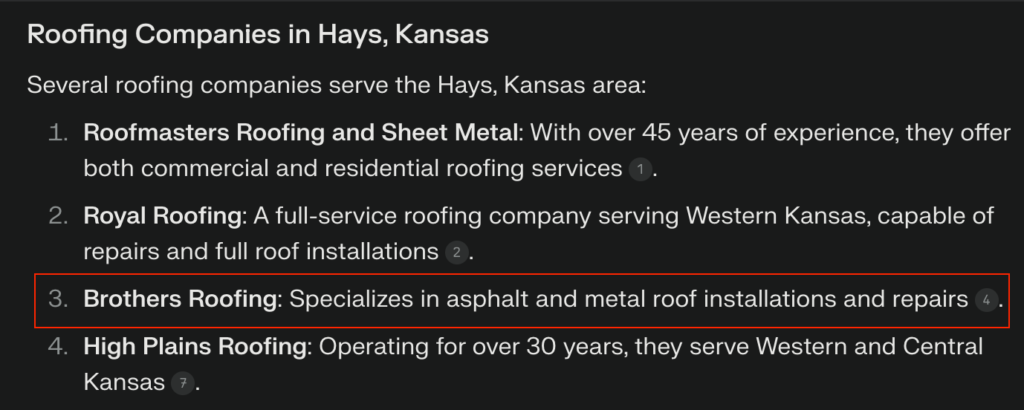

Screenshot of Perplexity AI Roofing Company Answer

source: Perplexity


Google AI Mode

Like Google AI Overviews, AI Mode is powered by Gemini but, in this instance, is separated from standard Google search results.

AI Mode is likely to become Google’s default search engine sometime in 2026, a sign of things to come for an evolving search landscape.

Below, you can see Google AI Mode recommending a local roofing company that provides mechanical lock metal roofing services.


Grok

Grok’s 64 million monthly active users position it as a leader in AI search relevance across all industries, including local roofing services.

Below, you’ll notice Grok recommending a silicone roofing contractor in a specific city.
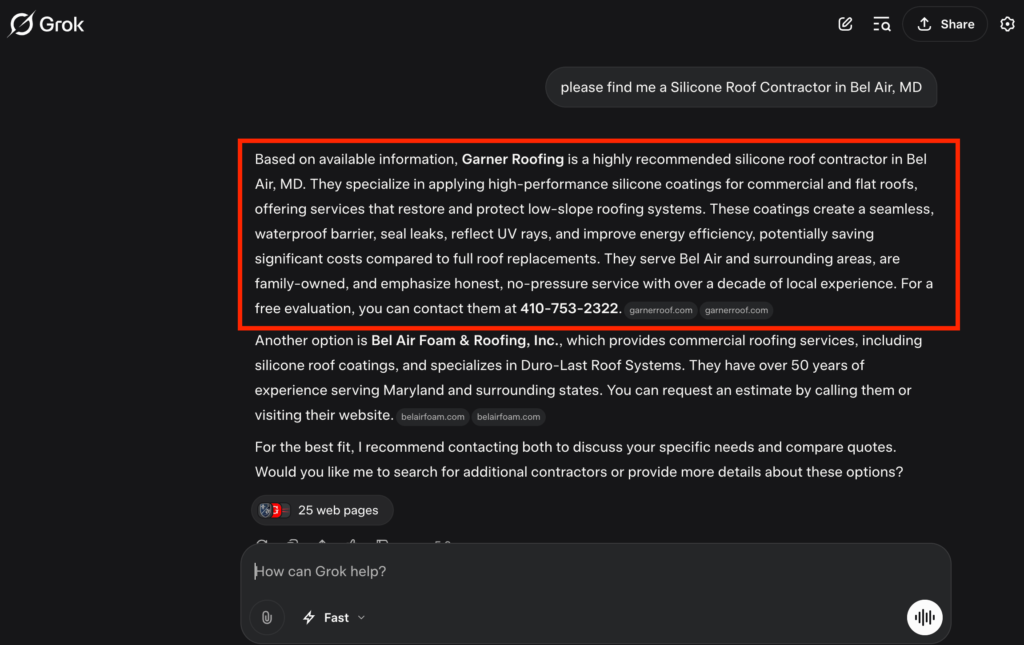


source: Grok


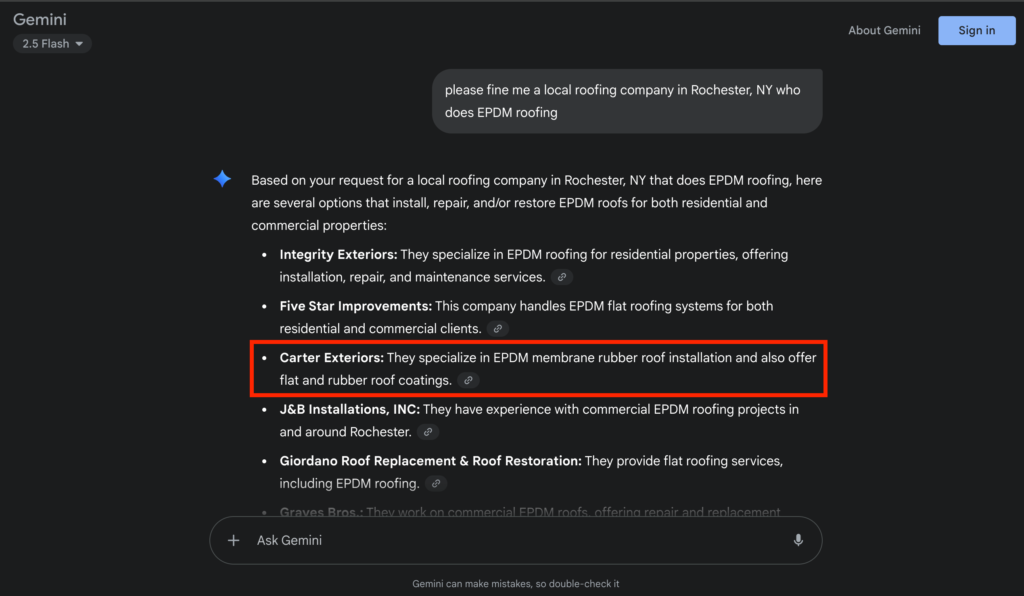
Gemini

Google Gemini powers both AI Overviews and AI Mode, and also serves as a standalone AI platform comparable to ChatGPT.

Below, you can see a local roofing company mentioned in the Google Gemini interface, separate from AI Overviews and AI Mode.


Claude

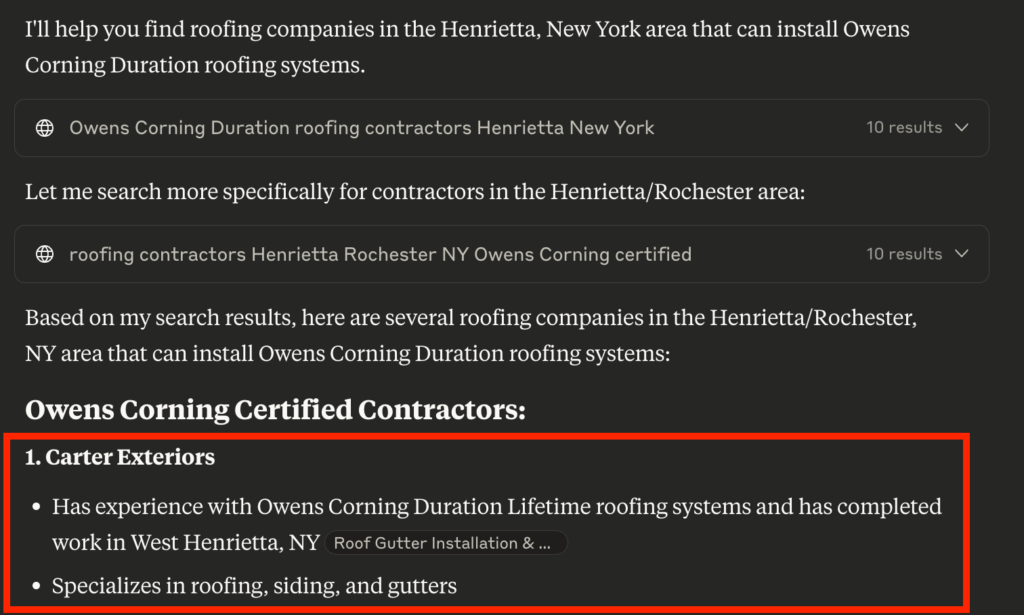
Anthropic’s Claude has nearly 30 million monthly active users and continues to grow at a rate that local roofing companies should monitor.

The example below showcases Anthropic Claude generating a local roofing company in its answer to a question about a specific type of shingle installation.


ChatGPT

With over 900 million monthly active users, ChatGPT has become a “household name” for most consumers and one they are increasingly utilizing to find, compare, and research roofing companies.

You can see ChatGPT recommending a local roofing company as its “top recommended contractor” based on a specific recent project demonstrated on the roofing company’s website.


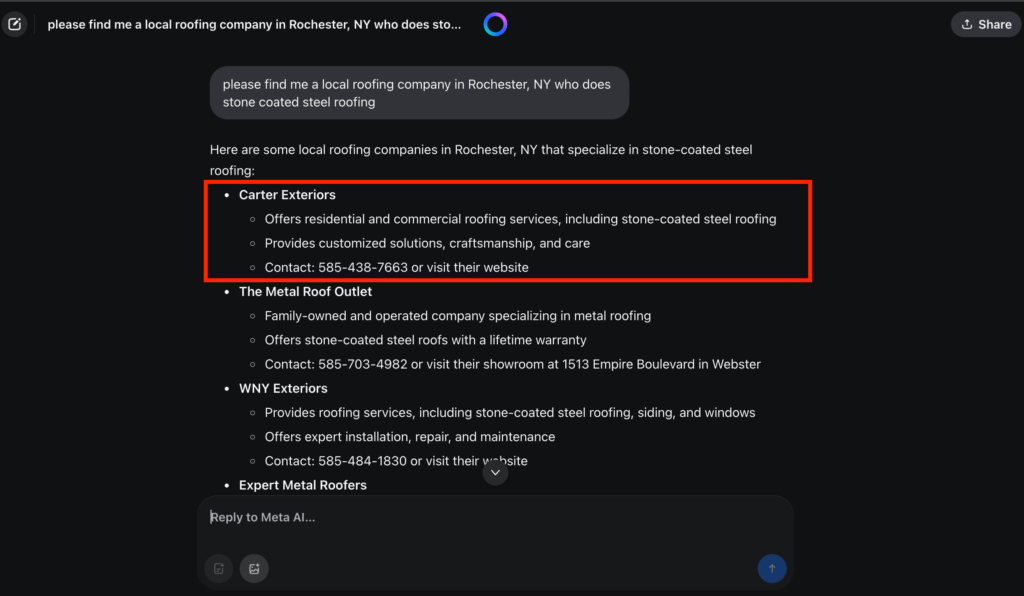
Meta AI

Meta AI has surpassed 1.2 billion monthly active users thanks to its integration across multiple apps, including Facebook, Instagram, and WhatsApp.

You can see Meta AI suggest a local roofer for a specific query and outline the company’s services and contact information.


Using AI-targeted optimization, your local roofing company can also appear in these types of AI answers.


Optimizing for AI Training Data

In a study by Rand Fishkin of SparkToro, he describes brand mentions in training data as the critical factor for appearing in AI and LLM answers.


AI Training Data Explained for Roofers

LLMs are primarily trained on internet data, such as web pages, articles, lists, and directories. As a result, your roofing company’s website and listings on major directories may be used as training data.

Most AI platforms use “grounding,” which means accessing the live web to find the most recent results, but a presence in their pre-existing training data can still provide an advantage in AI search visibility.


Maximizing Training Data Mentions

The first step to being included in training data is to make sure your website is crawlable by AI crawler bots like GPTBot and ClaudeBot.

Depending on your DNS settings and firewall, your site may automatically block AI bots, preventing it from being used for training data.

One way to check this is a analyze your website’s log files, which you can outsource to a credible marketing agency.


Assuming AI bots are crawling your site, your traditional SEO efforts serve as a foundation for training data.

For example, having an official company website, a Google Business Profile, and listings on other directories like Yelp and BBB all contribute to your chances of appearing in AI-generated answers.

We’ve also found that our software tool, DataPins, which allows you to showcase recent roofing jobs directly on your website with descriptive job captions, is leading to direct citations in some AI responses.

The goal is for AI platforms such as Google Gemini, Claude, Grok, Perplexity, and ChatGPT to be trained on your specific jobs rather than on generic, commodity content.


Optimizing for Generative AI Features

Google has published official guidance on optimizing for generative AI features, which calls for applying foundational SEO best practices, such as creating valuable content and maintaining a clear technical structure.

While that document comes specifically from Google, the underlying principle, that foundational content quality drives AI visibility more than tactical “hacks,” holds broadly across platforms like ChatGPT and Perplexity, based on our own research.

Here are some of the strategies we’ve seen success with when optimizing for generative AI features:


Create Valuable, Non-Commodity Content

Your roofing website should only feature valuable, non-commodity content, meaning pages and posts that provide a unique perspective rather than regurgitating content from around the web.

Most SEO guides have outlined the importance of natural language processing for Google optimization, and the benefits of using concise, direct language extend to AI mentions as well.

To make it easy for LLMs to mention your web content within their answers, you provide them with language that matches common user queries and summarize it in a direct, concise manner.


Earn Listcale Mentions (High-Risk Tactic)

Many popular AI platforms (notably Google AI Mode and ChatGPT) directly cite lists when providing answers about the best roofing companies in a specific city or region.

You’ve probably seen lists on Google search results titled “10 best roofers in Dallas, TX” and other cities, and those are the types of lists AI is currently citing when “ranking” roofers.

3rd-party lists are far more influential than first-party lists (ranking your own company on your own website), and the latter looks very much like spam, something you should avoid in general.

Creating listicles at scale almost certainly violates Google’s spam policies, and recent industry studies have found correlations between sites that publish these listicles and significant drops in their organic search traffic.


Earn Company Reviews

It’s also evident that AI platforms are pulling customer reviews from platforms such as Google Business Profile, Yelp, and Facebook.

Google’s AI Mode will directly cite Google Business Profiles, while ChatGPT may cite Yelp and Facebook reviews.

Google’s official documentation mentions optimizing your local business and states that Google Business Profiles can help make your services visible in AI responses.


Become Agent Accessible

AI agents can perform tasks on behalf of people, including comparing quotes between roofing companies and even booking services.

There are web design principles that help AI agents navigate your website, such as ensuring a stable layout, avoiding “ghost” elements, and using semantic HTML.

Consult with Google’s guide to build an agent-friendly website to learn more about the specific elements.


Moving Forward With AI SEO for Roofers

AI’s impact on search engines is significant, with Google’s AI Overviews directly integrating into daily search engine results.

Roofing companies that have already invested in the best SEO practices are positioned to benefit from exposure on AI platforms and large language models (LLMs).


For nearly two decades, my agency, Roofing Webmasters, has helped thousands of roofers navigate the evolving landscape of digital marketing.

My goal is to help your local roofing company thrive in the age of AI search, AEO, and LLMs with forward-thinking strategies that adapt to modern search technology and user behavior.

To further discuss AI search and its impact on your roofing business, call me on my personal cell at (800) 353-5758.


Nolen Walker

Author: Nolen Walker

Nolen Walker is the founder of Roofing Webmasters and the creator of DataPins™, a Local SEO platform for roofing companies. He has over 16 years of experience helping roofing businesses grow through organic search, Google Maps, and AI-driven visibility.

Nolen is the author of A Complete SEO Guide for the Roofing Small Business Owner. He also hosts The Roofing SEO Podcast on Spotify.

Posted: | Updated: May 18, 2026 | Categories: Uncategorized

300 Roofing Blog Topics + Ideas (w/Free Download)


The best roofing blog topics come from your personal experience and expertise as a roofing professional.

For example, you may have unique insights into how your local climate impacts roof material degradation.

Perhaps you’ve tracked internal data on the lifespan of roofing systems in a particular zip code.

These organic topics, based on first-hand experience, form the foundation of ideal blog posts.

The goal is to inform your audience with unique and original information.

As a long-time SEO agency owner, I strongly advise against the mass production of blog posts on your roofing website.

Google’s most recent content guidelines stress the importance of content that adds unique value.


Roofing Blog Topics (Blog Cover)

Here are 300 blog post ideas for roofing companies.


(Download The Full List of 300 Roofing Blog Topics)


The 10 Best Roofing Blog Topics

After you download the complete list of 300 blog topics above, it’s time to publish your first post. Remember that you can alter the titles of these posts, add local context, and sprinkle in some of your personal insights. 


Below are the top 10 roofing blog topics to get your website started on the right note:


1) I Tested 5 “Miracle” DIY Roof Sealants: Here’s What Happened

A recent study from Zyppy found that websites with articles that used “I” performed better after recent algorithm updates.

Roofers who speak in the first person provide first-hand value to readers.

An article detailing your tests of overhyped products is an effective way to build goodwill with consumers.


2) Neighborhood Case Study: (Your Town’s) Most Popular Roof Systems

Location-specific blog posts attract the right types of backlinks for your website.

The key is creating local content that is unique and engaging.

A neighborhood case study will likely be the first blog post of its kind and will feature findings that only you and your staff can access.


3) My Lessons Learned from Decades of Ice Dam Removals

As we witness more Reddit threads appear in search results, it’s clear that users are looking for first-hand experiences.

What better way to demonstrate yours than with a retrospective of your 10+ years of ice dam removals?

Any blog post that contributes unique insights will outperform regurgitated articles.


4) The History of Roofing Styles in (Your State)

Realistically, a roofing blog topic has little chance of going viral.

However, your one chance is to write a historically accurate blog post based on research and experience.

The key is writing a post about your primary service area to attract links from local reporters.


5) Study: (Brand Name) Roof Coatings Extend Lifespan by 10 Years

Data-driven assets are another excellent option for blog posts. These articles not only help attract links but also reflect favorably on your company and website.

As a professional roofer, you likely have access to data that non-professionals do not.

Publishing this data (when appropriate) is one of the most effective ways to build your brand.


6) Confessions of a Storm Chaser: How it Almost Ruined My Roofing Career

Consider writing a blog post that reads almost like an autobiography.

While not all roofing contractors have the most exciting career trajectory, some, including former storm chasers, have some crazy stories.

Take Google’s advice by writing for users rather than search engines, and reap the rewards of building an authentic connection with your readers.


7) Ask a Roofer Anything: Answering My Most Common Questions

Reddit is famous for AMAs, which stands for Ask Me Anything.

People of influence typically host these threads (sometimes celebrities) that garner a lot of questions from other users.

As a blog post, you can apply this same concept to the roofing industry.

Answer your customers’ most common questions for publication.


8) Insurance Claim Success Rates in (Your City)

If you’ve heard the phrase “informational query,” it sounds more complicated than it is.

Publishing a post about the insurance claim success rates in your service area is a great way to attract clicks for those query types.

You likely have data about the success rates that you can share with your website visitors.

This is precisely the type of blog post that Google (and its users) want to see in 2025.


9) Analyzing Manufacturer Warranty Trends Over Time

Evaluating trends is another great angle to take for a roofing blog topic.

Like many other topics on this list, trend articles attract high-quality links.

Furthermore, they allow you to demonstrate expertise in your field, which helps establish your brand and local presence.


10) Tracking The Impact of Roof Materials on Indoor Sound Levels

While roofing may seem boring to the average Google user, its impact on their daily comfort is much more intriguing.

With this in mind, publishing a post about the impact of roofing on noise pollution is bound to get attention.

Remember to address the user and not write for search engines.

Talking directly to your readers helps establish a rapport that will bode well for your company’s long-term trajectory.


Blog posts that address a customer pain point relating to one of your primary services, like hail damage or roof repair, help build relevant topical authority for your high-conversion service pages.


Roofer Blog Post Screenshot

Blog Topics Alternatives for Roofers

Websites collectively publish around 7.5 million blog posts daily. Yet, nearly 96% of all content gets zero traffic from Google. The reality is that most of your blog posts are ineffective and fail to improve your website’s Google ranking or attract new customers to your roofing business. 

One great alternative to blogging is DataPins. The DataPins tool allows roofers to snap photos of each job, write a short caption, and auto-publish the pin to their corresponding website page. 

In addition, the pins are wrapped in schema markup and geo-coordinates to validate the job’s location. This combination of relevant data easily overpowers blog posts.


Why DataPins Outperforms Blog Posts

When users seek roofing services online, they don’t care to read a 1,200-word blog post written by the English major your marketing company hired to regurgitate someone else’s article. 

Nobody cares, and they never will. What consumers actually want is E-E-A-T, expertise, authority, and trust. Blog posts don’t provide E-E-A-T, but pins do. More importantly, pins keep your pages fresh and updated with legitimate proof of your work rather than garbage blog posts.

DataPins creates pins that include natural long-tail keywords from your captions and the overall context of the job. For example, a recent Ahrefs study proves that nearly 50% of all Google clicks are hidden queries, meaning Google did not register the particular click with a corresponding query.

Most hidden terms originate from long-tail keywords and those that fail to register a baseline search volume. Still, these queries are critical, as evidenced by their share of queries for all Google searches. 

DataPins helps you rank for these hidden terms, which generate higher click-through rates, conversions, and more overall clicks compared to sites that only target measurable queries.


Feel free to utilize our download on blog topics for roofers to craft posts for your company website.

However, remember that the best roofing blog ideas come from DataPins, which auto-generates E-E-A-T content for your website, captures rankings for hidden terms, and drives new business to your roofing company.


Facebook (Meta) Ads for Roofers: The Ultimate Guide


Facebook (Meta) Ads have evolved from a luxury promotional item for local roofing companies to a foundational component of your digital advertising strategy.

While Google remains the top lead source for homeowners actively seeking roofing services, Facebook is the premier channel for reaching homeowners before they advance to a deliberate selection process.

In today’s competitive search landscape, heavily influenced by AI, local roofing companies must be proactive by investing in a Facebook Ads campaign to generate leads before competitors capture them.

The following guide from Roofing Webmasters will outline how roofing companies can maximize their performance with Facebook Ads.


Roofing Facebook Ads (Guide)

Key Takeaway

Roofers succeeding with Facebook Ads leverage the platform’s AI by providing it with high-quality creative assets and allowing it to identify homeowners who need their roofing services.


How Facebook (Meta) Ads Work for Roofing Companies

Manually targeting Facebook users through your advertising platform is an obsolete practice. Roofers succeeding with Facebook leverage thAdvantage+ AI Audience to find the ideal users to display their ads to.

That shifts the focus from who you target to what you provide Facebook to work with, such as high-resolution images, diverse headlines, and a unique value proposition for potential customers.


AI-Powered Location Targeting

Provide Meta with a broad 15-20 mile radius around your primary city, and their AI will analyze real-time behavioral signals to serve your ad to users with the highest conversion probability.


Advantage+ Creative Automation

Roofers are no longer tasked with creating five separate ads and manually testing their performance.

Your primary goal is to provide Meta with high-quality assets, such as photos, videos, and headlines, and they will mix and match them to serve the ideal ad to the ideal customer.


Getting Started With Facebook Ads for Roofers

Automated Lead Generation is the appeal of Facebook Ads for roofers, and utilizing Meta’s AI to identify homeowners is the way to achieve this affordably and at scale.


Choosing The Leads Objective

Meta provides six options after you select the green “Create+” button. As a local roofer, you can ignore the other options and select Leads.

Once selected, choose Instant Forms as your Conversion Location. This keeps the user inside the Meta app (typically Facebook or Instagram) and pre-fills their contact information.


Choosing a Performance Goal

Most roofers should select “Maximum number of leads” to start, as it generates the most volume and lets you get a feel for demand in your service area.

However, roofing companies that use the Conversions API (CAPI) to connect their CRM to Meta can select “Maximum number of conversion leads,” which targets prospects most likely to schedule a service.


Set up Your Advantage+ Perimeter

Look for the “Drop Pin” or “Address Search” tool in the Ad Set under Locations to set your primary location.

From there, use a 15-20-mile radius to give Meta’s AI a large enough pool of people to identify patterns and trends.


Here’s an example of what your Ads Manager screen should look like:


  • Location: Office Location + 20 miles (Hard Boundary)
  • Age: 40–65+ (Hard Boundary)
  • Advantage+ Audience: ON (AI has freedom within the radius)
  • Suggestions: Home Improvement, Residential Area (Optional hints for the AI)
  • Exclusions: Existing Customer List

Build Your Instant Form

Select “Higher intent” as your form type to filter out accidental clicks. From there, add a Custom Question to qualify the lead, such as “Are you a homeowner?” or “How old is your current roof?”

Remember to link to your website’s privacy policy so it does not get flagged by Meta’s compliance engine.


Upload Your Creative Assets

To get started, upload one video of you or your team on a roof, and one before-and-after photo. Meta will dynamically swap your headlines and placements to learn which perform best.

Hit “Publish” to push your ad into the 48-72 hour learning phase, where the AI identifies the first pool of high-conversion homeowners within your radius.


Best Practices for Facebook Ads for Roofers

Success with Facebook Ads relies on creative quality, which empowers the AI to maximize its impact. Keep in mind that creative quality is not merely about “looking good,” it’s about feeding the AI enough detailed information about your business and its services.


Below are some of the best practices for Facebook Ads:


Direct-Response Copywriting

Lead with a specific pain point, such as “Hail season is here,” then follow with a benefit and an instruction such as “Get Quote.”

Make sure to include roofing-specific language, such as roof replacement and storm damage, to feed the AI, rather than relying on puns or vague generalities.


High-Signal Visuals

Image quality matters (choose high-resolution photos), but authenticity is equally important for your ad’s performance.

A 15-second video clip from your smartphone can perform just as well (or better) than a polished brand photo if it speaks directly to the consumer’s needs.

This is where video clips of real roofing jobs shine, as they offer a refreshing change from the flood of stock photos homeowners encounter online.


Verified Social Proof

AI has made consumers question the validity of most claims, making authentic, verified social proof more essential than ever for brand trust.

Use a screenshot of Google Reviews rather than typing out their content, or better yet, feature a 30-second clip from a real customer praising your services.

Social proof is all the more potent when it’s location-specific, which is why user-generated content (UGC) that mentions specific cities, towns, neighborhoods, and subdivisions tends to perform well.


Prioritize Reels

91% of Americans own a smartphone, which means the average Facebook user is consuming vertical videos, otherwise known as Reels.

Your clip must show value within the first 3 seconds to keep the user’s attention, and it must rely on visual over audio, as most users browse with the sound off.

Meta will typically generate captions for your videos, but it’s important to double-check their accuracy.


Final Thoughts on Facebook Ads for Roofers

Facebook (Meta) Ads have evolved from a luxury item for local roofing companies to a foundational advertising component. With that said, success is rarely achieved with a single ad, but instead through the integration of local authority and AI-driven targeting.

Roofers may find it challenging to resist the instinct to micro-manage their Facebook Ads campaign, but the Advantage+ algorithm drives performance in ways that no human can replicate.

Setting your geographic perimeter and providing high-quality creative assets empower the AI to maximize your campaign and identify homeowners as they require your services.

As consumers grow more skeptical of roofing providers, hyper-local Meta Ads are an effective way to break through and reach your target customers on their platform of choice.


Nolen Walker

Author: Nolen Walker

Nolen Walker is the founder of Roofing Webmasters and the creator of DataPins™, a Local SEO platform for roofing companies. He has over 16 years of experience helping roofing businesses grow through organic search, Google Maps, and AI-driven visibility.

Nolen is the author of A Complete SEO Guide for the Roofing Small Business Owner . He also hosts The Roofing SEO Podcast on Spotify.

Posted: | Updated: Apr 10, 2026 | Categories: Facebook

17 Great Ways To Get Commercial Roofing Leads


Commercial roofing leads are extremely valuable because they generate the highest-ticket jobs in the industry.

Most commercial roofing keywords are also easier to rank than residential ones because fewer companies target them through SEO and content marketing.

So, while the traditional roofing lead generation methods typically apply to residential jobs, executing a custom strategy to generate commercial roofing leads can quickly yield results for your company.


Targeting a commercial audience for leads requires a different mindset and strategy. You must identify which sub-services within the commercial roofing category, like TPO, EPDM, and coatings, are worth targeting online.

With this in mind, Roofing Webmasters has crafted a helpful list of 17 practical commercial lead-generation strategies.


Commercial Roofing Leads (Blog Cover)

Idea #1: Create a Commercial Roofing Lead Generation Process

Buying leads from other companies can only take you so far as a business. You cut out the third party when you craft your own lead generation strategy.

The best way to get commercial roofing leads is to create a branded online presence with a custom website and organic SEO.

You have a major advantage over startups if you already own a domain name and a Google Business Profile.


You can hire a website design and SEO agency to optimize your website and start ranking for various commercial roofing keywords.

Adding new content to your website allows it to rank for more commercial roofing terms on Google.

Furthermore, website content also helps your Google Business Profile rank in the Local Map 3-Pack for those same terms.


Your listing may even showcase that you offer a specific commercial service with what is known as local justifications.

If you don’t currently have a domain name or GBP, you should grab them ASAP. A domain name can cost as little as $9.99 annually, while a Google Business Profile is free to claim and optimize.


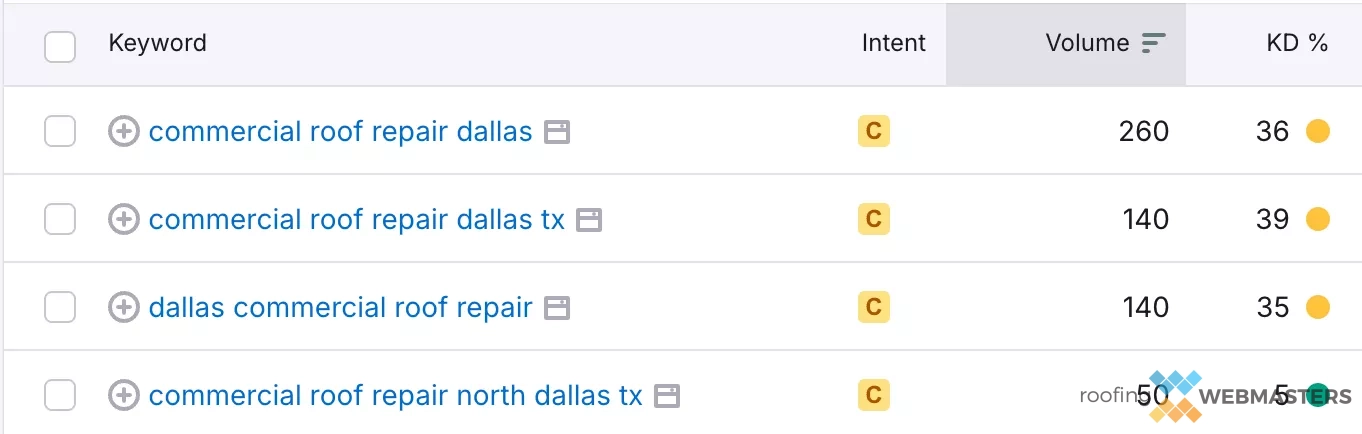
Keyword research tools let you measure the search volume and difficulty of various commercial roofing keywords.


Commercial Roofing Keyword Research on SEMRush for "Commercial Roof Repair Dallas"

Idea #2: Perform Competitive Analysis

One of the fastest ways to identify roofing lead generation opportunities is to compare your strategy with your competitors’.

Marketing research unlocks your target competitor’s strategy. Staying up to date with modern concepts enables your business to tackle new ideas confidently.


Now, this inspiration can come from competitors both on a local level and at a national level.

First, focus on keyword research for your local area (e.g., “commercial roofing repair in San Jose, CA“).

While there’s a lingering temptation to target national-level keywords immediately, local businesses are typically your most important competitors.


Second, a competitive analysis gives you the threshold you’ll need to beat to rank in Google search.

Google will tell you which websites they value by their rankings. Search Google for relevant terms like commercial roofing services and commercial roof repair to find websites producing results.


Top-ranking roofing websites share common traits you can reverse engineer for your strategy.


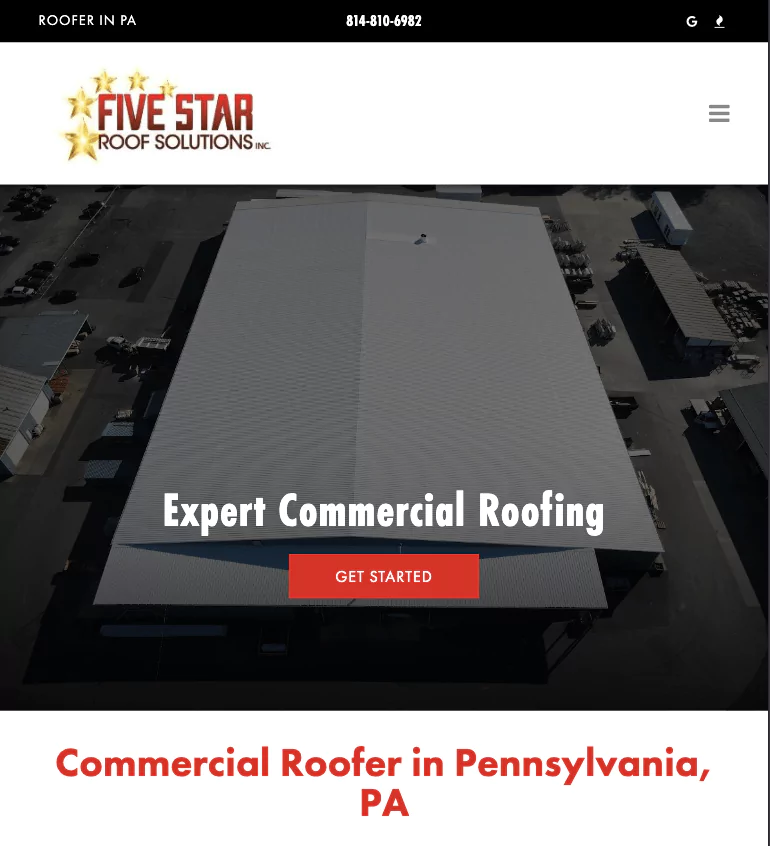
Commercial Roofing Website Example

High-Ranking Experts Outside Your Service Area Can Still Offer Valuable Insights


Idea #3: Study Top Local Opponents

Do you ever wonder how those lucky few in the local pack managed to secure their spots? Google’s local algorithm is based on proximity, relevance, and prominence.

So, even before starting a more in-depth inspection, we know these top performers have thoroughly completed their Google Business Profile.

As we’ve mentioned in our podcasts, you don’t have to be perfect to compete in roofing SEO. You only need to be better than everyone else in your service area.


Start by crafting a simple baseline strategy that most of your competitors follow:


  • Do they showcase recent jobs, award badges, etc?
  • What keywords are they using?
  • How old is their business?
  • Do they offer insightful pages for each service they provide?
  • Is their website design straightforward and easy to navigate?

Idea #4: Study Dominant Commercial Roofers Throughout the U.S.

Don’t limit your research to roofers in your immediate service area. Go ahead and expand your competitive research to other high-ranking businesses in your state (or even beyond).

See if you spot new keyword combinations and helpful design features that your local rivals haven’t adopted yet.


These could be some powerful tools for earning commercial roofing leads. You can even analyze major industry publications for ideas.

Magazines are especially adept at crafting “listicle” articles, which rank for dozens of relevant keywords.


These resources provide valuable insights and guidance for potential commercial clients and drive significant traffic to your website.

While there are many paths towards ranking #1 in Google, a listicle could earn you a featured article slot.  That’s one of the most prestigious awards and positions Google awards in SERPs.


Idea #5: Beat Your Competitors’ Baseline

Examine website design, advertising platforms, and the quality of content marketing. Are they focusing on Google Ads or spreading their budget through multiple channels?

It’s easy to tell how much effort a company puts into a website, but it might take some keyword searches to find where they advertise.


There are a handful of tools most businesses can use to get ahead:


  • Diversified Keyword Strategies
  • Schema-Rich Website Design
  • Consistent, Diverse Reviews Collection
  • Ongoing Content Production

Remember, you’re going up against experienced companies. They probably already have a handful of very positive reviews and a decent website backing them up.

You have to top these businesses, not just imitate them.

You must be willing to go the extra mile while providing the excellent services that all long-term successes do.


Idea #6: Low-Cost Social

If a channel provides commercial roofing leads at a low cost, why not give it a try? That’s the logic that’s driven thousands of companies toward social media.

While homeowning consumers are particularly keen to explore social media for their essential roofing services, commercial organizations aren’t far behind.

Your roofing company’s social media profile offers an open invitation to anyone curious about your brand.


Are your social accounts encouraging new commercial roofing leads or preventing them?


Key Facets of an Optimized Facebook Business Profile:


  • Up-to-date Contact Information
  • Tactfully Answered Client Reviews / Recommendations
  • Clear Calls to Action
  • Relevant Pictures
  • Links to the Main Company Homepage
  • Posts with Pictures of Your Recent Work
  • A Well-Written About Page

Facebook business pages are free, so it’s a low-risk investment for commercial roofers. At the very least, Facebook pages help build your brand and accumulate positive feedback about your business.

Facebook business pages contribute to E-E-A-T, increasing brand awareness and conversion rates.


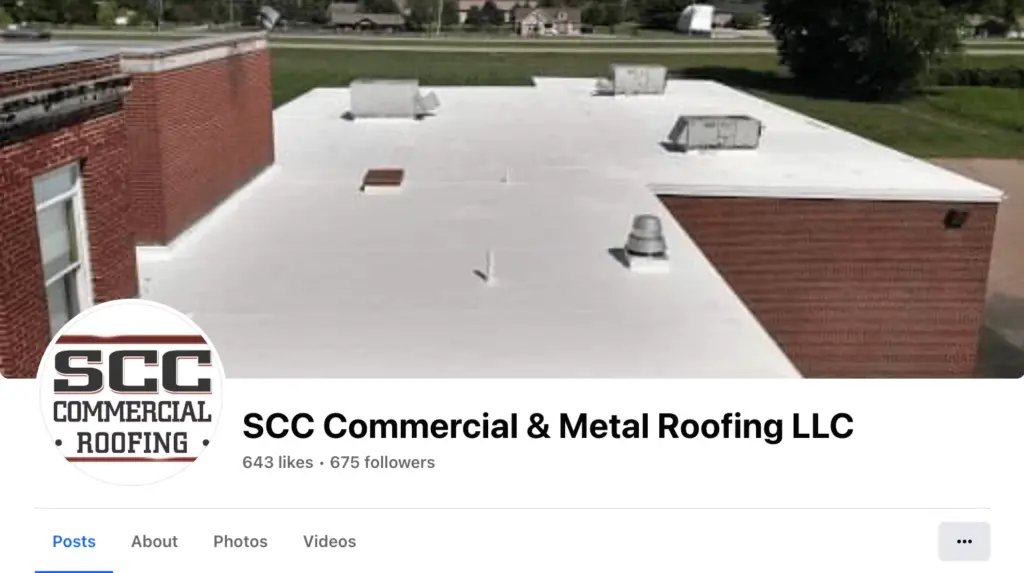
Screenshot of Facebook Business Page for Commercial Roofing Company

Is Your Facebook Business Page Ready to Take on Commercial Roofing Leads?


Idea #7: Rank on AI Search

Every commercial roofing job should expand your marketing reach by optimizing your company and website for AI search or GEO, AEO, etc.

More users are adopting AI platforms such as Google Gemini, ChatGPT, and Perplexity, which means showing up there can increase your lead volume.


Most of your standard SEO strategy translates to AI optimization, but there are additional things you should consider, such as query-fan-out optimization.

For example, AI platforms break down a user’s prompt into 8 or 9 subqueries, which are searched simultaneously before being synthesized into an all-encompassing response.

You can optimize for these subqueries by adding more details to your service pages and writing in an NLP-friendly format that AI crawlers can easily parse.


Your online reputation, including reviews on your Google Business Profile, also influences how much or how little you appear in AI-generated answers.


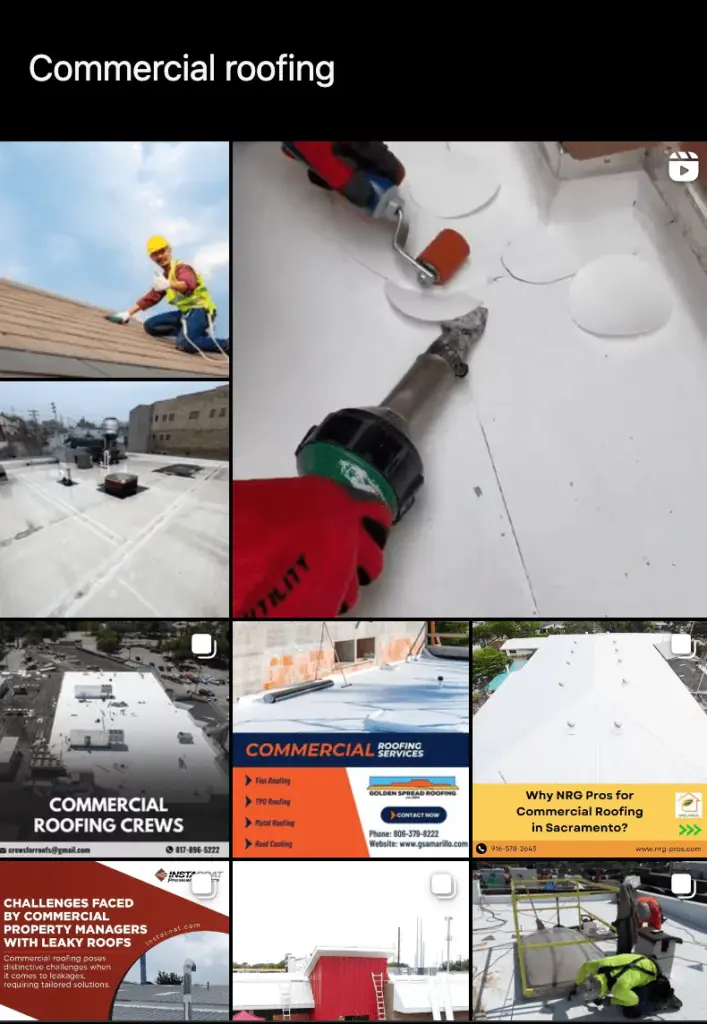
Idea #8: Get Hyper-Visual With Instagram

As Facebook’s more visually oriented sister platform, Instagram offers incredible opportunities to generate commercial roofing leads. It’s the perfect place to showcase your team’s craftsmanship and handiwork.

Posts use images or videos, with captions that offer space for relevant keywords. According to Statista, Instagram’s user base in the U.S. alone is 181.75 million.


Let your custom photos tell the story of an expert roof replacement or original installation.

You can spend a little time each month uploading quality photos and videos from your latest projects. Try to paint a broad picture of your team’s commercial work.

Promote your most compelling work into custom ads. Instagram is becoming increasingly essential as younger generations climb the workforce ladder.


Having a presence ready for them will undoubtedly funnel some commercial roofing leads your way. Instagram is a great platform to showcase images of your staff, jobs, trucks, and equipment.


Screenshot of "Commercial Roofing" Topic Within Instagram's Explore Feature

Idea #9: Expertise Branding

There are thousands of commercial roofing companies. What separates your brand from the rest?

Perhaps you’re a seasoned expert in metal roof construction, but (again) many roofers offer metal installation. Does your logo stand out?


Presenting that expertise can make all the difference in generating commercial roofing leads. Turn your expertise into a branding tool for your business.

The goal is for search engines and AI platforms to associate your company’s name with specific qualities, something you can achieve by publishing original content in multiple formats, including video.


Idea #10: Advertise Your Employees

Your top roofing professionals are more than just employees. They’re the face of your company. Please think of the countless roofing projects they’ve installed, repaired, and restored over the years.

Instead of promoting a service, what if you boosted the seasoned professionals behind the service?


Take a little talent inventory to see what sort of experience you could showcase.

This advertising method isn’t for businesses with constantly shifting personnel, but is perfect for companies with many long-time employees.

Try going beyond the traditional “About Us” or “Meet the Team” pages and linking your employees directly to their areas of expertise.


Do you have a green roofing pro that you’re incredibly proud to call an employee? Tie them into a relevant service page and sprinkle in some related keywords.


Idea #11: Turn Expertise Into Content

Your seasoned roofing professionals have a wealth of insight to offer.

They’ve probably answered the same old questions hundreds of times, making them an excellent resource for lead-driving content.

You don’t need them to write a 5,000-word blog post, but they probably have some interesting facts and quotes to enrich your next how-to article.


Take 10 to 15 minutes. Have your content writer and project expert discuss the most common questions your commercial roofing leads ask.

Whether it’s metal roofing or PVC installation, your roofer’s expertise offers fresh insights that rank well in local searches.


Present it in an optimized format, and chase after those featured snippets we discussed earlier. Add your roofer’s name and bio to the publication when the article is ready.


Idea #12: Promote Your Content

Articles, guides, and how-tos all have a lifespan of their own. How you manage that content over its lifespan ultimately determines the traffic you get from it.

If you want to generate more traffic and commercial roofing leads for your business, try harnessing your best content as an advertising tool.


There are so many ways to advertise and promote your content:


  • Share them as downloadable e-books on & off your website
  • Promote the content on Facebook
  • Create Instagram stories
  • Could you share them with an industry publication?

Idea #13: Hunt the No’s

Understanding why people turn down your outstanding services is essential to persuade them in the future.

We all have our reasons for saying “No.” Whether the root lies in fear, distrust, or simple confusion, there are ways to overcome initial disinterest.


Hundreds, sometimes thousands, of consumers come across your website daily, but commercial clients often have different reasons for saying the big “No.”


Reasons Commercial Prospects Say “No”

  • Their company budget can’t handle an expensive roof service.
  • They need further encouragement that your company is the right choice.
  • They aren’t in the purchase phase of their study.
  • There’s a negative perception that your company must overcome.
  • There’s confusion or uncertainty regarding the right solution.

You can address many of these potential “no” sources within your website design and local search content.

Roofing companies unknowingly create all sorts of reasons for doubt as they promote their services.

Grammar errors, unnecessary jargon, and a lack of clear descriptions establish more distance between your readers and their destiny as commercial roofing leads.


Idea #14: Eliminate Fear of Uncertainty

There are dozens of facts, points of comparison, and internal company matters to consider when a business needs a new roofing system.

All those considerations add to a lot of uncertainty, naturally creating resistance to big purchases. Think of every concern as a brick that lies between your prospect and saying “yes” to a new roof.


What if you could eliminate most of that uncertainty?

The process begins with your company providing clear and consistent information.

Where does your service area lie? Does your roofing team provide the necessary solution and requisite experience to perform the job?


Answer these questions directly (and honestly, of course).

Many businesses unintentionally confuse would-be clients by mixing up their service hours and solutions across their various listings.

While updating their website or Facebook page regularly (for instance), they may neglect other sources you can maximize.


Idea #15: Minimize Fear of Loss

A commercial roof replacement is more of a fleeting expenditure. It represents a significant investment in a building’s energy efficiency and weather protection.

For some, a replacement also means substantial disruption to day-to-day operations.


When the time finally comes for a business to undergo this critical project, there’s no room for error or wasted effort.

Your business can take many steps to mitigate potential clients’ fear of loss. The most potent tool is feedback from past customers.


Homeowners and business owners alike increasingly rely on online reviews and word of mouth when making decisions about essential services.

Half of adults under 50 consulted online reviews before purchasing (Pew Research). 

Continue asking businesses for reviews after each project, and you’ll notice that commercial roofing leads are much more likely to convert.


Generous warranties and careful expectation setting further turn “No’s” into clients. Take some time to establish the time and resource requirements of your project.

You’d be amazed at how much clients appreciate this and how often it appears in reviews.


Idea #16: Identify Losing Content

Local SEO is an ongoing process. That’s particularly true for promoted business practices regarding website content and keywords.

A page that ranks at the top of local search results today may require serious updates to maintain that position down the road.

That’s why continued research into Google Analytics is essential for your website.


Take time every quarter to inspect your website metrics and identify underperforming pages. 


This content may show a few signs of decay:


  • Lowered page visits over time
  • Increasing bounce rates
  • Increasing exit rates
  • Dropping time on page

When you discover a weakly-performing page, please don’t rush to scrap it. Some of the most value-driving industry content comes from repurposed, consolidated, and re-released pages.

You can use premium guides from past years, update them, and watch the commercial roofing leads come in.


Idea #17: Experiment With CTAs

Your calls to action (CTAs) have much more power than you realize.

In a series of fantastic CTA case studies, Moz showed that changing a call to action’s offering, hook, or phrasing can turn a dormant page into a highly productive lead-generation tool.

If you are unfamiliar with the science behind CTA design, you need to read these fantastic resources.


Calls to action rely on four key elements:


  • Clarity on the services offered
  • Placement on the page
  • Timing in the user’s buying cycle
  • Motivation to answer the call

A well-crafted CTA acknowledges where a potential user is in their buying cycle while clearly outlining the value of the services.

It stands out from the rest of the page, and users experience little friction in answering the call. Experimenting with new CTAs offers opportunities for significant improvement in conversion rates.


How can you reword your call to action to turn interested readers into commercial roofing leads? Do your downloadable resources provide enough value to deserve a company’s email?

These are the sorts of questions you’ll need to ask as you experiment.


Find Your Commercial Roofing Leads

Need help generating leads for your commercial roofing business? Our team at Roofing Webmasters would love to partner with your team to produce results.

Our current clients enjoy fantastic Google rankings and visibility on AI Platforms like Gemini and ChatGPT, which help them attract consistent traffic and more commercial roofing leads.


Nolen Walker

Author: Nolen Walker

Nolen Walker is the founder of Roofing Webmasters, assisting roofers with SEO and digitial marketing for 16+ years. Nolen is also the creator of DataPins™ and author of A Complete SEO Guide for the Roofing Small Business Owner . In addition, Nolen hosts The Roofing SEO Podcast on Spotify .