
Roofing SEO is the process of optimizing your website, Google Business Profile, and broader web presence so that your company appears prominently in search results when potential customers search for roofing services in your area.
Optimization tasks include editing title tags, refining keyword placement, building internal and external links, improving site speed, and maintaining accurate business listings across directories. Any activity that increases your organic search rankings, impressions, or clicks qualifies as a form of SEO.
SEO applies across multiple surfaces: your company website in traditional organic search results, your Google Business Profile listing in the Local Map Pack, and, increasingly, AI-generated answers on platforms like Google Gemini, ChatGPT, and Perplexity.
TL;DR: Key Findings:
- Roofing SEO increases organic visibility on Google Search, Google Maps, Google AI Overviews, and AI platforms like ChatGPT Search and Perplexity without paying for ads on a per-click basis.
- Local SEO, specifically Google Business Profile optimization and NAP consistency, is the highest-leverage starting point for most residential roofers.
- Google operates exclusively on mobile-first indexing as of July 2024, meaning your mobile site is the version Google uses to rank you.
- Google’s official performance benchmark for page loading (Largest Contentful Paint) is 2.5 seconds or less. Pages that miss this threshold are at a ranking disadvantage.
- AI-sourced website traffic grew 527% year-over-year between January and May 2025, according to the Previsible AI Traffic Report, but AI platforms still represent a small fraction of total search traffic. Organic search remains the primary channel and should anchor your strategy.
- The December 2025, March 2026, and May 2026 Core Updates have consistently rewarded content demonstrating genuine, first-hand experience. Mass-produced content without authentic experience signals has lost rankings across all three update cycles.
- Most roofing-focused SEO agencies charge between $1,500 and $5,000 per month. Services under $1,000/month rarely include the scope required to move rankings in competitive roofing markets.
- SEO typically requires 6–12 months before producing significant ranking movement. Campaigns that show no measurable progress after 12 months warrant a full strategy review.
Why SEO Matters for Roofing Companies
Ranking at the top of search results for terms like “roof repair in [your city]” or “roofing company near me” places your business in front of homeowners and property managers at the exact moment they are looking for a roofer.
That timing is the core advantage of organic search over other marketing channels; you are not interrupting someone; you are answering a need they have already expressed.
Higher rankings produce more clicks, more calls, and more booked jobs. The conversion funnel begins the moment a potential customer sees your business name, address, and phone number in a search result, before they have visited your website at all.
Google’s search results page now surfaces roofing businesses across multiple formats: traditional organic links, the Local Map Pack (Google Maps listings), Google AI Overviews (automatically generated AI summaries that appear above organic results for qualifying queries), and, for users who select it, Google AI Mode, a fully conversational search interface powered by Gemini.
Appearing consistently across these surfaces, rather than in only one, is the direction SEO strategy is moving for roofing companies in 2026.
This applies most directly to: established residential roofers serving a defined geographic area who already have a website and some digital presence.
This applies differently to: new roofing companies with no domain history, commercial roofing specialists targeting B2B buyers, and multi-location operators, each of which requires a modified approach covered in the relevant sections below.
Creating an SEO Strategy
A roofing SEO strategy requires decisions made before any optimization work begins. Keyword research, URL structure, and content planning must be established first; changes made later are significantly more expensive to implement than getting these decisions right at the outset.
New vs. Established Roofing Companies: Different Starting Points
The appropriate SEO strategy depends heavily on where your business is starting from.
If your roofing company has been operating for more than two years and has an existing website, your primary levers are: fixing technical issues that suppress existing pages, improving on-page optimization for service and location pages, and building citations and reviews to strengthen your Google Business Profile.
If your roofing company is new or has no established web presence, your first 6–12 months should focus on a narrower set of priorities:
- Build and verify your Google Business Profile before anything else; it produces ranking results faster than a new website in most local markets.
- Target long-tail, low-competition service keywords rather than broad terms like “roofing company.” A new domain cannot compete for broad terms against established local competitors immediately.
- Prioritize review generation from your first completed jobs. Review quantity and recency are among the most heavily weighted factors in the Local Map Pack, according to Whitespark’s 2026 Local Search Ranking Factors report.
- Invest in one well-optimized homepage and two to three service pages before creating additional content. Thin content spread across many pages is harder to rank than a smaller number of thorough, well-structured pages.
Keyword Research
Keyword research provides the foundation for every subsequent SEO decision: your URL structure, your page content, your title tags, and your city pages all flow from the keyword choices made at this stage.
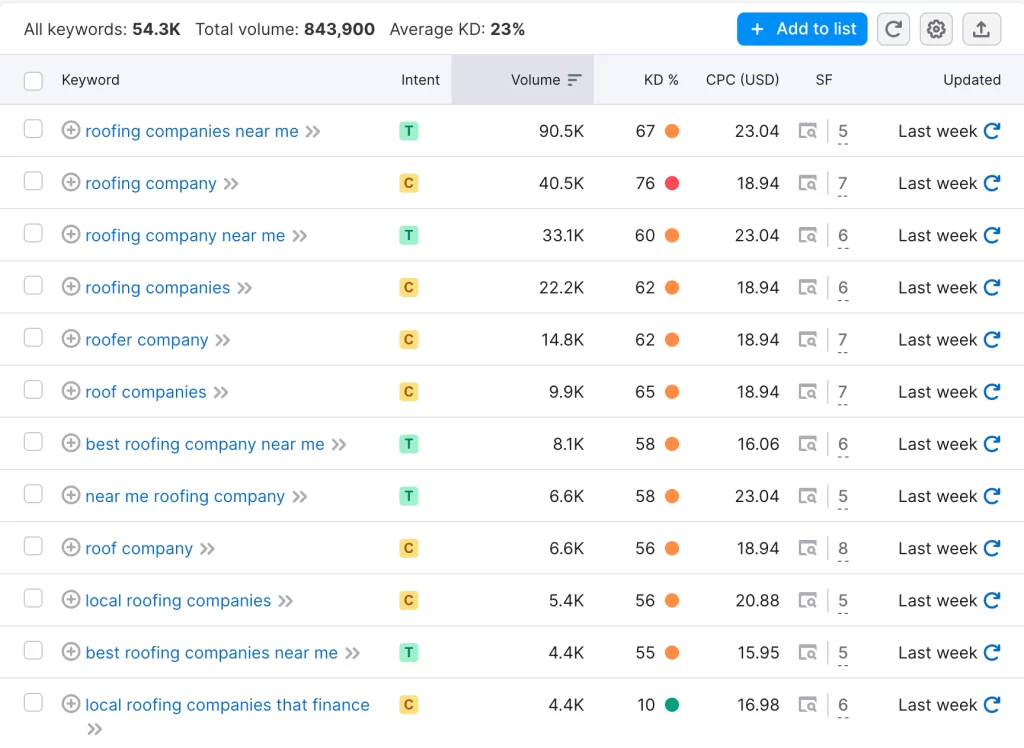
Your business should identify the keywords that attract the most relevant customers and note each term’s search volume and competition level. Tools including Moz, SEMrush, and Ahrefs provide volume and difficulty metrics for both national and local terms.
National Keywords
High-volume terms like “roofing company,” “roofer,” and “roofing services” garner significant search volume nationally but function as location-dependent queries.
Google adjusts results based on the searcher’s location, so a roofer in Phoenix is not competing nationally for these terms.
These broad keywords form the conceptual backbone of your strategy and inspire the long-tail variations that will drive the majority of your targetable traffic.
Local Keywords
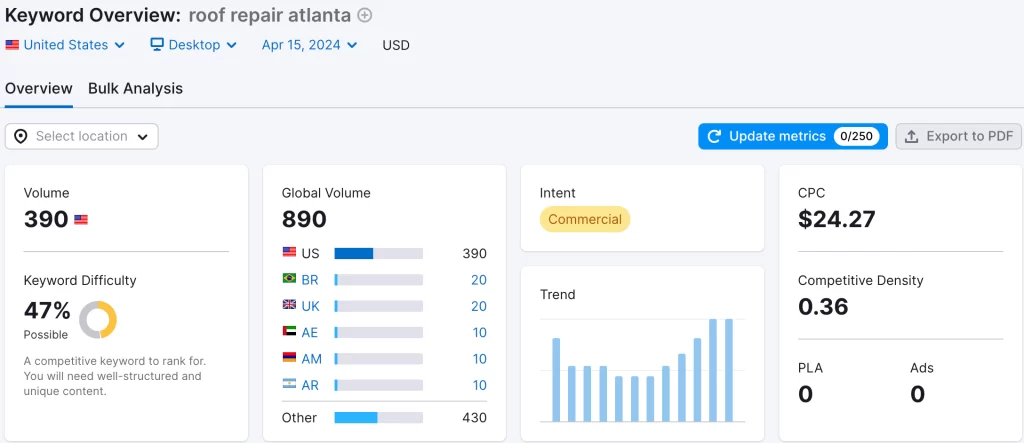
The most actionable keywords for a roofing company combine a service term with a specific location. “Roof repair” is a nationally competitive term. “Roof repair Atlanta” is a local keyword with defined, measurable volume and a realistic path to ranking.
According to SEMRush data, “roof repair Atlanta” has a monthly search volume of 390, while the closer variation “Atlanta roof repair” has a monthly search volume of 320.
Using the city name rather than “near me” targets explicit queries over implicit ones, which can improve rankings relative to competitors that rely on implicit location signals.
Service Keywords
Interior service pages perform best when they target specific services combined with a location modifier.
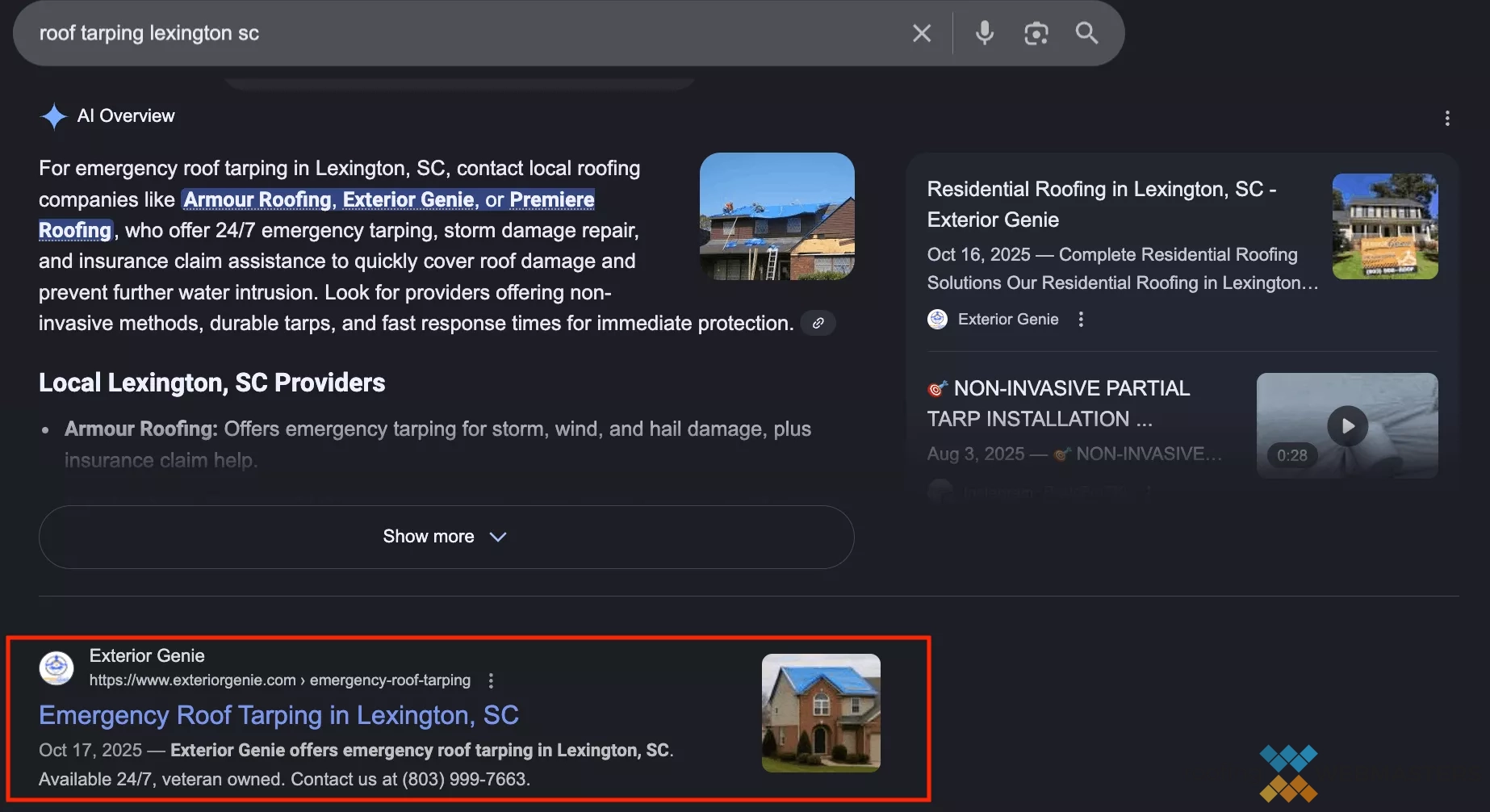
A roofing company in Lexington, SC, offering emergency roof tarping should target “emergency roof tarping lexington sc” rather than the broader “roof tarping.”
Long-tail service keywords carry lower competition and higher purchase intent; a visitor searching for that specific a term is closer to a buying decision than someone searching “roofing company.”
Competitor Gap Analysis
Before finalizing your keyword list, identify which of your direct local competitors are ranking for keywords you are not. This gap analysis shapes where you focus content creation first.
The process has three steps:
- Enter your top two or three local competitors’ domains into SEMrush, Ahrefs, or Moz.
- Pull their top-ranking pages and the keywords driving traffic to those pages.
- Identify terms where competitors rank in positions 4–20; these represent achievable targets where the ranking is not yet locked up, and where a well-optimized page on your site can realistically compete.
Competitor gap analysis is particularly useful for identifying service pages you have not yet built and location-based terms your competitors are capturing from surrounding cities.
URL Structure and Hierarchy
Your URL structure should reflect your keyword strategy and be established before you build or significantly expand your website.
Changing URLs after pages are indexed requires 301 redirects and carries ranking risk during the transition period.
How to structure a roofing website URL hierarchy:
- Start with your homepage as the root: www.yourroofingwebsite.com
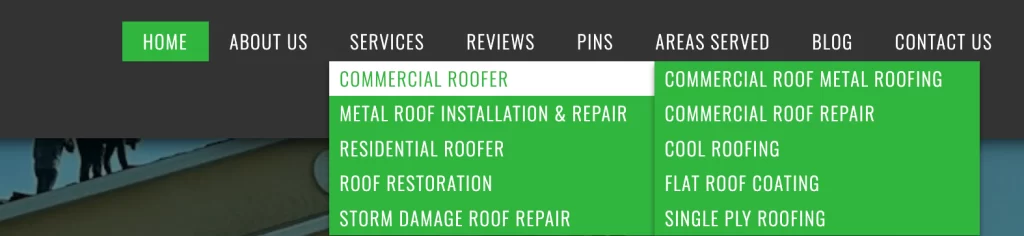
- Create top-level parent pages for your primary service categories: www.yourroofingwebsite.com/residential-roofing/ and www.yourroofingwebsite.com/commercial-roofing/
- Add child pages for specific services beneath each parent: www.yourroofingwebsite.com/residential-roofing/residential-roof-replacement/
- Add sub-level pages only where a service has enough content depth to justify a dedicated page: www.yourroofingwebsite.com/commercial-roofing/flat-roofing/modified-bitumen/
- Stop at three levels deep. URLs beyond three levels are harder for Google to crawl and less likely to rank well in search results.
Parent pages are top-level service categories (Residential Roofing, Commercial Roofing). Child pages are specific services nested beneath a parent (Roof Replacement, Roof Repair, Roof Inspection).
A well-structured URL hierarchy makes it easier for Google to understand your site’s topical organization and for visitors to navigate between related services.
On-Page SEO for Roofing
On-page SEO is the set of optimizations applied directly to your website’s pages: title tags, meta descriptions, header tags, URL slugs, body content, and image alt text.
These are the most frequently discussed SEO tasks and the ones with the most direct, measurable connection to keyword rankings.
Pages optimized correctly today continue earning rankings for years as they accumulate authority and trust. Precision at this stage compounds over time; a well-optimized service page built now becomes progressively more valuable as it ages.
Keyword Placement
Your target keyword should appear in four locations on each page: the title tag, the H1 header, the meta description, and naturally within the body content. Placement at the left-hand side of each element carries the most weight.
For a roofing company targeting “roof replacement in [city]”:
- Title tag: Roof Replacement in [City] | [Company Name]
- H1: Roof Replacement Services in [City]
- Meta description: [Company Name] provides roof replacement in [City, State]. Call [###-###-####] to schedule your inspection today.
This achieves three instances of the keyword across distinct on-page elements without any of them reading as keyword-stuffed or misleading.
Apply the same logic to H2 and H3 tags, image alt text, and paragraph content, but only where the keyword fits naturally. Forced keyword insertion reduces readability and can trigger over-optimization signals.
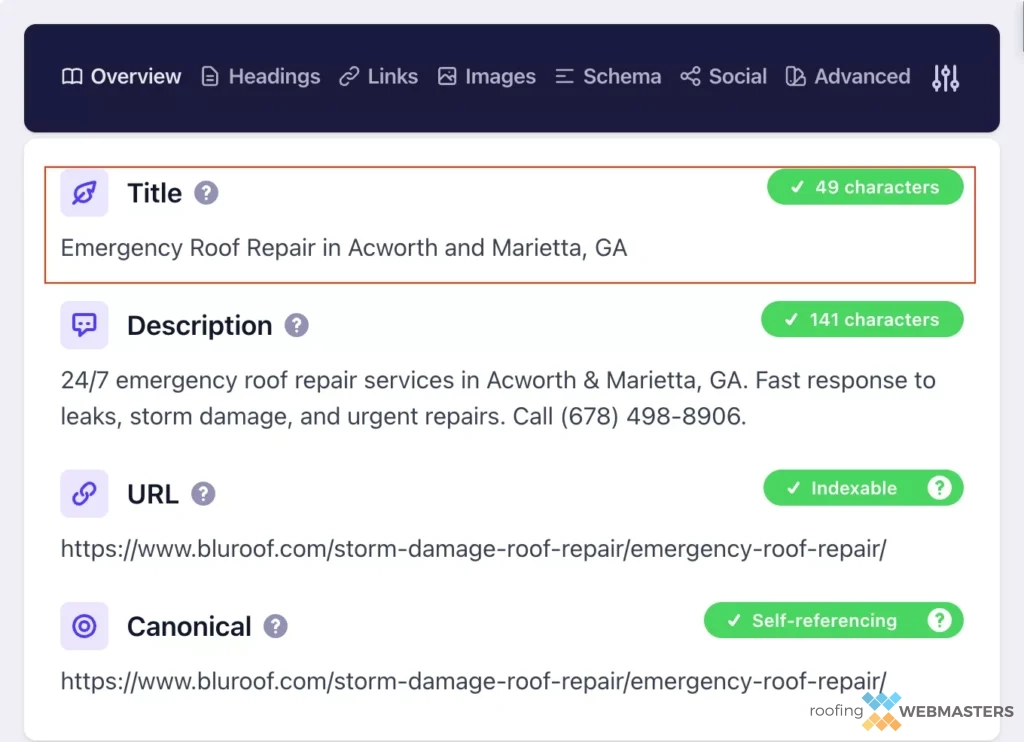
Title Tags
A title tag is the clickable headline displayed in search results. It should include your primary keyword and a reason to click, but it must accurately represent what the visitor will find on the page. Misleading title tags increase bounce rates, which signals to Google that searchers did not find what they expected.
For local roofers, a functional title tag follows this pattern: “[Service] in [City, State] | [Company Name]” or “[Service], Schedule Your Free Inspection Today.” Use Moz’s title tag preview tool to confirm your title falls within the character limit for full display in search results.
Meta Descriptions
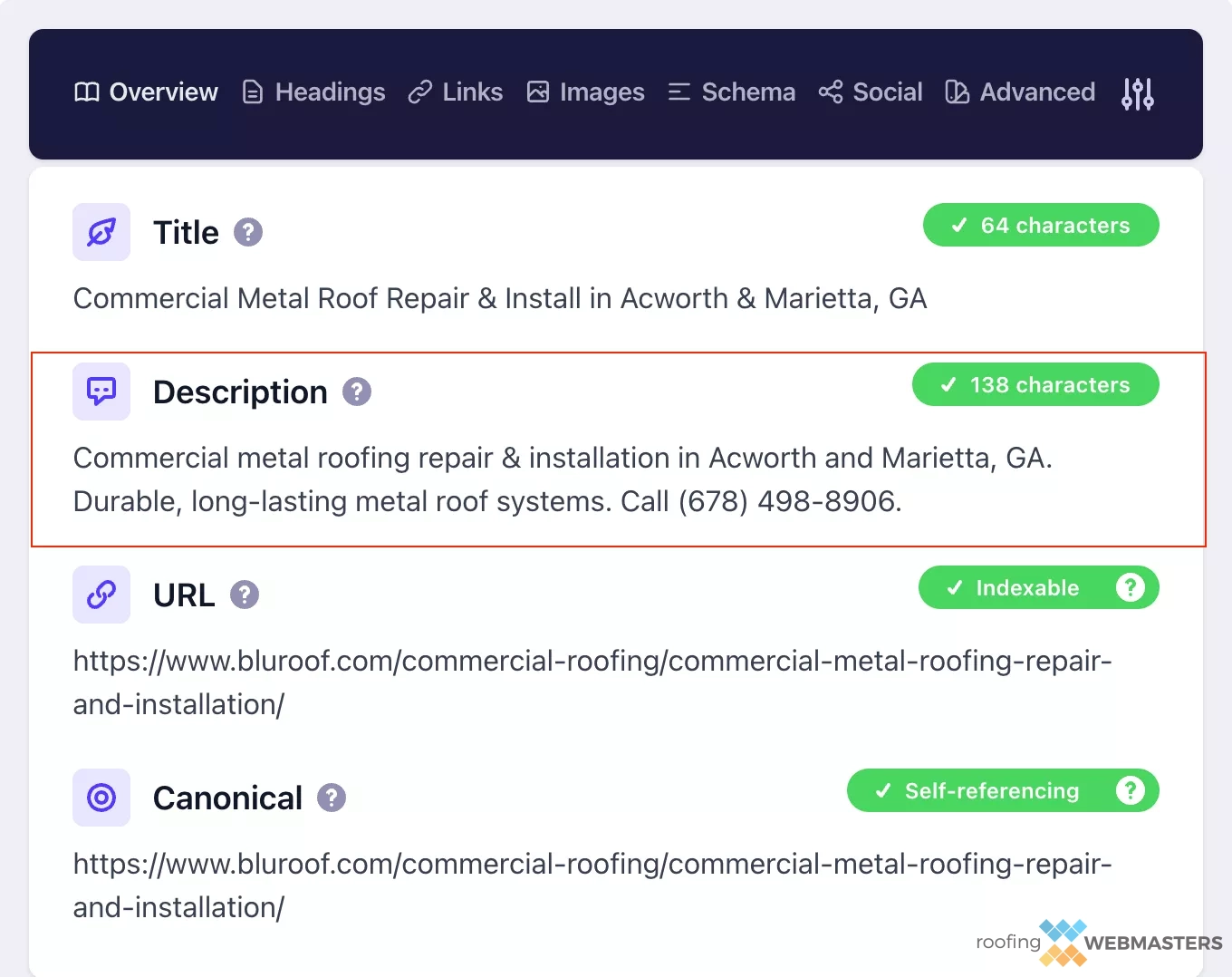
The meta description is the 130–160-character block of text displayed beneath the title tag in search results. It is not a direct ranking factor, but it influences click-through rate.
Include one instance of your target keyword and an accurate summary of the page’s content. A phone number or call to action in the meta description can improve click-through for mobile searchers
Header Tags
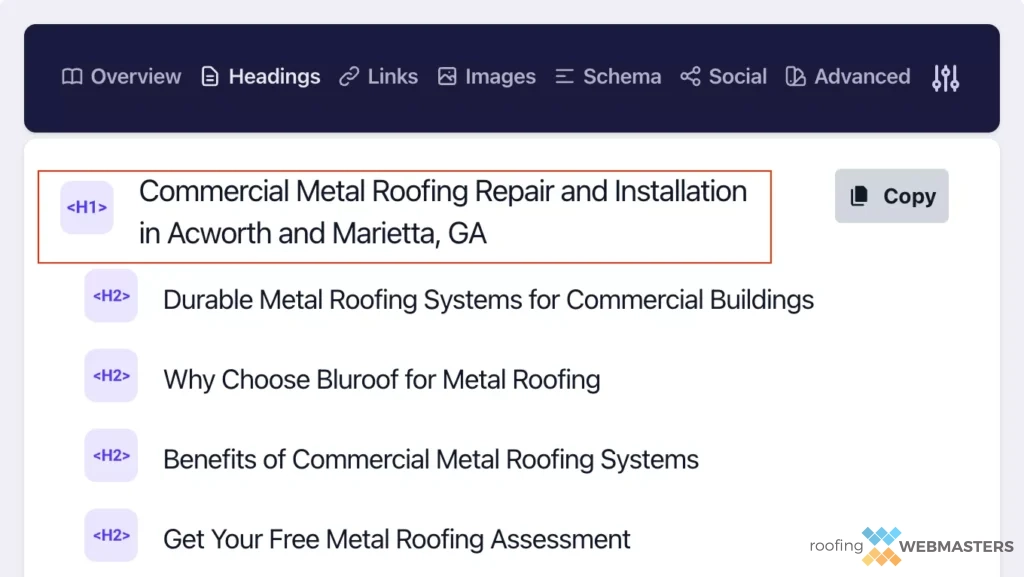
The H1 is the most important header for on-page SEO; it functions as the page’s primary subject declaration and should include your target keyword. Each page should have exactly one H1.
H2 and H3 tags organize the body content into sections. They matter primarily for readability and crawlability rather than direct keyword ranking, but a well-structured header hierarchy makes it easier for Google to parse the page’s topical structure and for visitors to navigate long pages.
URL Slugs
The URL slug is the portion of the web address to the right of your domain. For a residential roof repair page, a well-formed slug is:
myroofingcompany.com/residential/roof-repair
rather than:
myroofingcompany.com/residential/residential-roof-repair
The first version is cleaner, less redundant, and easier for both search engines and visitors to read. URL slugs are permanent.
If you need to retire a page, implement a 301 redirect rather than deleting it outright. The original URL will remain indexed until the redirect has been in place long enough for Google to process the change.
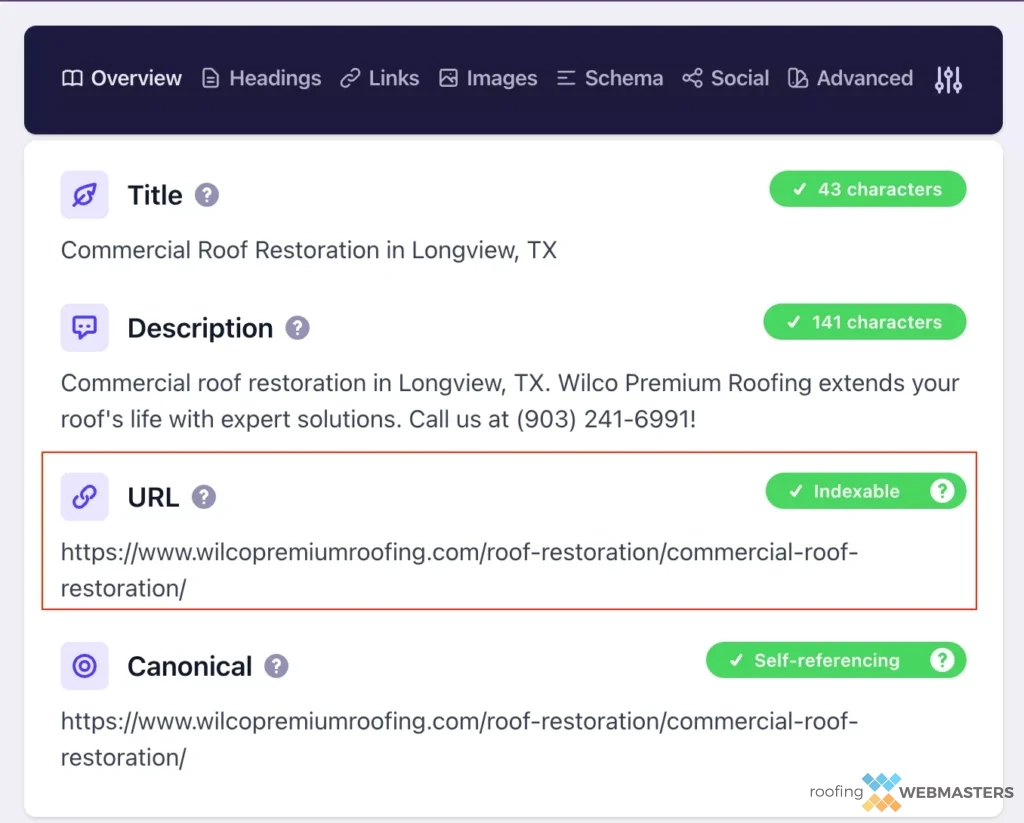
Image Alt Text
Image alt text is a short description of each image embedded in your page. It serves two purposes: it tells Google what the image depicts (contributing to image search rankings), and it provides a text alternative for screen readers.
Name image files in lowercase with hyphens before uploading: company-name-roofing-truck.jpg. Write alt text that describes the image plainly: “Company Name roofing truck at job site.” This is a small task with a cumulative SEO benefit across a site with many images.
Custom Design and Trust Signals
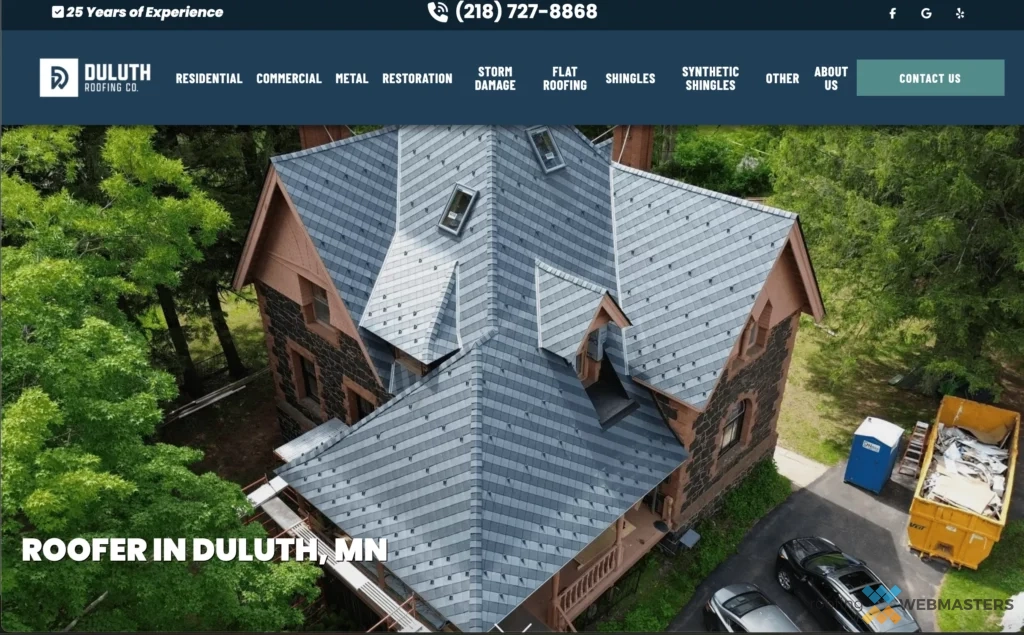
A visitor forms an impression of your roofing company within moments of landing on your website. That impression determines whether they stay to read your content or return to the search results and call a competitor.
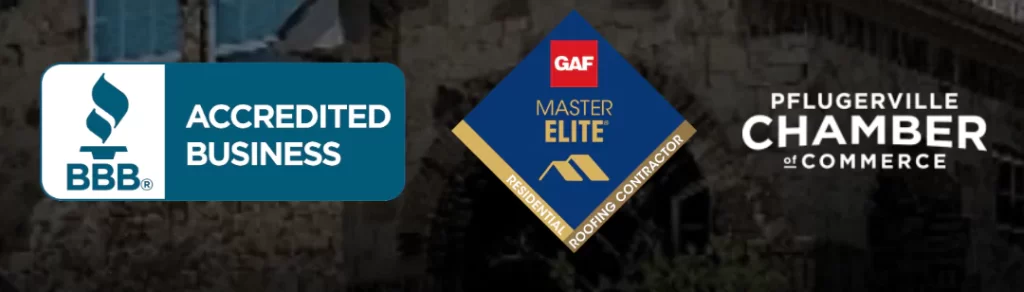
The trust signals that most reliably keep visitors on roofing websites are: original photographs of your crew and completed jobs, clearly visible contact information, recognizable certification badges (Better Business Bureau, manufacturer certifications, local Chamber of Commerce), and customer reviews displayed on the page.
Websites with outdated designs, broken layouts, or misaligned mobile formatting are more likely to be perceived as inactive or untrustworthy, increasing bounce rates and, over time, suppressing rankings.
Call to Action
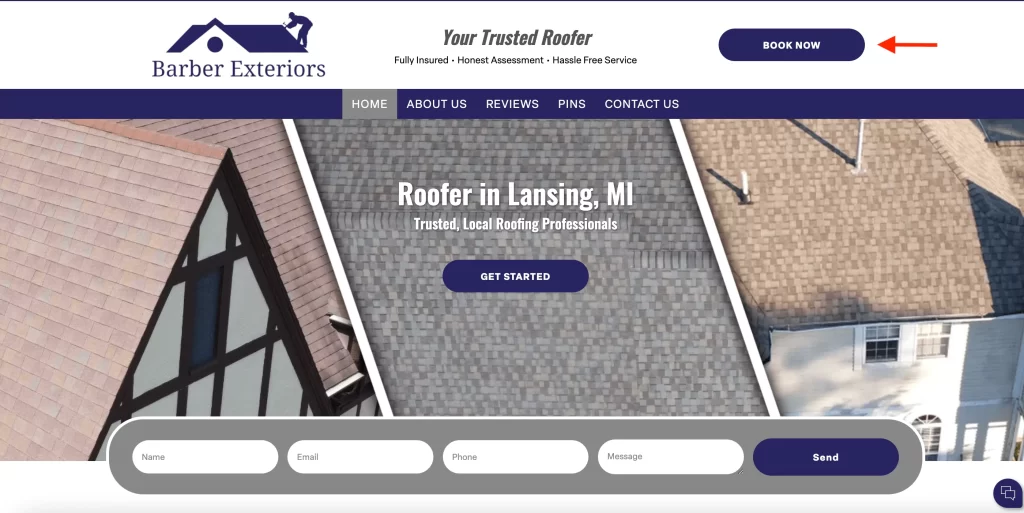
A call to action (CTA) is any element on your page that prompts a visitor to take a specific step, such as calling your office, submitting a contact form, or requesting an estimate.
Effective CTAs for roofing websites are specific and low-friction. A clickable phone number button is the highest-converting CTA for mobile visitors because it requires one tap. A “Request a Free Estimate” form works better for visitors who are not yet ready to call.
CTAs serve different stages of the decision funnel. Phone number links close visitors who are ready to hire now. Estimate request forms capture visitors who are still comparing options.
Images and Videos
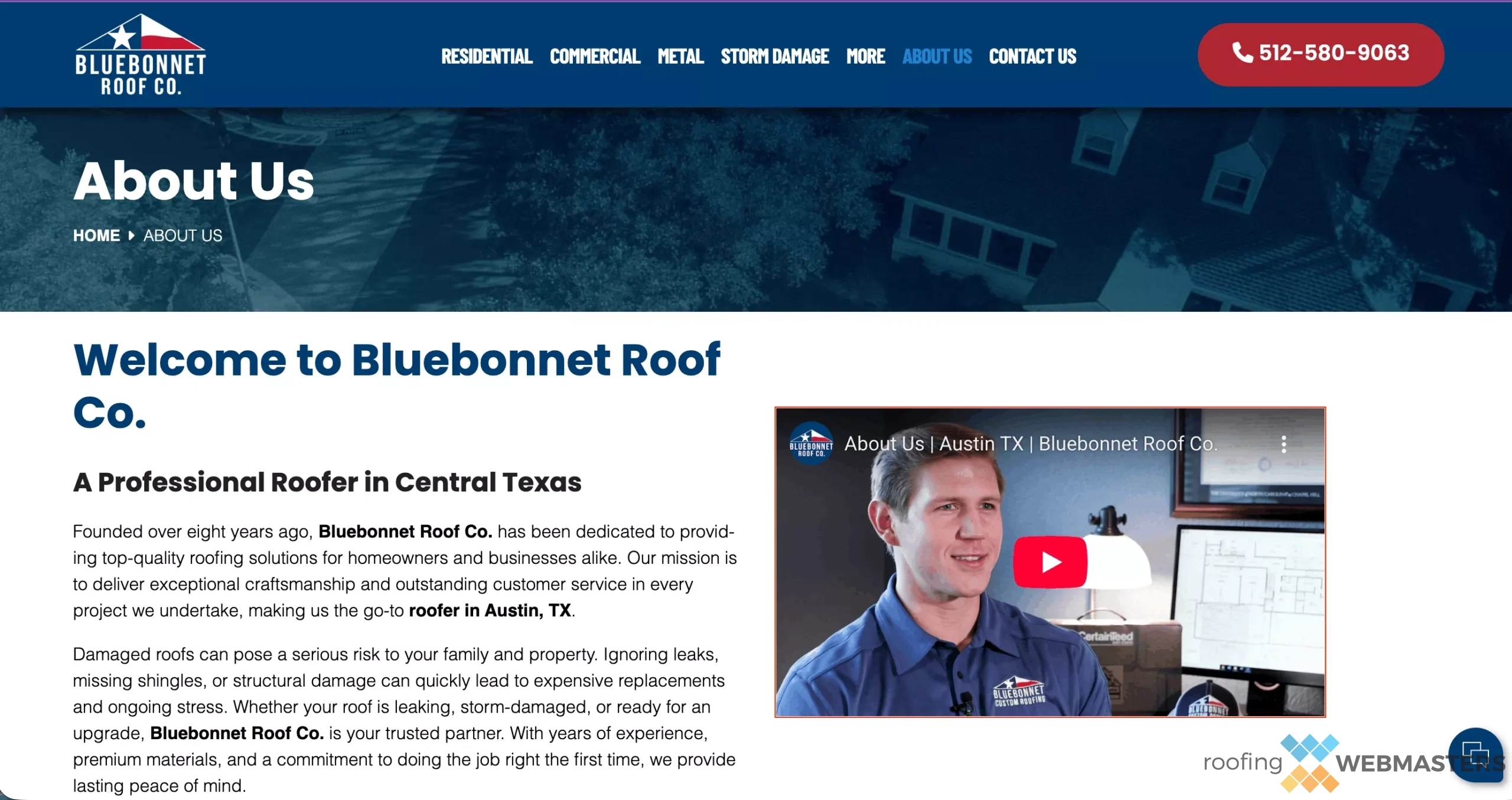
Original photos and videos serve two functions: they improve the user experience for visitors and provide trust signals that distinguish your site from competitors that use generic stock imagery.
The most effective images for a roofing website are photographs of your actual crew, trucks, equipment, and completed jobs, particularly before-and-after shots. Stock photos are recognizable as generic and do not build the same credibility with visitors evaluating whether to call you.
Compress images using the WebP file format to maintain fast load times. You can test your image loading performance using Google PageSpeed Insights.
Video is underused on roofing websites. Job footage, including before-and-after sequences, shot on a smartphone, is sufficient. The most efficient workflow is to upload a video to YouTube and embed it on your website using WordPress’s YouTube embed block.
This approach allows your content to appear in both YouTube search results and Google’s video carousel, extending its reach without duplicating hosting costs.
Badges, Accolades, and Testimonials
Certifications from national organizations like the Better Business Bureau, manufacturer programs, or local business associations come with digital badges you can display on your website. These serve as third-party trust signals that help visitors confirm your company’s legitimacy before calling.
Displaying customer reviews directly on your homepage adds user-generated content to your site, which Google values as a freshness and relevance signal. Several reputation management plugins can pull your Google reviews onto your website automatically.
Technical SEO for Roofing Contractors
Technical SEO refers to the optimizations applied to your website’s underlying code and architecture, the elements visitors do not see, but that directly affect how Google crawls, indexes, and ranks your pages.
For roofers without a programming background, the practical priority is this: technical SEO issues are often invisible until they cause a ranking problem.
A site that loads slowly, lacks an SSL certificate, has broken redirects, or is missing a sitemap can underperform in search results even when its content and on-page optimization are strong.
An annual technical audit, using tools like Google Search Console, Screaming Frog, or Ahrefs, is the minimum maintenance standard.
301 Redirects
When a webpage is no longer useful to visitors because a service has been discontinued or a page has been consolidated, redirect it to the most relevant active page rather than deleting it.
Deleting a page outright removes it from Google’s index and breaks any inbound links pointing to it, both of which damage your rankings.
A 301 redirect preserves the destination URL in Google’s index and routes both visitors and search engine crawlers to the replacement page without them noticing the transition.
XML Sitemaps
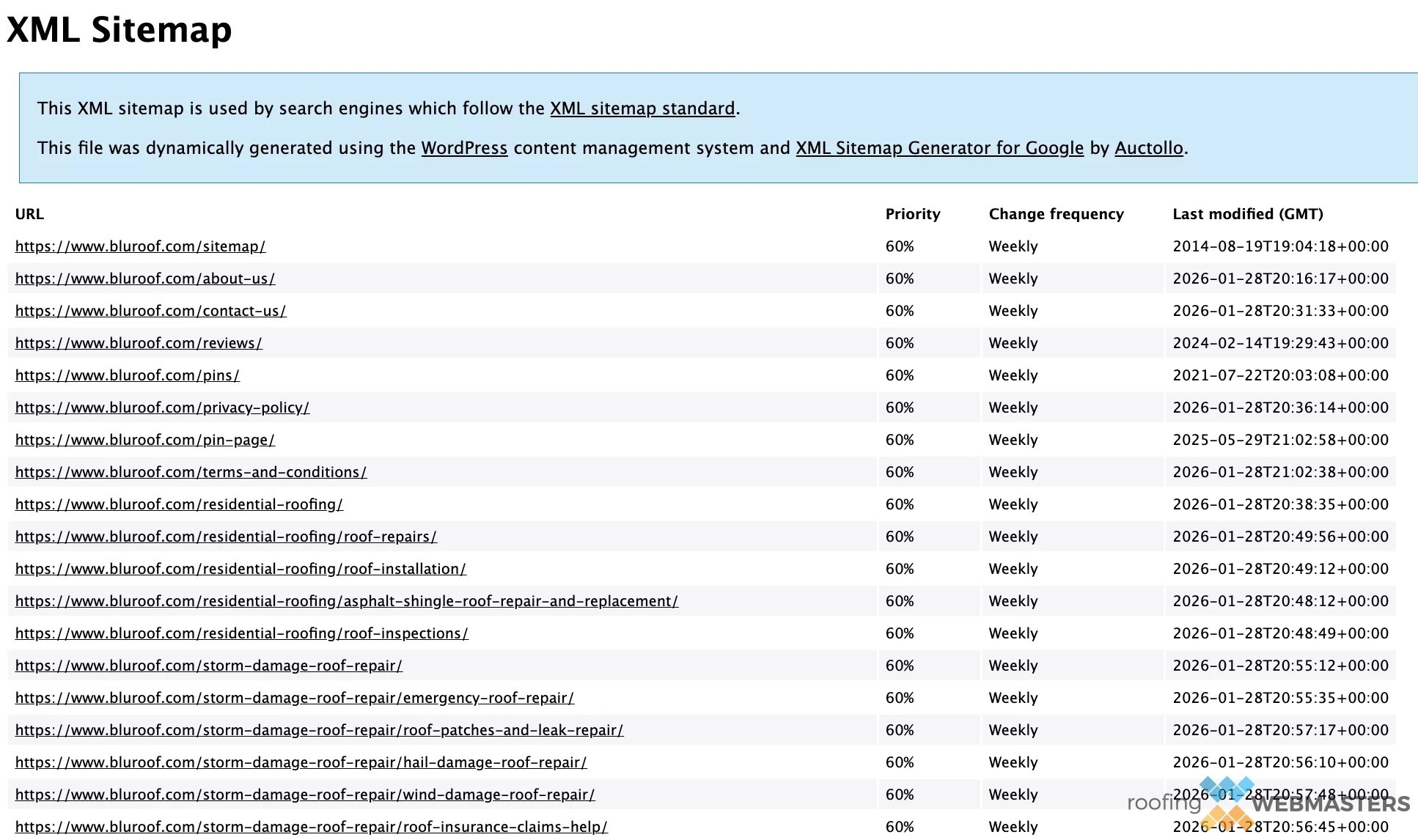
Every roofing website should have an XML sitemap submitted to Google Search Console.
The sitemap tells Google which pages exist on your site and prompts it to crawl pages that may not be easily reachable through internal links, particularly important for larger sites with many service or city pages.
Site Speed Optimization
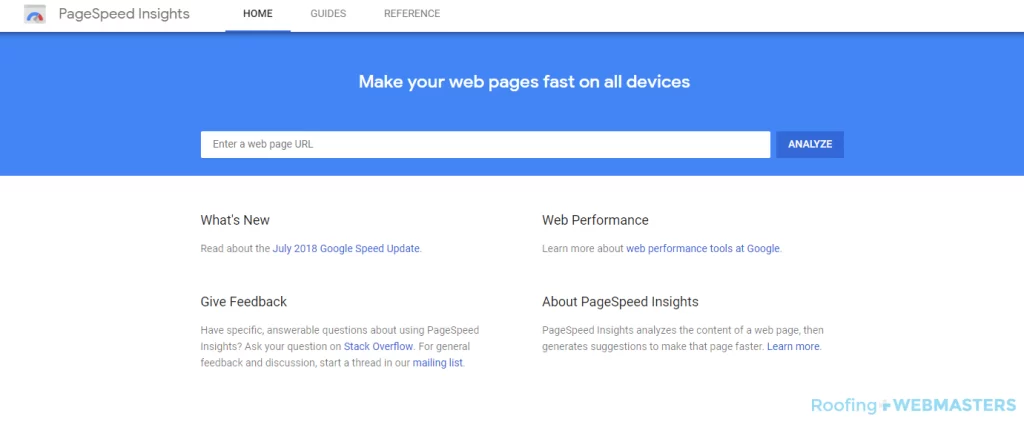
Page loading speed is a confirmed Google ranking factor and a direct driver of visitor behavior. According to Google’s Core Web Vitals documentation on web.dev, pages should achieve a Largest Contentful Paint of 2.5 seconds or less to meet the “good” threshold.
Pages that load more slowly see higher abandonment rates; visitors return to the search results and contact a competitor instead.
Common speed improvements for roofing websites include compressing images to WebP format, reducing JavaScript that blocks page rendering, and enabling browser caching. A professional developer can audit and address these issues systematically.
Google PageSpeed Insights provides a free, page-level speed report with specific recommendations.
SSL Security
SSL (Secure Sockets Layer) is the security protocol that makes your website address display as https:// rather than http://. Major browsers flag non-HTTPS sites with a “Not Secure” warning, which is visible to visitors before they interact with your content.
Sites with SSL enabled are https:// addresses. For a roofing company, the practical SEO implication is that a “Not Secure” warning reduces visitor trust, increases bounce rates, and sends negative behavioral signals to Google, making SSL a meaningful indirect ranking factor even for businesses that do not process payments online.
Schema Markup for Roofing Websites
Schema markup tells Google explicitly what your business is and what your pages cover. For roofing companies, the most applicable schema types are:
- LocalBusiness schema: Declares your company name, address, phone number, service area, and hours. Reinforces NAP consistency signals.
- Service schema: Describes individual services (roof repair, roof replacement, TPO installation) with associated descriptions and service areas.
- Review schema: Marks up customer reviews so Google can display star ratings in search results.
- FAQPage schema: Marks up question-and-answer content so Google can display it as an expandable FAQ in search results, particularly valuable for AI-generated answers that pull from structured content.
Schema markup does not guarantee enhanced search result features, but it gives Google the structured data it needs to display them when appropriate.
Mobile Optimization
Google operates exclusively on mobile-first indexing. The mobile version of your website is the version Google uses to crawl, index, and rank your pages, for every website, without exception, as of July 5, 2024, per Google Search Central.
If your mobile site has missing content, slow load times, or broken navigation, those deficiencies directly affect your rankings regardless of how well your desktop site performs.
Mobile optimization priorities for roofing websites:
- Responsive design that adapts to any screen size
- Clickable phone number buttons (tap-to-call)
- Navigation menus that collapse cleanly on small screens
- Images sized for mobile bandwidth
- LCP under 2.5 seconds on mobile (test with Google PageSpeed Insights)
Consider the mobile user’s situation specifically: they are likely standing in a driveway, looking at a damaged roof, searching for someone to call. Friction at any point in that mobile experience, slow loading, hard-to-tap buttons, buried phone numbers, loses the lead.
Google Analytics Tracking
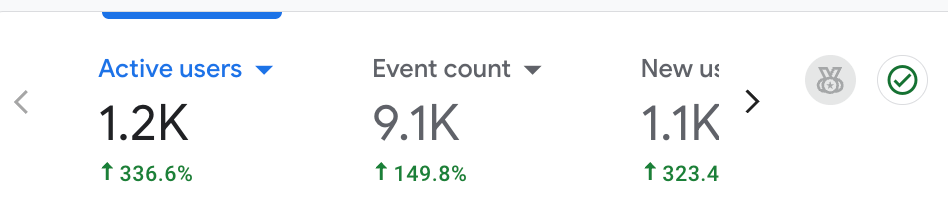
Google Analytics 4 (GA4) is the standard tool for tracking SEO performance on roofing websites. The Acquisition Report in GA4 shows how many visits your site receives daily, weekly, monthly, and annually, broken down by traffic source, organic search, direct, referral, and others.
Tracking your organic traffic baseline before making SEO changes is essential. Without a baseline, there is no reliable way to distinguish SEO-driven growth from seasonal variation in roofing demand (which is significant in most U.S. markets).
Sudden drops in organic traffic visible in GA4 are often the first detectable signal of a technical issue, a Google algorithm update, or a competitor gaining ground on a key keyword.
Local SEO for Roofing Companies
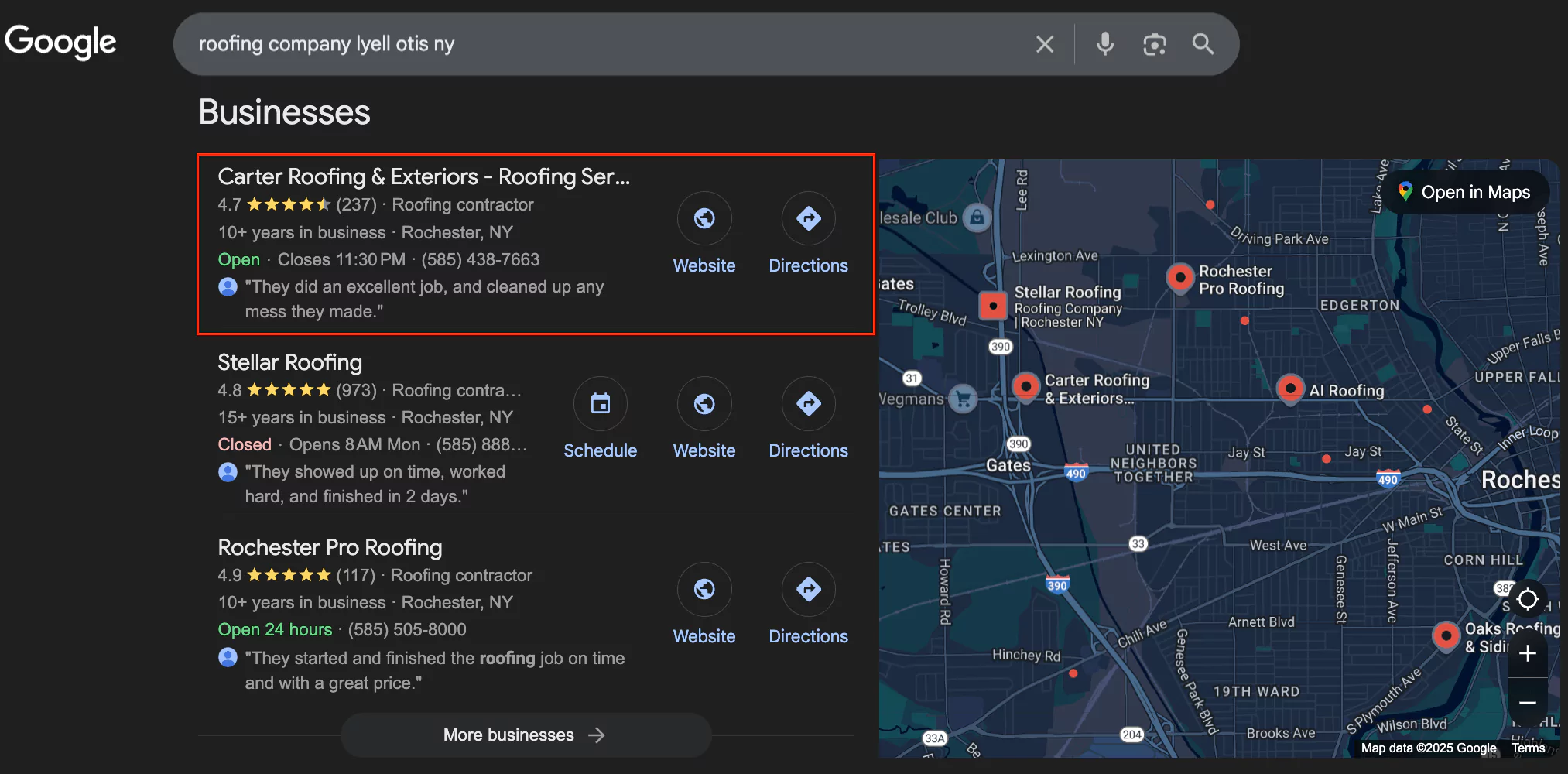
Local SEO determines how your roofing company appears in Google Maps, the Local Map Pack (the three listings shown above organic results for location-based queries), and local organic results. For most residential roofers, this is the highest-leverage part of their SEO strategy.
Google Business Profile Optimization
A Google Business Profile is the most critical aspect of a roofing company’s Local SEO.
Your GBP listing is the primary data source Google uses to place your business in the Local Map Pack. It must be claimed, verified, and actively maintained, not set up once and forgotten.
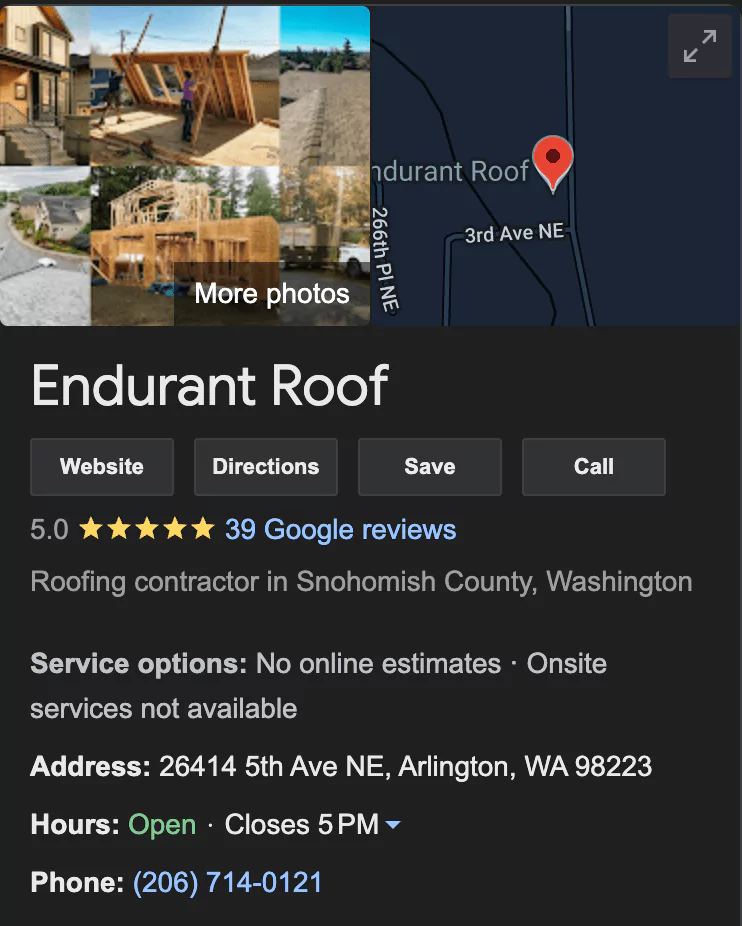
GBP optimization checklist for roofing companies:
- Claim and verify your listing through Google’s video verification process.
- Select your primary business category as “Roofing Contractor.” Add secondary categories for any specialty services (e.g., “Siding Contractor”).
- Add your complete NAP (name, address, phone number), exactly matching the NAP on your website.
- Write a business description that includes your primary service terms and service area cities.
- Add photos: exterior of your office or vehicles, crew photos, and completed job photos (before-and-after, where possible). Listings with photos receive significantly more direction requests and website clicks than those without.
- Enable the “Call Now” button so mobile users can contact you directly from the listing.
- Add your service area cities if you are a service-area business operating without a public-facing storefront.
- Publish Google Posts at least twice per month, job updates, seasonal offers, or recent reviews. Post activity is a behavioral signal that your business is active.
- Respond to every review, positive and negative. Review response cadence is listed as a ranking signal in Google’s own local ranking documentation.
- Use the Q&A feature to populate common questions (service area, emergency availability, insurance acceptance) before customers ask them.
Service Area Businesses (SAB): No Physical Storefront
Roofing companies that operate from a home address or prefer not to display a physical location publicly can designate their listing as a Service Area Business (SAB) in Google Business Profile.
The SAB designation hides your address from public view while still allowing you to rank for searches in your defined service area.
To verify an SAB listing, Google requires evidence that the business is legitimate and operating: a vehicle with business branding, a business license, and utility bills in the business name are commonly requested during verification.
Once verified, you define your service area by the cities or ZIP codes you serve rather than a pin on a map.
Important: SAB listings rank within the service area you define, but proximity to the searcher still matters. A roofing company listed as serving 20 cities will rank more strongly for searches in cities closest to its actual operating location. Expanding your defined service area beyond your realistic working radius does not proportionally improve your rankings.
Local Business Citations
A citation is any online mention of your business’s name, address, and phone number, on directories like Angi, Yelp, the Better Business Bureau, and hundreds of niche and general-purpose platforms.
The goal is to claim all available high-leverage citations and ensure their accuracy. Local business data is constantly compiled automatically by major data aggregators, such as Data Axle and Neustar Localeze, which pull information from public records, utility bills, and commercial registries before distributing it to mapping services and directory platforms.
Because these auto-generated profiles rely on legacy records, they are frequently inaccurate or outdated, creating conflicting data signals that can quietly suppress your local search rankings.
Tools, including Whitespark and Moz Local, help identify, claim, and correct citations across multiple directories from a single interface, particularly useful for businesses that have operated under different addresses or phone numbers over the years.
NAP Consistency
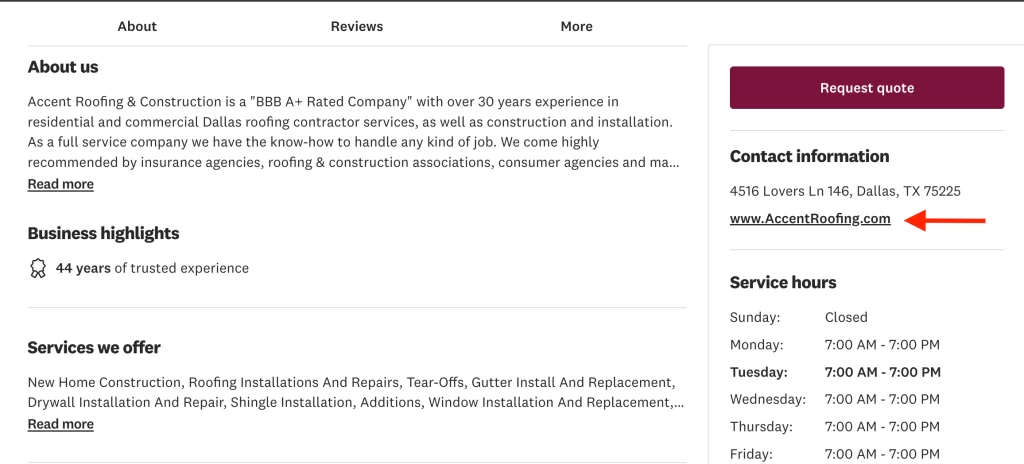
NAP stands for name, address, and phone number. That information should be clearly evident on each website page, particularly the homepage, and must be identical across every directory listing, social profile, and your Google Business Profile.
Even minor inconsistencies, “St.” versus “Street,” a missing suite number, an old phone number on a forgotten directory, create conflicting signals that can suppress local rankings.
Choose a single, authoritative version of your NAP and apply it uniformly everywhere. Tools like Whitespark and Moz Local can audit inconsistencies across hundreds of citations for established businesses with long histories.

Entity authority in 2026: NAP consistency is one component of a broader signal that Google and AI platforms use to verify that your business is a legitimate, established entity. In addition to consistent NAP data, entity authority is built through: your business name appearing consistently across third-party sources (manufacturer directories, Chamber of Commerce listings, industry associations, local press), a complete and active Google Business Profile, and review volume that confirms real customer interactions.
AI platforms, in particular, cross-reference multiple data sources when deciding whether to cite or recommend a local business. A roofing company with consistent NAP data, active third-party mentions, and a verified GBP is significantly more likely to be cited in an AI-generated recommendation than one whose information is scattered or inconsistent.
City Pages
Roofers serving multiple cities within a radius often create individual city pages to capture location-specific search traffic, a page targeting “roof repair in Naperville” rather than relying on the homepage to rank for that query.
City pages are effective when they are genuinely unique to each location: specific to local neighborhoods, local building codes or permit requirements, recent jobs completed in that area, or customer reviews from that city.
Google’s guidelines explicitly prohibit doorway pages, pages created solely to rank for a location keyword with no meaningful unique content. Mass-produced city pages that use duplicate ycontent with only the city name swapped out risk being classified as doorway pages and suppressed or penalized.
The use of AI to generate city pages at scale introduces additional risk. Pages that contain genuinely location-specific information, such as local permit requirements, neighborhood references, and specific job details from that area, are less likely to be classified as doorway pages than pages where only the city name changes between otherwise identical templates.
Off-Site SEO for Roofing
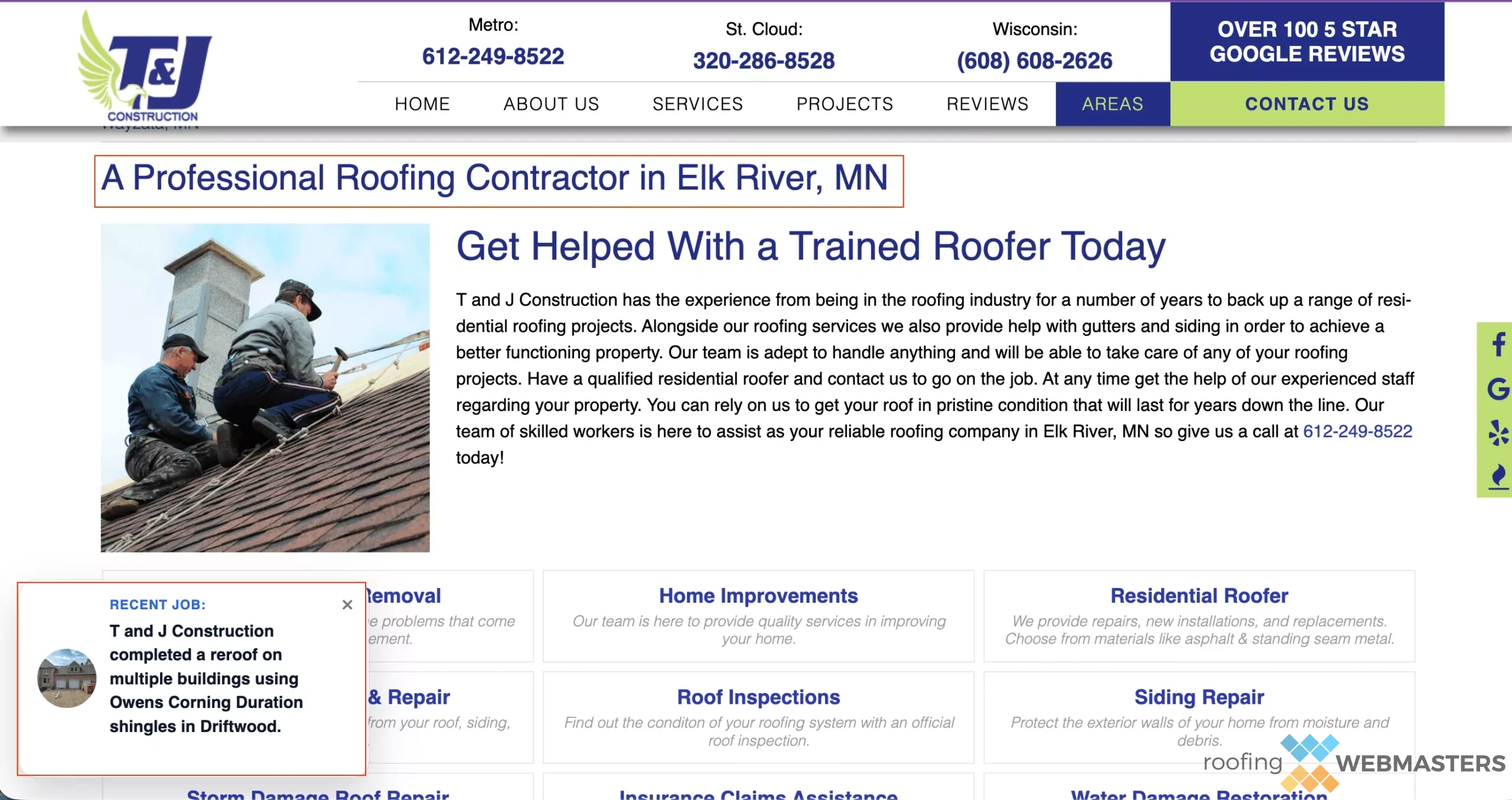
Off-site SEO encompasses all ranking signals that originate outside your own website, inbound links from other domains, brand mentions, social media activity, and directory citations. Google evaluates these external signals to assess your overall authority and relevance within your market.
Social Media
Social media platforms, Facebook, Instagram, YouTube, LinkedIn, and others, function as off-site entities that expand your brand’s presence beyond your main website. Publishing job photos, before-and-after content, and customer reviews on social platforms builds brand awareness and drives referral traffic.
Social engagement (likes, shares, comments, and brand mentions) has been formally recognized as a measurable local search ranking factor for the first time in Whitespark’s 2026 Local Search Ranking Factors report.
Google itself has not confirmed social signals as a direct ranking factor, but the indirect mechanisms are well-documented: social activity drives branded searches, increases brand mention frequency, and generates referral traffic, all of which feed into local ranking signals.
For roofing companies, Facebook and YouTube are the highest-return platforms. Facebook drives local referral traffic and review activity. YouTube job videos can appear directly in Google search results, compounding their SEO value beyond the platform itself.
Link Building
Inbound links from other websites remain one of the most influential ranking factors in both local and organic search.
For a roofing company, the most valuable links come from locally and topically relevant sources: local news coverage, Chamber of Commerce listings, home services directories, manufacturer partner pages, and supplier or distributor websites.
Tactics that produce durable, relevant links for roofing companies:
- Digital PR: Pitching local home improvement publications, news outlets, or regional business journals for coverage of a completed project, community initiative, or expert commentary on storm season roofing demand. Coverage that earns a named link to your website is the highest-quality link a local roofing company can acquire.
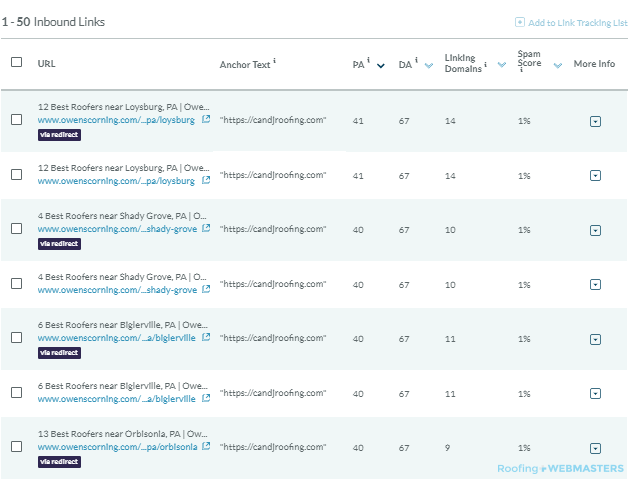
- Manufacturer and supplier listings: Many roofing product manufacturers maintain contractor directories or “find a pro” pages. Being listed on a GAF, Owens Corning, or CertainTeed contractor page produces a relevant, authoritative inbound link.
- Chamber of Commerce and trade associations: Memberships that include a directory listing on the organization’s website produce locally relevant links that reinforce geographic authority.
Earning links through genuinely useful content and legitimate local relationships remains the most durable strategy. Purchased links from blog networks or low-quality directories carry zero-sum value at best and ranking risk at worst.
Google’s link spam detection has improved substantially since the original Penguin update and continues to be refined in core updates.
Targeting Specialized Roofing Services With SEO
Competing for broad terms like “roofing company” or “roofing services” is unrealistic for most roofing companies in their first one to two years of SEO; established competitors with years of domain authority have a structural advantage on those terms.
Targeting a specific roofing system or service narrows the competitive field and creates a faster path to ranking.
This approach works best for: newer companies building their first rankings, established companies entering a new service category, and operators in densely competitive markets where broad terms are locked up by large regional players.

Metal Roofing
Metal roofing is a high-intent, lower-competition keyword cluster relative to generic roofing terms in most local markets.
Building a dedicated metal roofing page, optimized for terms like “metal roofing company [city]” and “metal roof repair [city]”, targets homeowners who have already decided on the material and are selecting a contractor.
Including “metal” in your company’s legal business name has produced ranking advantages on both Google Maps and Google Search for metal roofing queries in practitioner observation across local search campaigns.
Commercial Roofing
Commercial roofing SEO targets a fundamentally different buyer than residential SEO. The customer is a property manager, facilities director, or business owner evaluating a higher-ticket project with a longer decision cycle.
The search behavior reflects this: commercial roofing queries tend to be more specific (“TPO roofing contractor [city],” “EPDM flat roof replacement [city]”) and less impulsive than residential emergency repair searches.
An effective commercial roofing SEO strategy requires:
- Dedicated sub-pages for each commercial system you install: TPO, EPDM, modified bitumen, built-up roofing, and roof coatings should each have their own optimized page rather than being bundled onto a single commercial roofing page.
- Content that addresses B2B buyer concerns: Warranty terms, project timelines, compliance with commercial building codes, and experience with multi-unit or multi-building properties are the information commercial buyers are looking for, not the same content that converts residential homeowners.
- Case studies or project summaries: Commercial buyers evaluate contractors differently from homeowners. A documented project summary, square footage, system installed, location type, timeline, and provide the evidence a commercial buyer needs to include you in a shortlist. Even a brief, anonymized project description is more useful than generic claims about commercial experience.
Including “commercial” in your business name has shown the same pattern observed in metal roofing campaigns, faster Google Maps ranking movement for commercial-related queries, based on practitioner observation in local search.
Tile Roofing
Tile roofing is a residential specialty that targets a specific sub-segment of homeowners, typically in markets with significant Spanish-style, Mediterranean, or high-end construction. It allows a residential contractor to differentiate without moving into commercial work.
A tile roofing page optimized for “[tile roofing company] [city]” and “[clay tile roof repair] [city]” captures homeowners with a specific material need and, in most markets, lower keyword competition than general roofing terms, though competition levels vary by region and should be verified with keyword research before committing to this as a primary target.
Roof Coatings
Roof coatings are a sub-niche within commercial roofing that works well as an entry point for contractors who find the full commercial category too broad or too competitive at the outset.
Search terms like “silicone roof coating [city]” and “polyurea roof coating contractor [city]” carry lower competition than general commercial roofing terms in most markets, though this varies by geography and should be confirmed with keyword research before targeting.
Building content around specific coating systems, silicone, polyurea, and acrylic, creates additional keyword surface area beyond the primary “roof coatings” term and positions your company as a specialist rather than a generalist.
Expanding SEO to AI and AEO
AI platforms are changing how some homeowners discover and research roofing contractors. According to the Previsible AI Traffic Report (December 2025), which tracked sessions across 19 GA4 properties, AI-sourced website traffic grew 527% year-over-year between January and May 2025, rising from approximately 17,000 to 107,000 sessions across the tracked properties.
Growth has continued into 2026, though comparable full-year figures from a named primary source are not yet available at the time of publication.
This growth is real and accelerating, but it requires context: AI platforms currently represent approximately 0.15% of total global web traffic, compared to 48.5% from organic search, according to SE Ranking’s 2025 research study.
Organic search remains the dominant discovery channel for roofing leads by a large margin. The correct response to AI’s growth is to add AI visibility to your strategy (a practice often referred to as AEO or GEO), not to replace the organic SEO work that is still driving the majority of your traffic.
Google’s Two AI Search Surfaces: AI Overviews and AI Mode
Google now surfaces AI-generated content in two distinct ways, and they work differently:
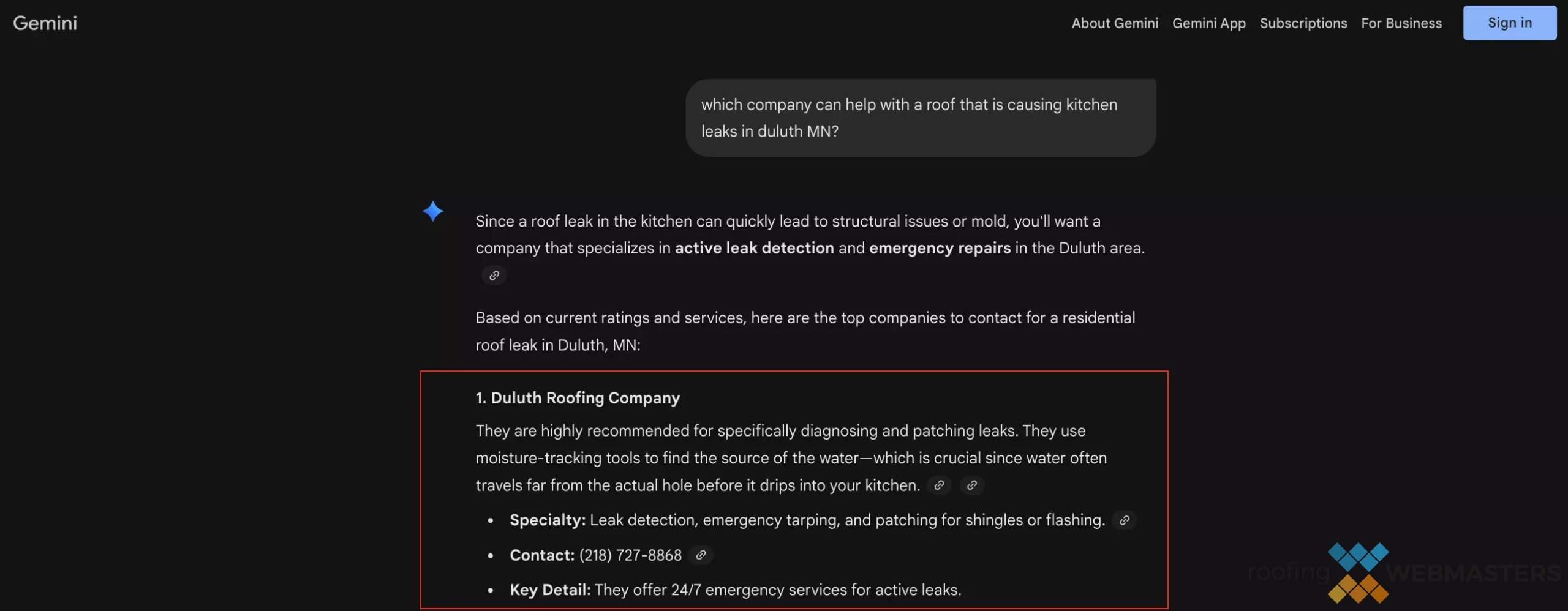
AI Overviews appear automatically above traditional search results for qualifying queries; they are the AI summaries you see without opting in. They are powered by Gemini and pull from Google’s index. A roofing company that ranks well in traditional organic results and has a strong Google Business Profile is well-positioned to be cited in AI Overviews, because Gemini draws heavily from Google’s own ranking data.
AI Mode is a separate, user-selected conversational search interface. Users who switch to AI Mode get a ChatGPT-style experience within Google, no list of blue links, just synthesized answers with citations. It aggressively uses query fan-out, breaking a single prompt into multiple sub-queries before generating a response.
The practical implication: optimizing for traditional local SEO is the primary lever for AI Overviews visibility. Optimizing for content breadth, structure, and sub-query coverage is an additional lever for AI Mode visibility.
How Other AI Search Platforms Process Roofing Queries
ChatGPT Search (OpenAI’s integrated search product, launched in 2024) crawls the web in real time and uses a multi-layer retrieval pipeline. It weighs content that is well-structured, clearly attributed to a named business or expert, and corroborated by third-party sources.
It utilizes Bing’s web index for initial discovery, supplements this with OpenAI’s OAI-SearchBot for real-time page analysis, and prioritizes direct data partnerships for authoritative news and social discussions.
Perplexity is a research-oriented platform with a U.S. user base that skews toward high-intent researchers. It cites sources explicitly and tends to pull from pages with high information density, structured content with specific claims, named sources, and clear answers performs better than general instructional prose.
Claude (Anthropic) and Grok (xAI) currently drive smaller traffic volumes for local service businesses, but are growing. Both emphasize source quality and factual grounding. Well-structured, specifically attributed content performs across all platforms without requiring a separate optimization strategy.
Query Fan-Out Optimization
AI platforms, including Google AI Mode, ChatGPT Search, and Perplexity, break a user’s prompt into multiple sub-queries before generating a response.
A user who asks “who is the best commercial roofer in Dallas” triggers sub-queries that might include: “how to evaluate a commercial roofing contractor,” “average cost of commercial roof replacement in Dallas,” and “commercial roofing companies in Dallas reviews.”
Roofing companies whose websites appear across multiple of these sub-queries, through distinct, well-optimized pages for each service, location, and common customer question, are more likely to be cited in the final AI response than companies whose content covers only one angle.
A single well-ranked homepage is less likely to generate AI citations than a website with dedicated pages for each service type, each primary city served, and FAQ content covering the questions your customers actually ask.
Building Entity Authority for AI Visibility
AI platforms are more likely to cite businesses they can verify as legitimate, established entities. The signals that build entity authority for a roofing company are:
- Consistent NAP data across your website, GBP, and directory listings, AI platforms cross-reference these sources to confirm your business is real.
- Third-party brand mentions on credible external websites: Chamber of Commerce pages, industry association directories, manufacturer contractor locators, and local news coverage.
- Structured content on your own website: Clear author attribution, explicit service area declarations, dated content, and FAQ sections give AI platforms parseable data about who you are and what you do.
- Review volume and recency on Google, Yelp, and relevant niche platforms. AI platforms that synthesize local business recommendations draw on review data as a proxy for real-world credibility.
Content Strategy: Refreshing vs. Creating New Pages
A common mistake in SEO for roofers is continuing to create new pages while existing pages with ranking potential go unimproved.
Content refresh, updating and expanding existing pages, often produces faster ranking gains than publishing new content, because the existing page already has some index history and potentially some inbound links.
Update an existing page when:
- It ranks in positions 4–15 for a target keyword but has not moved in 60 or more days.
- Its information is outdated (references old pricing, discontinued products, superseded permit requirements).
- It lacks structured elements that competitors’ pages have: a numbered process list and a comparison table.
- Its word count and information depth are significantly below what is ranking in positions 1–3 for the same query.
Create a new page when:
- No existing page on your site targets the keyword or service in question.
- A service you offer has grown significantly and deserves a dedicated page rather than a paragraph on a broader service page.
- You are targeting a new city or service area that does not have an existing location page.
A practical refresh process:
- Pull your Google Search Console performance report and sort by impressions, filtered to queries where your average position is between 4 and 20.
- Identify which pages are receiving impressions but not clicks; these are pages that are appearing in search results but losing to competitors at the click level.
- Compare the top-ranking competitors’ pages for those queries against your own page. Identify specific content, structure, or format gaps.
- Update the page to address those gaps, add a publication date update, and submit the URL for recrawl in Google Search Console.
Updating a page’s date without making substantive content changes does not improve rankings. Third-party post-rollout analysis of the December 2025 Core Update, including ALM Corp’s review, identified this as a pattern among sites that lost rankings during that cycle.
Adapting to Google Algorithm Updates
Google releases several significant algorithm updates each year. Core updates recalibrate how Google evaluates content quality across the entire web; they do not target specific spam tactics but adjust the relative weight of quality signals, shifting rankings across many sites simultaneously.
As of June 2026, Google has released three core updates since December 2025: the December 2025 Core Update (December 11–29, 2025), the March 2026 Core Update (March 27–April 8, 2026), and the May 2026 Core Update (launched May 21, 2026, still settling at time of publication).
All three used identical official language: “a regular update designed to better surface relevant, satisfying content.” None introduced new mechanisms.
The consistent pattern across all three cycles is that content demonstrating genuine first-hand experience, strong Core Web Vitals performance, and authentic entity signals has held or gained rankings, while thin, mass-produced, or experience-lacking content has continued to lose ground.
The Helpful Content Update
The Helpful Content Update targeted the practice of producing content primarily to rank in search engines rather than to genuinely answer a reader’s question. It did not specifically prohibit AI-generated content, but it penalized the mass production of content that adds no original value, regardless of how it was produced.
Roofing websites affected by the HCU typically shared common characteristics: large numbers of thin service or city pages with minimal unique content, templated page structures applied across hundreds of locations, and no clear indication of who wrote the content or what direct experience it was based on.
Self-diagnosis checklist for HCU risk:
- Do your city or service pages contain information that is genuinely specific to that location or service, or could the same content appear on any roofer’s website with just the city name changed?
- Does your content reflect direct experience, job photos, specific project details, named service areas, real customer reviews, or is it generic instructional prose?
- Has your organic traffic declined gradually over several months without a clear technical cause? Gradual traffic decline across many pages simultaneously is more consistent with an algorithmic quality signal than a technical issue.
Recovery from an HCU impact requires removing or substantially improving thin content, not simply rewriting it with different words. Pages that cannot be made genuinely useful should be consolidated into stronger pages or removed and redirected.
The December 2025 Core Update
Google released the December 2025 Core Update on December 11, 2025. The rollout was completed on December 29, 2025, an 18-day deployment.
Google described the update as “a regular update designed to better surface relevant, satisfying content for searchers from all types of sites,” per Search Engine Land‘s coverage of the Google Search Status Dashboard announcement.
Google did not identify specific new mechanisms in its public guidance. Third-party analysis from ALM Corp identified patterns among sites that lost rankings: content covering topics comprehensively but lacking signals of genuine first-hand experience, pages with Core Web Vitals scores below Google’s “good” thresholds (particularly LCP above 3 seconds on mobile), and pages where publishing dates had been updated without substantive content changes.
The Lesson for Roofers: Demonstrating real experience through job photos, named project locations, specific material brands and systems, and attributed author credentials has become a more significant ranking signal than in prior years.
The March 2026 Core Update
Google rolled out the March 2026 Core Update between March 27 and April 8, 2026. While the December update focused heavily on correcting the e-commerce space, March 2026 was widely analyzed as a “first-party, official-source correction.”
Data from SEO research firms like Amsive showed a massive algorithmic shift in favor of official, brand-owned domains and authoritative government (.gov) websites. Conversely, broad-scale comparison aggregators, reference sites, and generalized user-generated content lost significant visibility.
The Lesson for Roofers: Google explicitly penalized mid-tier comparison directories and third-party listicles. If your roofing company relies heavily on being “ranked #4 on a random local aggregate directory list,” that traffic pipeline is drying up. Google wants searchers to go directly to the actual, first-party local business website.
The May 2026 Core Update
Launched on May 21, 2026, the May Core Update is the latest standard-bearer for content quality signals. This update dropped right alongside massive structural changes announced at Google I/O 2026 (including the rollout of Gemini 3.5 Flash and the merging of AI Overviews with conversational AI Mode).
The May update doubled down on rewarding hyper-local, high-information-density content. Early analysis shows heavy volatility for standard, dry instructional prose.
Websites that merely explain how a roof is replaced using textbook definitions are losing ground to sites featuring deep, structured case studies with localized context (e.g., matching regional building codes, localized storm damage history, and project-specific timelines).
If your rankings dropped after the December 2025, March 2026, or May 2026 updates:
- Do not panic or make reactive changes mid-rollout. If you are tracking a drop during the active May 2026 window, wait at least one to two weeks after Google announces the update is fully completed before altering your content. Mid-update data is incredibly noisy and often exhibits temporary “ghost drops” that resolve on their own.
- Check Google Search Console (GSC) to isolate the exact dates. Match your traffic drops against the official rollout windows (December 11–29, 2025; March 27–April 8, 2026; or starting May 21, 2026) to confirm you were actually affected by a core update rather than a localized technical bug or a manual action.
- Audit your Core Web Vitals report. Core updates heavily weigh technical user experiences. Look at your Search Console dashboard specifically for mobile URL performance; ensure your Largest Contentful Paint (LCP) isn’t ticking past the 2.5-second mark due to uncompressed roof project photos.
- Differentiate “comprehensive text” from “first-hand experience.” Review your worst-performing pages. If a service page reads like a generic textbook definition of “how a shingle roof is installed,” it likely ran afoul of the latest updates. Inject proof of real-world entity execution: add job-site photos, geotagged project summaries, or localized structural notes.
- Accept the recovery timeline. Algorithmic re-scoring is structural. If a core update suppresses your roofing site, substantial content and performance improvements generally will not fully reflect in your rankings until Google runs its next major core update cycle, which historically occurs every three to four months.
Choosing an SEO Agency
For most roofing companies, implementing a comprehensive SEO strategy requires either dedicated in-house time or an external agency.
If you are evaluating roofing SEO services, the following criteria help distinguish agencies with genuine expertise from those selling templated packages.
What Roofing SEO Should Cost
Roofing-focused SEO agencies typically charge between $1,500 and $5,000 per month, based on 2025 pricing data from Pipeline On’s roofing marketing analysis and Ahrefs’ 2025 survey of SEO professionals.
The Ahrefs survey of 439 SEO professionals found that U.S.-based agencies average $98.90 per hour, while small- to medium-sized business retainers average $1,500–$3,000 per month.
Treat $1,000/month as the practical risk threshold in 2026: engagements at or below this level rarely include the combined scope of technical auditing, content creation, GBP management, citation maintenance, and performance reporting that competitive roofing markets require.
You may receive some of these services, but not all of them, at the depth needed to move rankings against established local competitors. The result is often a year of spend with no meaningful ranking movement, a more expensive outcome than investing the appropriate budget from the start.
Be cautious of agencies that lock you into 12 or 24-month contracts without clearly defined deliverables and performance benchmarks tied to specific milestones.
Agency Selection Criteria
| Criterion | What to Look For | Red Flag |
|---|---|---|
| Case studies | Documented ranking or traffic improvements for roofing or home services clients, with before/after data and approximate timeframes | No case studies, or case studies with no performance metrics |
| Pricing transparency | Clear scope of work for the monthly fee; itemized services | Vague “custom packages” with no defined deliverables |
| Contract terms | Month-to-month or short-term agreements; defined exit terms | 12+ month lock-in with no performance benchmarks |
| Reviews | Google Reviews from roofing or contractor clients specifically | Reviews only from non-roofing businesses, or thin review history |
| Roofing knowledge | Demonstrates understanding of roofing-specific keyword patterns, seasonal demand, and local pack dynamics | Generic SEO language with no roofing industry context |
| Reporting | Monthly reports showing organic traffic, keyword rankings, GBP performance, and lead attribution | No reporting, or reports that show impressions only without traffic or leads |
| Communication | A named point of contact who responds to questions specifically | Rotating support teams with no continuity |
Questions to Ask Before Signing
- What does the first 90 days of the engagement look like, specifically?
- Which keywords are you targeting first and why?
- How do you measure success, and what does success look like for a roofing company at my stage?
- Have you worked with roofing companies in markets similar to mine?
- What happens to the content and optimizations you create if I stop working with you?
When Roofing SEO Fails: What to Watch For
SEO does not produce results on a fixed timeline, but it should produce measurable directional progress within a defined window.
Understanding what failure looks like and why it happens helps you reassess before a non-performing campaign consumes years of budget.
Realistic Timeline Expectations
Most roofing companies begin to see measurable ranking movement within 3–6 months for long-tail, low-competition keywords.
Movement on competitive local terms (“roofing company [major city]”) typically requires 9–18 months of consistent effort.
Campaigns that show no measurable progress in rankings, organic impressions, or GBP visibility after 12 months warrant a full strategy review.
Common Reasons Roofer SEO Campaigns Underperform
The market is more competitive than the strategy accounts for
Broad terms in large markets (Houston, Atlanta, Phoenix) are dominated by established regional operators with years of domain authority.
A strategy targeting the same terms as the market leaders without a clear plan for differentiation, specialty services, longer-tail keywords, and underserved suburbs will produce slow results regardless of execution quality.
The technical foundation has unresolved issues
Crawl errors, broken redirects, thin duplicate content, and Core Web Vitals failures suppress rankings that content optimization alone cannot overcome. If technical issues have not been audited and resolved, other SEO work is partially wasted.
Content is being produced without a keyword or audience target.
Publishing blog posts or service pages that do not map to specific search queries your customers are actually using does not produce ranking improvements. Every page should have a defined target keyword with confirmed search volume.
Google Business Profile is under-optimized.
For residential roofers, Local Map Pack rankings often produce more leads per month than organic website rankings. Agencies that focus exclusively on website SEO without actively managing the GBP listing leave significant lead volume on the table.
When to Reassess
Initiate a formal strategy review if, after 12 months of consistent effort:
- Organic traffic has not increased meaningfully.
- Your Google Business Profile is not appearing in the Local Map Pack for your primary service terms.
- You cannot identify specific keywords where your rankings have improved.
A roofing SEO strategy review should evaluate whether the right keywords are being targeted, whether technical issues remain unresolved, whether the content produced aligns with actual search demand, and whether the budget is appropriate for the competitive landscape.

Author: Nolen Walker
Nolen Walker is the founder of Roofing Webmasters and the creator of DataPins™, a Local SEO platform for roofing companies. He has over 16 years of experience helping roofing businesses grow through organic search, Google Maps, and AI-driven visibility.
Nolen is the author of
A Complete SEO Guide for the Roofing Small Business Owner. He also hosts
The Roofing SEO Podcast
on Spotify.