
Local SEO for roofing companies is the process of optimizing a website and Google Business Profile for one or more service locations.
The practice centers on two connected but distinct goals: ranking in Google’s Local Map 3-Pack and ranking in traditional organic search for city- and service-specific queries. It also includes business citations on directories like Yelp and Angi.
Ranking within the top three results locally matters because 42% of local searchers click a Google Map 3-Pack result, more than any other result type on the page.
The following guide outlines how local SEO works for roofing companies, the best practices, and what we’ve observed over 16+ years of local optimization here at Roofing Webmasters.
Key Takeaways
- NAP (name, address, phone) consistency matters less as a standalone factor than it used to, though citations still support how search engines validate a business.
- A Google Business Profile (GBP) is required to appear in Google’s Local Map 3-Pack. There is no workaround.
- Google Maps and Google’s organic search results run on separate algorithms with different ranking factors.
- Review signals account for roughly 20% of local pack ranking weight as of 2026, up from 16% in prior years.
Google Maps vs. Organic Search
Google Maps and traditional organic search use different algorithms, even though both factor in location. The table below breaks down what each system weighs.
This comparison assumes a roofing company wants visibility with homeowners actively searching Google. A contractor operating primarily through referrals, long-term commercial contracts, or GC-subcontracted work has less reason to invest in either system.
| Factor Type | Google Maps (3-Pack) | Organic Search |
|---|---|---|
| Primary drivers | Distance, relevance, prominence | Domain authority, on-page keyword use, content depth |
| Business address | Directly influences ranking (proximity to searcher) | Indirect; city/location references matter more than a physical address |
| Reviews | Direct ranking factor for Maps prominence | Indirect; reviews build trust signals referenced by content |
| Result types shown | Three business listings plus a map | Directory lists, official websites, location pages |
A roofing company can rank well in one system and miss the other entirely. A location page optimized for “Frisco roof replacement” competes in organic search, while a complete, review-active Google Business Profile competes in the Map 3-Pack.
Google Business Profile Is Mandatory
Only businesses with a registered Google Business Profile are eligible to appear in Google Maps or the Map 3-Pack. This makes a GBP a baseline requirement, not an optional upgrade.
This requirement applies to any roofing business with a physical location or defined service area that wants to appear in Google Maps results. It doesn’t apply to manufacturers, wholesale suppliers, or roofing businesses that operate purely as subcontractors to general contractors with no direct-to-homeowner presence; those businesses have little to gain from Map 3-Pack visibility.
Additional optimizations, such as unique photos, up-to-date information, and regular Google Posts, improve a listing beyond that baseline. The most consequential single addition is the website URL field, which ties the listing to a location’s on-site content.
Jobsite Check-Ins and Documentation
Most roofing companies work across multiple cities near a single home office, which complicates local SEO because Google weighs proximity to the searcher.
Roofers can address this by combining jobsite check-ins with mini-maps, schema markup, geo-coordinates, original photos, and taggable job captions for each completed project.
These check-ins give a roofing company dated, location-specific evidence of work performed in a given service area, which supports both organic relevance and review generation.
NAP Citations and Business Directories
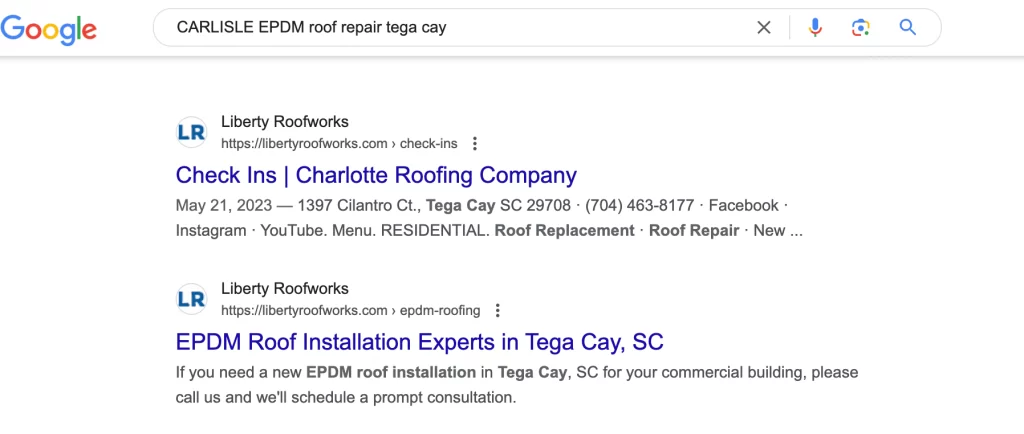
NAP stands for name, address, and phone number. Citation consistency across directories still supports how Google and other search engines validate a business, though its influence as a standalone ranking factor has declined relative to review signals and Google Business Profile completeness.
This matters less when a business has few directory listings to begin with. It matters more for companies with a longer history of citations across changed addresses or rebrands, where inconsistency can accumulate.
The most common citation sources for roofing companies are Yelp, Facebook, Better Business Bureau, and Angi. Linking the business website from each listing helps search engines associate the citation with the correct site.
Reviews
Review signals make up roughly 20% of local pack ranking weight as of the 2026 Whitespark Local Search Ranking Factors survey, up from a 16% weighting in earlier years. This makes consistent review generation one of the highest-leverage activities available to a roofing company.
Consumer tolerance for imperfect ratings is higher than many contractors assume. A Roofing Webmasters consumer survey found most consumers will consider a contractor rated below a perfect 5 stars, with acceptance concentrated between 4.0 and 4.9 stars.
The same survey found roughly half of consumers check more than one review platform before choosing a contractor, which is why diversifying review requests across Google, Facebook, and directory sites outperforms concentrating on a single platform.
This emphasis on review volume applies to businesses that directly take on new residential customers. It matters less for subcontractors who never interact with the homeowner directly and whose next job comes through a general contractor relationship rather than a Google search.
Local Keyword Research
Keyword research for local roofing companies differs from national keyword research. Tools like SEMrush, Ahrefs, and Moz measure national search volume accurately but are less precise for hyper-local terms.
A long-tail keyword is three or more words and highly specific. A moderate long-tail example for roofers would be “modified bitumen roof installation,” which registers an 80 search volume nationally, making it a workable local target even at that volume.
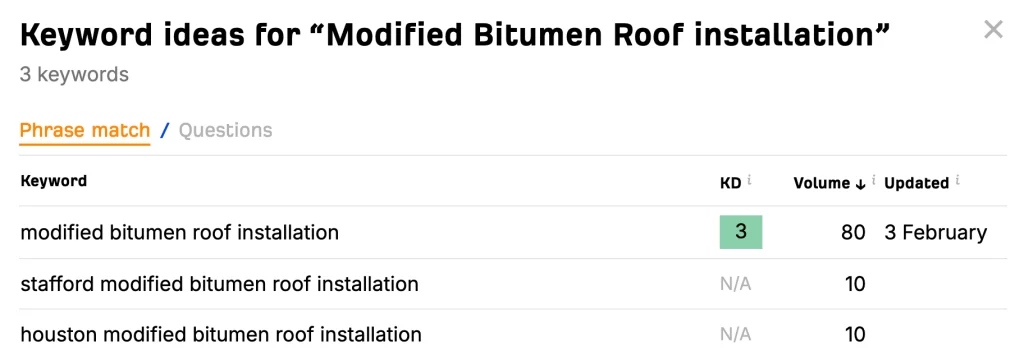
Based on client campaigns, many local searches combine a specific product or service term with a brand name and a city (for example, a specific roofing material paired with a nearby town), and these combinations often don’t register in standard keyword tools at all.
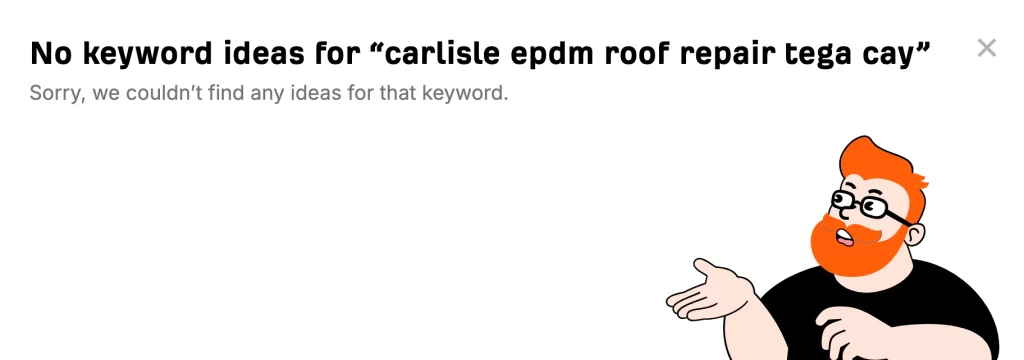
This doesn’t mean the tools are broken; it means keyword research for a single-location or multi-city roofing business benefits from reviewing actual Google Search Console query data alongside any third-party tool.
It’s also a best practice to build pages that meet your customer’s intent without necessarily building out a page or post for every single roofing keyword your website visitors might search.
In many cases, similar phrases share the same intent, meaning they can be answered on a single page rather than on multiple variations of a page.
Deploying an intentional page-intent strategy is especially beneficial under Google’s Helpful Content Update and subsequent core updates, which deprioritize thin and narrowly scoped pages.
Experience, Expertise, Authoritativeness, and Trustworthiness (E-E-A-T)
Google’s own documentation states plainly that E-E-A-T itself isn’t a specific ranking factor, but that Google’s automated systems use a mix of measurable factors to identify content that demonstrates it.
In practice, this means there’s no “E-E-A-T score” to optimize for directly, but the underlying signals (expertise displayed on a page, verifiable credentials, customer-facing trust indicators) do influence how content is evaluated.
About Us Page
An About Us page that details an owner’s or team’s experience and credentials gives Google’s raters something concrete to evaluate against the E-E-A-T framework described above.
A page listing licenses, certifications, and specific project history performs better here than generic company language.
Badges and Awards
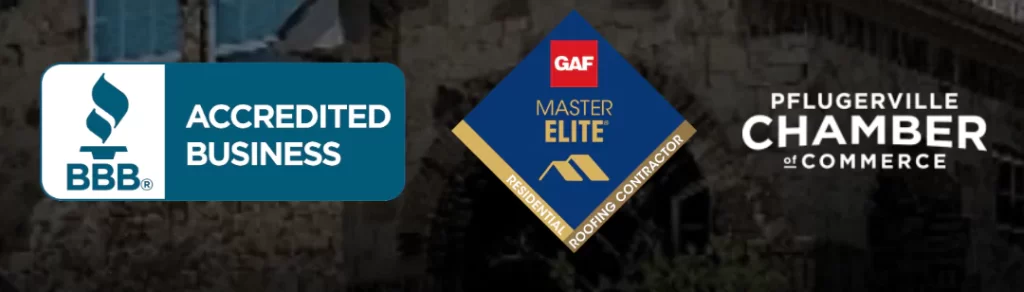
Fewer than 2% of roofing contractors nationwide hold GAF’s Master Elite certification, which makes it a genuine differentiator when displayed with the certifying body named.
The same applies to other named, verifiable credentials; an unnamed or unverifiable “award” carries little weight for either readers or Google’s raters.
Social Proof
An embedded review display pulling from an actual review platform, paired with a documented jobsite history (photos, geo-tags, dates), gives both users and Google’s systems a way to verify claims of experience rather than take them at face value.
Closing Summary
A roofing company’s local SEO strategy rests on three foundations that don’t substitute for one another: a fully claimed Google Business Profile for Map 3-Pack eligibility, consistent review generation across platforms, and content built around genuine credentials and documented work rather than unverifiable claims.
Companies that treat these as a single combined effort, rather than three separate checklists, are best positioned as Google’s local algorithms continue to weight review signals and profile completeness more heavily each year.

Author: Nolen Walker
Nolen Walker is the founder of Roofing Webmasters and the creator of DataPins™, a Local SEO platform for roofing companies. He has over 16 years of experience helping roofing businesses grow through organic search, Google Maps, and AI-driven visibility.
Nolen is the author of
A Complete SEO Guide for the Roofing Small Business Owner. He also hosts
The Roofing SEO Podcast
on Spotify.