
Negative reviews influence whether homeowners hire a roofing company.
According to BrightLocal’s 2026 Local Consumer Review Survey, 97% of consumers read local business reviews, and 77% say negative reviews make them less likely to use a business.
The same survey found that 89% of consumers expect business owners to respond to reviews.
A roofing company’s reply to a negative review is public, giving prospective customers a chance to judge how the business handles complaints.
The six steps below are based on Roofing Webmasters‘ reputation management work with more than 1,000 roofing companies over 16+ years, and they follow Google’s published guidance for Business Profile owners.
These six steps apply to genuine reviews from real customers. Fake reviews, extortion attempts, and reviews from people who were never customers need a different process, covered in the section on when the six steps don’t apply.
Summary: How to Respond to a Negative Roofing Review
- Respond quickly: reply within one business day of the review posting.
- Thank the customer: refer to their specific job instead of using a template.
- Acknowledge the problem: restate the exact issue the customer described.
- Apologize when appropriate: apologize for the experience without admitting fault you have not confirmed.
- Explain or offer a solution: give a one-sentence explanation, a concrete fix, or both.
- Move the conversation offline: give a direct phone number or email for the person handling the issue.
1) Respond to Reviews Quickly
A roofing company should reply to a negative review within one business day. BrightLocal’s survey found that 19% of consumers expect a same-day response, 32% expect one by the following day, and 81% expect a response within a week.
The share expecting a reply by the next day rose from 18% in 2025 to 32% in 2026, according to the same survey.
Google Business Profile sends alerts when customers leave new reviews, delivered by email, in Google Search, or in Google Maps.
Turning on review notifications in Google Business Profile, along with the equivalent alerts on any other review platform the company uses, lets the owner see a complaint the day it is posted.
An office manager or designated staff member can handle review replies when the owner cannot respond personally. Before writing anything, the responder should pull the job file, including the install date, the assigned crew, and any job notes.
Speed should not come at the expense of accuracy. A roofing company that hasn’t confirmed the facts of a job can post a brief acknowledgment that it is looking into the issue, then follow up after reviewing the job file.
2) Thank Customers for Their Business
A roofing company’s reply should start by thanking the reviewer and referencing their specific job. BrightLocal’s survey found that templated or generic replies make 50% of consumers unlikely to choose a business.
Google’s guidance for Business Profile owners advises against sending the same “thank you” to everyone.
A personalized opening reads like this: “Thank you for choosing us for your roof replacement last month, and for letting us know about the leak you described.” The opening names the service and the issue, so the reviewer can see that someone read the review.
Gratitude in a reply also speaks to future customers. Google’s own guidance notes that business replies are public, and that replying shows customers the business values their feedback.
3) Acknowledge The Customer’s Problem
A negative review response should name the specific problem the customer raised.
A reply that restates the complaint in concrete terms, such as a ceiling stain after a storm or shingle debris left in the flower beds, shows the reviewer and every future reader that the company read the review.
Acknowledging a problem is not the same as accepting blame. Google guidance recommends acknowledging mistakes without taking responsibility for things outside the business’s control.
A roofing company can acknowledge that a customer found nails in the driveway without yet agreeing on how they got there.
Specific acknowledgment also replaces the template problem. A reply built around the customer’s details cannot be copied and pasted under another review, which separates it from the generic replies that put off half of consumers in BrightLocal’s data.
4) Apologize For The Inconvenience
A roofing company should apologize for a customer’s negative experience when appropriate, and keep it brief and specific. Google’s Business Profile guidance lists apologizing when appropriate as a tip for negative reviews and notes that a genuine apology can help rebuild trust.
An apology for an experience is different from an admission of fault. “We’re sorry the cleanup didn’t meet your expectations” acknowledges how the customer feels. “We’re sorry our crew damaged your skylight” states liability in a permanent public record before anyone has inspected the skylight.
The fault-neutral approach matters most for disputed workmanship, warranty, and insurance claims. When a review concerns a dispute that could become a legal claim, a roofing company should express empathy without confirming fault and have an attorney review the reply before posting.
Google’s guidance says that constructive replies and follow-ups can encourage a customer to update their review. A short apology tied to a confirmed failure, such as a missed callback, is the easiest kind for a roofing company to own outright.
5) Offer an Explanation or Solution
A roofing company should either explain what caused the problem or state what it will do to fix it, and ideally both.
Some complaints point to a real gap in crews, scheduling, or procedures that the company should correct. Others come from isolated circumstances the customer can’t see.
Circumstances roofing customers often cannot see include weather that stops an install mid-job, material backorders from a supplier, and storm-season scheduling backlogs.
Google’s guidance recommends being honest about limitations and explaining what the business can and cannot do, using the example of a business that monitors weather and sends advance cancellation notices.
An explanation should be one or two sentences and should never read as an excuse. The goal is to show future customers that the reviewer’s experience was not typical, without arguing with the reviewer.
A concrete solution carries more weight than an explanation alone. Offering a free inspection of the flashing, a return visit to clear debris, or a review of the warranty terms gives the reviewer a clear next step and shows prospective customers how the company handles issues.
6) Invite The Customer to Talk Privately
If possible, use the reply to move the conversation offline. End the response with a direct phone number or email for the person handling the issue.
Google’s guidance recommends asking the reviewer to make contact by phone or email when a situation is complex, and warns against sharing a reviewer’s private information in a public reply.
Google notifies reviewers when a business replies, and reviewers can update their review after reading the reply. A private conversation gives the roofing company a chance to resolve the issue before the reviewer decides whether to update.
A roofing company may ask a customer to update a review once an issue is resolved, but Google’s Maps content policy prohibits offering incentives for revising or removing reviews, including payment, discounts, and free services. Offering a discount on a future repair in exchange for an updated review violates that policy.
Example Response to a Post-Installation Leak Review
Consider a homeowner named Dana who leaves a 1-star Google review saying her new roof leaked into an upstairs bedroom three weeks after installation and nobody returned her call. A reply that follows all six steps reads:
“Hi Dana, thank you for choosing us for your roof replacement and for telling us about the leak in your upstairs bedroom. You should have heard back from us the same day you called, and we’re sorry you didn’t. We’ve pulled your job file and would like to send our project manager to inspect the flashing and the area above the bedroom this week at no charge. Please call Mike directly at [phone] or email [email] so we can schedule it. Mike, Project Manager, [Company Name]”
Each part of the reply maps to a step. Thanking Dana by name for her specific job covers Step 2, and naming the bedroom leak and the missed call covers Step 3.
The apology covers the missed callback, a failure the company can confirm, without conceding that the installation caused the leak before an inspection (Step 4). The free inspection is the solution (Step 5), and the direct contact moves the conversation offline (Step 6). Posting the reply within one business day completes Step 1.
Roofing-Specific Complaints and How to Answer Them
Four complaint types come up repeatedly in Roofing Webmasters’ work with roofing clients: post-installation leaks, insurance claim disputes, storm-season delays, and cleanup problems. Each one changes how you apply the six steps.
Post-installation leak complaints should be answered with an inspection offer before the company states a cause. A leak after a new roof can come from components outside the job’s scope, such as an existing chimney or skylight, so the reply should commit to finding the source rather than defending the installation. Warranty terms shouldn’t be included in the public reply.
Insurance claim disputes often blame the roofing company for decisions the homeowner’s insurer makes. A reply can clarify that the insurer sets the claim amount without discussing the claim itself, since claim details are the reviewer’s private information. Offer help, such as documenting damage for a supplement request, in a private follow-up.
Storm-season delay complaints should acknowledge the wait, explain the backlog in one sentence, and give a specific scheduling update. A reply that names a date gives future customers more confidence than one that only cites weather.
Cleanup and nail complaints are usually the easiest to resolve because the facts are visible. A roofing company that confirms the problem can apologize outright and offer a return visit to sweep the property with a magnet.
Neighbor complaints come from people affected by a job who were never the customer, such as an adjacent homeowner bothered by an early start or debris. These reviewers had a real experience with the business, so their reviews are unlikely to qualify for removal under Google’s policy. The six steps still apply, except you don’t need to thank the reviewer for their business.
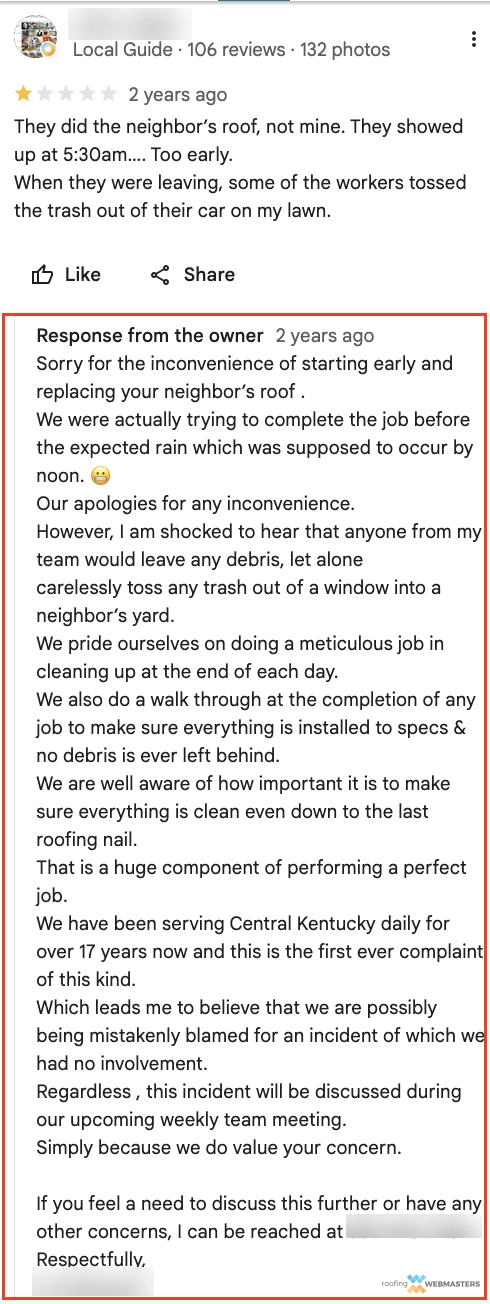
One real 1-star review shows both sides of a neighbor complaint. A neighbor wrote that a crew arrived at 5:30 a.m. and that workers tossed trash onto his lawn as they left.
The owner’s reply apologized for the early start, explained that the crew was racing a noon rain forecast, and provided a direct phone number. The reply then turned defensive about the trash, describing the crew’s cleanup standards and suggesting the company was being blamed by mistake.
A stronger reply would keep the apology and the weather explanation, drop the defense, and offer to send someone to check the lawn.
When the Six Steps Don’t Apply
The six steps assume the reviewer is a real customer with a real experience. Google’s Maps content policy prohibits reviews not based on a real experience, reviews posted by competitors to undermine a business, and reviews based on a conflict of interest such as current or former employment.
Google removes only reviews that violate its content policies. Google states that it doesn’t get involved in business-customer conflicts, so a negative review describing a real experience is not eligible for removal even when the roofing company disputes the facts.
Owners can flag a review from their Business Profile or through the Reviews Management Tool. Evaluation typically takes several days, and a review that is not removed can receive a one-time appeal.
A review from someone who never had an actual experience with the business should be flagged for removal.
If the company replies at all, the reply should be short and factual, with no thanks and no apology: “We have no record of a job under this name and have reported this review to Google. If we’ve missed something, please call us at [phone].”
Google instructs businesses targeted by negative-review extortion scams not to engage or pay. These scams typically pair a sudden spike in 1-star and 2-star reviews with a demand for money or services to remove them. Owners should screenshot every demand and report it through Google’s merchant extortion report form.
Federal rules also limit how a business can fight negative reviews. The Federal Trade Commission’s final rule banning fake reviews, announced in August 2024, prohibits businesses from using groundless legal threats, intimidation, or certain false public accusations to prevent or remove a negative review. A reply that falsely accuses a genuine customer of lying risks falling into that category.
| Review type | Respond publicly? | Move offline? | Flag for removal? |
|---|---|---|---|
| Genuine complaint, facts not in dispute | Yes, using all six steps | Yes | No |
| Genuine complaint, facts disputed (workmanship, warranty, insurance) | Yes, brief and fault-neutral | Yes | No |
| Reviewer had no actual experience with the business | Optional, short and factual | No | Yes |
| Competitor or current or former employee | Optional, short and factual | No | Yes |
| Extortion (review spike plus a demand) | No | No | Yes, plus Google’s extortion report form |
| Profanity, harassment, or personal information | No | No | Yes |
| Subject of active litigation | Only after an attorney approves | Through counsel | No |
Small Roofing Companies With Few Reviews
A single negative review weighs more on a roofing company with few reviews, because it makes up a larger share of the profile.
BrightLocal’s survey found that 47% of consumers won’t use a business with fewer than 20 reviews, and only 9% would use one with five or fewer.
For a newer roofing company, a well-written reply is one of the few signals a prospective customer can weigh against the negative review.
Google’s guidance notes that a mix of positive and negative feedback often feels more trustworthy, and encourages businesses to remind customers to leave reviews through a review link or QR code.
Do Review Responses Affect Local Rankings?
Google includes responding to reviews among its tips for improving local ranking, but it describes the benefit as helping a business stand out.
Google names relevance, distance, and popularity as ranking factors (which it later calls prominence), and it states that more reviews and positive ratings can help a business’s local ranking.
Google’s documentation does not state that the act of replying changes a business’s ranking position. A reply can still matter indirectly, since a resolved customer who updates a 1-star rating changes the business’s overall rating.
Key Takeaways for Roofing Companies
Future customers can see every negative review a roofing company receives alongside the company’s reply.
The most effective replies are fast (within one business day), specific to the customer’s job, and fault-neutral on any disputed claim, and they move the details to a phone call or email.
Genuine complaints and policy-violating reviews require different approaches. Reply to genuine complaints using the six steps; flag fake, competitor, and extortion reviews through Google’s reporting tools.
Under Google’s policy, no roofing company should offer a discount or free service in exchange for an updated or removed review.

Author: Nolen Walker
Nolen Walker is the founder of Roofing Webmasters and the creator of DataPins™, a Local SEO platform for roofing companies. He has over 16 years of experience helping roofing businesses grow through organic search, Google Maps, and AI-driven visibility.
Nolen is the author of
A Complete SEO Guide for the Roofing Small Business Owner. He also hosts
The Roofing SEO Podcast
on Spotify.