
Google’s Local Services Ads (LSA) is Google’s pay-per-lead advertising platform for verified roofing contractors and other local businesses. Only roofing companies that pass Google’s screening and verification process are eligible to run these ads.
To participate, businesses must pass a verification process that varies by category and location.
According to Google’s official documentation, this process may include a business entity check, business owner background check, field worker background check, license verification, and insurance verification.
On average, screening and verification take three to four weeks to complete once documents are submitted, though some advertisers qualify for accelerated badging while finishing the remaining steps.
Once verified, roofers pay only for leads generated through the ad rather than paying per click, as with traditional Google Ads. Local Services Ads appear above traditional paid advertisements for people performing a local search for roofing services in their area.
The following guide breaks down how roofing companies can maximize the impact of LSA.
Key Takeaways
- Local Services Ads (LSA) is Google’s pay-per-lead advertising platform for verified roofing contractors, distinct from traditional Google Ads PPC.
- Businesses earn the Google Verified badge by passing entity, license, insurance, and background checks. Google discontinued the separate Money Back Guarantee program tied to the older “Google Guaranteed” name; verification and trust signals now run through the single Google Verified badge.
- LSA availability and cost vary significantly by zip code, trade, and competition level. There is no single national price that applies evenly across markets.
- Downsides include unpredictable lead quality, dependency on Google’s verification status, and the risk of suspension or revocation, which can be appealed but isn’t guaranteed to be resolved quickly.
- LSA works best as one channel within a broader strategy that includes SEO, website conversion, and reputation management, rather than as a standalone lead source.
The Google Verified Badge
The Google Verified badge is a single trust badge that Google now issues to all qualifying Local Services Ads advertisers.
It replaced the prior two-tier badging system, and Google has discontinued the Money Back Guarantee that was previously tied to the older program name. Existing advertisers who had already completed verification automatically received the new badge with no action required; new advertisers earn it by completing the standard screening and verification process.
The badge signals to consumers that a business has passed Google’s checks, but it does not function as a consumer reimbursement program the way the prior structure did.
Roofing companies should not represent the badge to customers as including a money-back guarantee, since that mechanism no longer exists in its earlier form.
How Local Services Ads Work
Local Services Ads operate on a pay-per-lead model, where you only pay after the customer contacts you through the ad. This differs from standard PPC ads, which charge the advertiser per click regardless of whether the user contacts the business.
Users who click on your ad can contact you in one of three ways: a phone call, which Google records and lets you mark as qualified or junk; a direct message through the LSA platform; or a booking through your connected calendar.
A pay-per-lead model shifts more of the risk to the platform, since users who weren’t seriously considering a service tend to filter themselves out before contacting the business, unlike with click-based PPC.
| Channel | Pricing Model | Best For | Limitation |
|---|---|---|---|
| Local Services Ads | Pay per lead | Verified businesses wanting top-of-page placement with minimal click waste | Availability and cost vary by market; less control over lead source |
| Google Ads PPC | Pay per click | Businesses wanting precise keyword and landing page control | Pay regardless of whether the click converts to contact |
| SEO / organic search | No direct cost per lead | Long-term, sustainable visibility independent of ad spend | Slower to build; requires ongoing content and technical investment |
| Third-party platforms (Angi, Thumbtack) | Varies (subscription, pay-per-lead, or both) | Businesses wanting exposure beyond Google’s ecosystem | Leads often shared with competing contractors bidding for the same job |
Local Services Ads, traditional SEO, and third-party lead platforms tend to work best as complementary channels rather than substitutes for one another.
A roofing company that relies on only one is more exposed to that channel’s specific risks, whether that’s rising LSA costs, algorithm shifts affecting organic rankings, or platform fees on third-party sites.
LSA Eligibility for Roofing Companies
LSA is not available in every location, and availability depends on your specific service area and licensing status.
Google’s targeting system lets advertisers define service areas by city, zip code, or county, and Google’s own guidance favors city or town-level targeting for the most accurate ad matching.
For roofing companies in rural or lower-density markets, this means service-area coverage can be inconsistent even within counties that technically qualify, since LSA’s availability is built around population and competition density rather than a simple in-or-out designation by state.
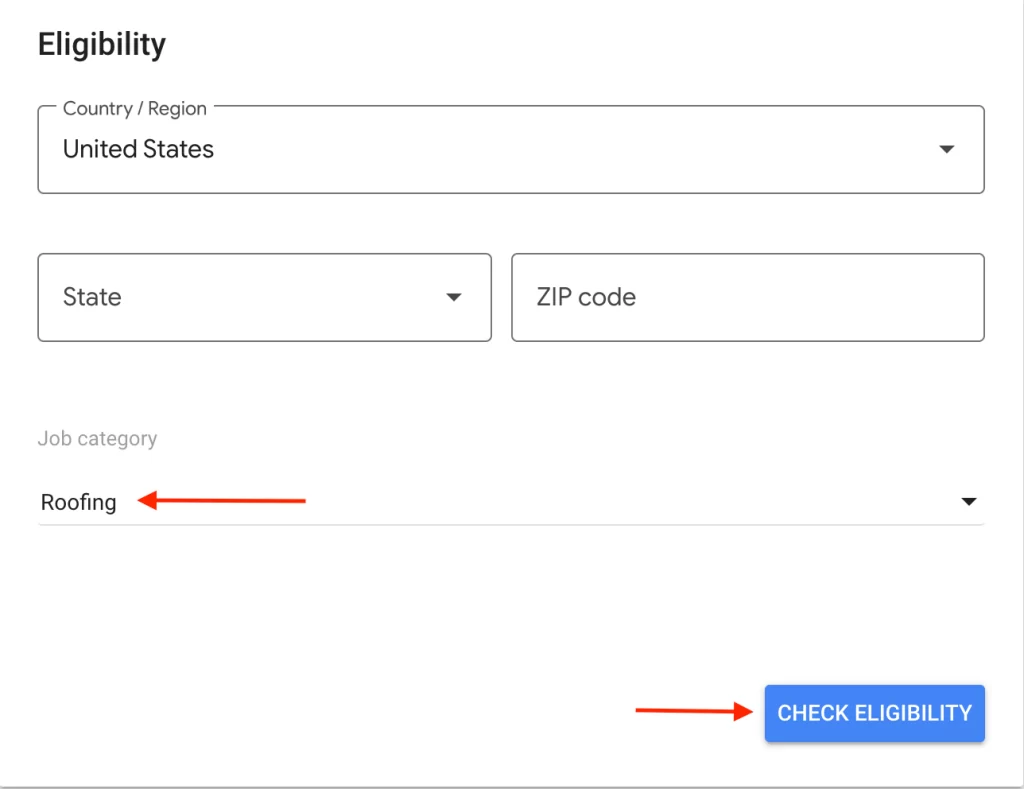
Roofers in these markets should check eligibility directly through Google’s service area tool rather than assuming availability based on neighboring cities.
Licensing is also a gating factor. Google verifies that advertisers and their workers hold applicable state and local licenses, and in some border regions, a license valid in one state may not extend coverage into a neighboring service area even if both fall within your intended footprint.
Roofing companies expanding into new territories should confirm licensing coverage before assuming LSA eligibility follows automatically.
New or low-review roofing companies face a separate consideration. Verification through Google does not require an established review history to begin running ads, but ranking and visibility within LSA’s results are influenced by review volume and quality over time.
A newly verified roofer with the Google Verified badge but few reviews will likely see lower visibility than an established competitor with the same badge, even in the same service area.

LSA Cost Considerations
LSA cost per lead varies substantially by zip code, trade, and local competition, and there is no single national figure that applies evenly across markets.
Roofing is generally among the more competitive and higher-cost categories within home services, since storm-driven demand spikes and high job values both push bidding activity upward in affected markets. Roofers can check their own market-specific estimate using Google’s built-in cost estimator tool, which reflects current conditions for a given zip code rather than a fixed published rate.
Based on agency experience managing LSA alongside organic search campaigns, organic leads typically carry a meaningfully lower long-run cost per acquisition than paid LSA leads, though the size of that gap depends heavily on market competition, a company’s existing search visibility, and how long it has invested in organic strategy.
Roofing companies evaluating LSA should treat it as one input in a broader cost-per-acquisition comparison rather than relying on a single industry-wide percentage difference.
Potential Downsides to LSA for Roofing Companies
LSA functions as a pay-per-lead advertising model, and pay-per-lead channels carry structural risks that roofing companies should weigh before relying on them as a primary lead source.
Lead quality and disputes
Roofers can mark fake or clearly invalid leads as junk to avoid paying for them, and Google continues to refine its spam filtering for LSA leads. However, the filtering system isn’t perfect, and some leads that appear legitimate at first still fail to convert into a sale.
In those cases, the roofing company pays for a lead that never produces revenue. Invalid leads can be formally disputed through Google’s dispute process, though dispute resolution timelines vary.
Google dependency
With LSA, Google controls verification status, badge eligibility, and the cost per lead. Google can suspend an account for policy violations under its Local Services and Google Ads terms, and a suspended account cannot run ads while the suspension is active, though the business can still access its reports.
If Advanced Verification is denied, an appeal can be submitted once, and Google’s appeal review typically takes about two weeks. By contrast, SEO campaigns still depend on Google’s search algorithm, but the relationship functions more like an ongoing partnership than a platform that can revoke access outright.
Wasted spend on unconverted leads
Because LSA charges per lead rather than per click, the financial risk shifts from impressions to contacts. A roofing company that doesn’t track which leads convert into booked jobs, beyond simply tracking cost per lead, risks misjudging whether the channel is actually profitable.
Moving Forward with Google LSA
LSA can be a useful component of a broader digital marketing strategy that includes SEO, website conversion optimization, and reputation management.
Relying solely on LSA as a primary lead source carries risk, since cost per lead is market-dependent and can rise without warning, and the channel remains fully subject to Google’s verification and policy decisions.
Roofing companies considering LSA should weigh it against their specific market’s competition level, their licensing footprint if they operate across state lines, and their existing review base before treating it as a primary growth channel rather than one option among several.

Author: Nolen Walker
Nolen Walker is the founder of Roofing Webmasters and the creator of DataPins™, a Local SEO platform for roofing companies. He has over 16 years of experience helping roofing businesses grow through organic search, Google Maps, and AI-driven visibility.
Nolen is the author of
A Complete SEO Guide for the Roofing Small Business Owner. He also hosts
The Roofing SEO Podcast
on Spotify.