AI SEO for roofers, or Answer Engine Optimization (AEO), helps roofing companies appear in answers from large language models (LLMs) such as those powering Google AI Overviews, Gemini, Claude, Grok, Perplexity, and ChatGPT.
AI search traffic grew 527% year over year in 2025, and that growth has accelerated since, with ChatGPT now surpassing 900 million weekly active users, and Meta AI crossing 1.2 billion monthly users.
Naturally, roofing companies are looking for ways to maximize their visibility on these platforms to drive more customers to their business in 2026 and beyond.
I’m Nolen Walker, the founder of Roofing Webmasters. For over sixteen years, I’ve been helping roofers rank on search engines like Google and Bing.
As AI search becomes increasingly common among Americans, ensuring your roofing business is part of this new information medium is crucial for maintaining or improving your online visibility in 2026.
Because we work with hundreds of roofing companies, we’ve continuously monitored our clients’ visibility on these various AI platforms to identify performance trends.
I will help you optimize for the following AI platforms:
- Google AI Overviews
- Google AI Mode
- Google Gemini
- ChatGPT
- Perplexity
- Claude
- Grok
- Meta AI

The following guide outlines how roofing companies should expand their SEO strategy to account for AI, LLMs, and increasingly popular tools like Google AI Overviews, Perplexity, and ChatGPT.
Key Takeaway
While some aspects of traditional SEO for roofers overlap with AI SEO (sometimes called AEO), our research indicates that additional steps are needed to maximize AI visibility.
How AI Search Works for Local Roofing Companies
AI search works by expanding user prompts into related sub-queries to gather contextual information, then verifying their accuracy and recency using retrieval-augmented generation (RAG).
Relevance is then calculated mathematically using vector embeddings, prioritizing content that is most relevant to the query.
AI also drills down content into chunks to extract subject-verb-object relationships and prioritizes consistent information that aligns with other trusted sources.
The last step is synthesizing everything above into an AI-generated response to the user.
Query-Fan Out
The process of breaking user prompts into sub-queries is known as query fan-out, meaning the search extends beyond the entered phrase to explore diverse information with probable correlations.
For example, a user’s AI search for “best roofing company” will “fan-out” into related sub-queries such as “how to choose a roofing company” and “average cost of roof replacement.”
This doesn’t mean your roofing website should create pages and posts for each query fan-out, as Google states this will violate their scaled content abuse spam policy.
Instead, create well-rounded pages and posts that cover the subtopics your target customers might consider when choosing a roofing company or service.
Grounding and Retrieval
The AI platform decides whether it needs “grounding,” which means validating its internal knowledge (based on training data) against web results.
Most queries related to roofing services and companies will trigger grounding, as information about the top roofers in a service area can shift daily based on reviews, website updates, and other variables.
Vector Embeddings
AI search platforms plot queries and documents as points in a multidimensional space, enabling them to measure the distance between the user’s query and the sourced documents using cosine similarity.
Roofing websites that focus on a specific service (roofing) and service area (Dallas, TX) generate a tighter vector embedding than general contractors that service the entire country, for example.
Entity Mapping
The AI platform translates text into semantic triples (subject-predicate-object) to map entities (such as a roofing business) to attributes (such as mechanical lock roof repair services).
An example of a semantic triple is: Jim’s Roofing provides mechanical lock metal roofing services.
Content Chunking
AI platforms break content into chunks to find the text passage that most directly relates to the user’s query or prompt.
Pages that feature clear H2s followed by concise paragraphs tend to be more easily retrieved by search engines and AI platforms.
It’s worth noting that Google’s official AI search guidance clarifies that content chunking is not a tactic webmasters need to manually optimize for. Good page structure helps readers first, and AI benefits as a result.
Consensus Checking
The AI platform checks its retrieved content against multiple authoritative sources to determine whether there is sufficient consensus to confidently deliver an answer to a user.
For example, a roofing website that makes exaggerated claims about the price of roof repair in a service area is less likely to be cited because reputable websites publish accurate, consistent price ranges.
AI SEO Examples for Local Roofing Companies
With proper AI search optimization (which is arguably the same as SEO), roofing companies can appear directly in AI search results for roofing-related queries.
The examples below highlight specific real-world cases in which a local roofing company appears in an AI search result.
Google AI Overviews
Google AI Overviews, powered by Google Gemini, are featured directly within the traditional search engine results page (SERP).
The example below shows a local roofer appearing in an AI overview for consumers seeking a TruDef Duration roofing system in their service area.

Perplexity AI
Perplexity has over 45 million monthly active users, making it a legitimate source of traffic and brand recognition for local roofing companies.
In a separate example, we see a different local roofing company appearing in the response from Perplexity’s LLM-generated answer.
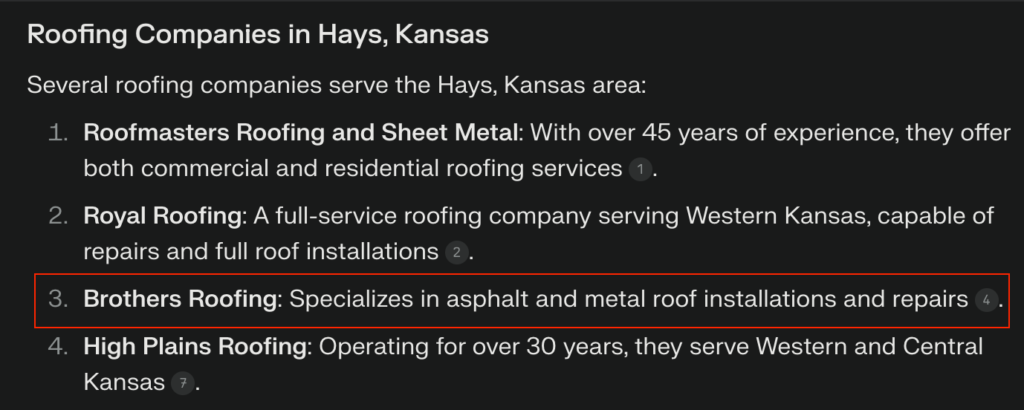
source: Perplexity
Google AI Mode
Like Google AI Overviews, AI Mode is powered by Gemini but, in this instance, is separated from standard Google search results.
AI Mode is likely to become Google’s default search engine sometime in 2026, a sign of things to come for an evolving search landscape.
Below, you can see Google AI Mode recommending a local roofing company that provides mechanical lock metal roofing services.

Grok
Grok’s 64 million monthly active users position it as a leader in AI search relevance across all industries, including local roofing services.
Below, you’ll notice Grok recommending a silicone roofing contractor in a specific city.
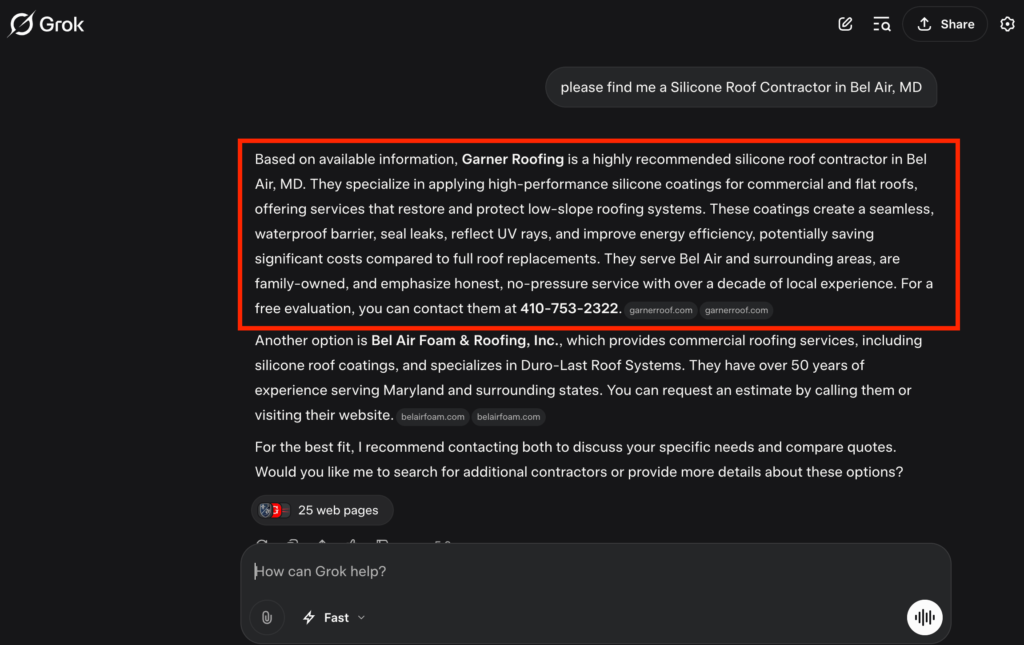
source: Grok
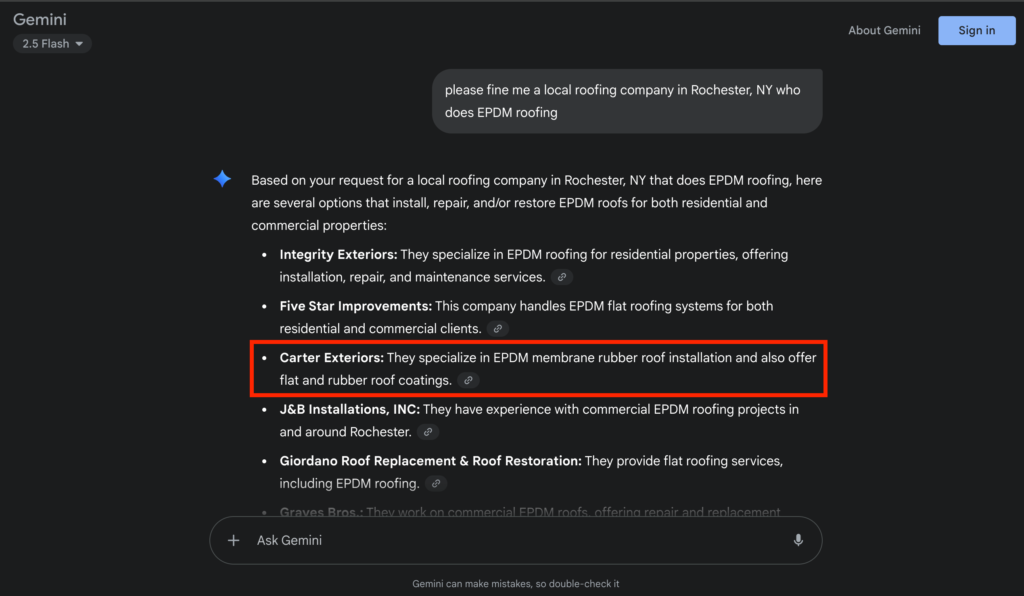
Gemini
Google Gemini powers both AI Overviews and AI Mode, and also serves as a standalone AI platform comparable to ChatGPT.
Below, you can see a local roofing company mentioned in the Google Gemini interface, separate from AI Overviews and AI Mode.
Claude
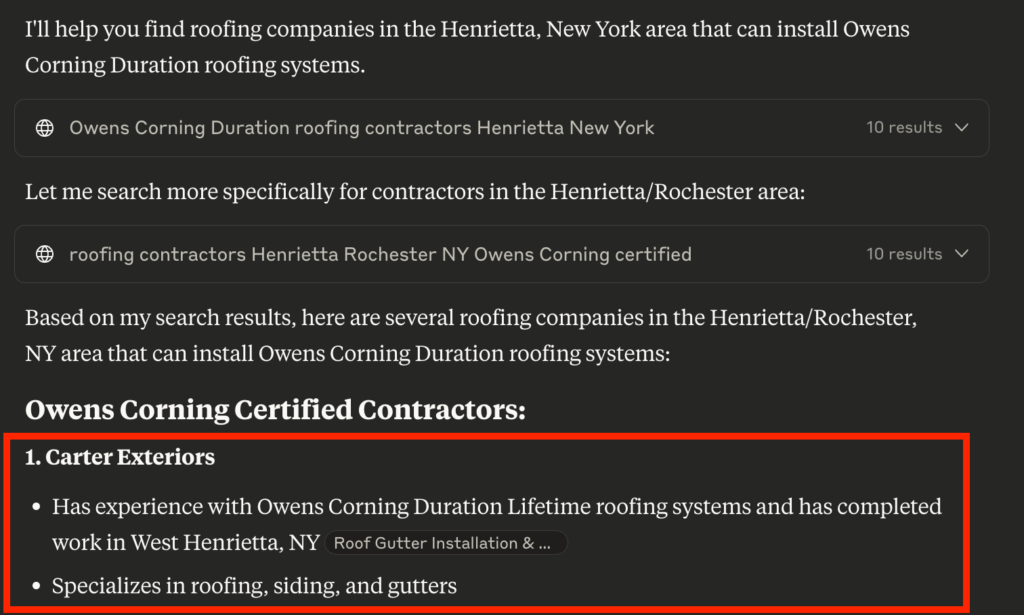
Anthropic’s Claude has nearly 30 million monthly active users and continues to grow at a rate that local roofing companies should monitor.
The example below showcases Anthropic Claude generating a local roofing company in its answer to a question about a specific type of shingle installation.
ChatGPT
With over 900 million monthly active users, ChatGPT has become a “household name” for most consumers and one they are increasingly utilizing to find, compare, and research roofing companies.
You can see ChatGPT recommending a local roofing company as its “top recommended contractor” based on a specific recent project demonstrated on the roofing company’s website.

Meta AI
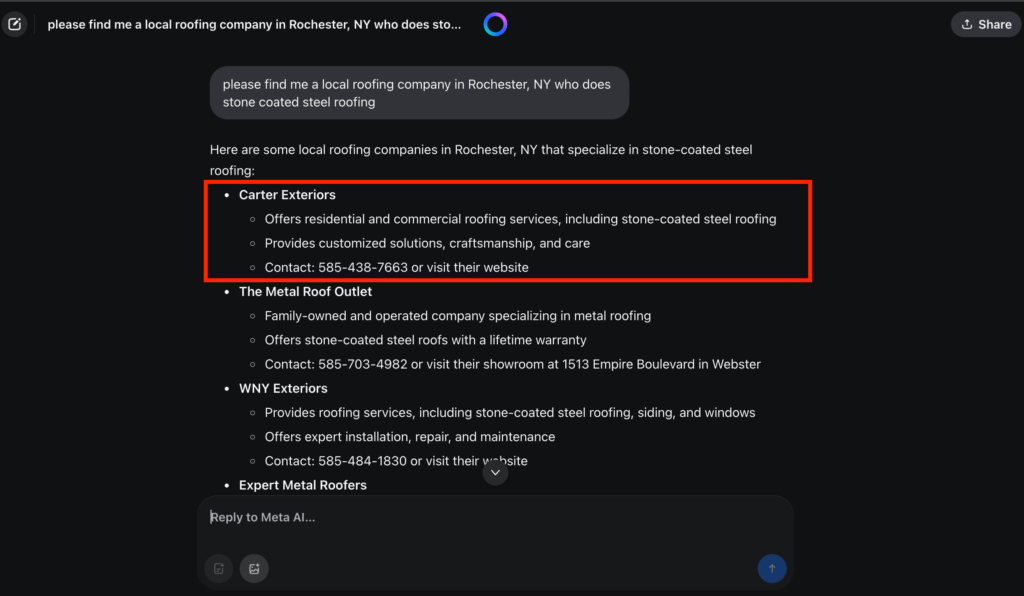
Meta AI has surpassed 1.2 billion monthly active users thanks to its integration across multiple apps, including Facebook, Instagram, and WhatsApp.
You can see Meta AI suggest a local roofer for a specific query and outline the company’s services and contact information.
Using AI-targeted optimization, your local roofing company can also appear in these types of AI answers.
Optimizing for AI Training Data
In a study by Rand Fishkin of SparkToro, he describes brand mentions in training data as the critical factor for appearing in AI and LLM answers.
AI Training Data Explained for Roofers
LLMs are primarily trained on internet data, such as web pages, articles, lists, and directories. As a result, your roofing company’s website and listings on major directories may be used as training data.
Most AI platforms use “grounding,” which means accessing the live web to find the most recent results, but a presence in their pre-existing training data can still provide an advantage in AI search visibility.
Maximizing Training Data Mentions
The first step to being included in training data is to make sure your website is crawlable by AI crawler bots like GPTBot and ClaudeBot.
Depending on your DNS settings and firewall, your site may automatically block AI bots, preventing it from being used for training data.
One way to check this is a analyze your website’s log files, which you can outsource to a credible marketing agency.
Assuming AI bots are crawling your site, your traditional SEO efforts serve as a foundation for training data.
For example, having an official company website, a Google Business Profile, and listings on other directories like Yelp and BBB all contribute to your chances of appearing in AI-generated answers.
We’ve also found that our software tool, DataPins, which allows you to showcase recent roofing jobs directly on your website with descriptive job captions, is leading to direct citations in some AI responses.
The goal is for AI platforms such as Google Gemini, Claude, Grok, Perplexity, and ChatGPT to be trained on your specific jobs rather than on generic, commodity content.
Optimizing for Generative AI Features
Google has published official guidance on optimizing for generative AI features, which calls for applying foundational SEO best practices, such as creating valuable content and maintaining a clear technical structure.
While that document comes specifically from Google, the underlying principle, that foundational content quality drives AI visibility more than tactical “hacks,” holds broadly across platforms like ChatGPT and Perplexity, based on our own research.
Here are some of the strategies we’ve seen success with when optimizing for generative AI features:
Create Valuable, Non-Commodity Content
Your roofing website should only feature valuable, non-commodity content, meaning pages and posts that provide a unique perspective rather than regurgitating content from around the web.
Most SEO guides have outlined the importance of natural language processing for Google optimization, and the benefits of using concise, direct language extend to AI mentions as well.
To make it easy for LLMs to mention your web content within their answers, you provide them with language that matches common user queries and summarize it in a direct, concise manner.
Earn Listcale Mentions (High-Risk Tactic)
Many popular AI platforms (notably Google AI Mode and ChatGPT) directly cite lists when providing answers about the best roofing companies in a specific city or region.
You’ve probably seen lists on Google search results titled “10 best roofers in Dallas, TX” and other cities, and those are the types of lists AI is currently citing when “ranking” roofers.
3rd-party lists are far more influential than first-party lists (ranking your own company on your own website), and the latter looks very much like spam, something you should avoid in general.
Creating listicles at scale almost certainly violates Google’s spam policies, and recent industry studies have found correlations between sites that publish these listicles and significant drops in their organic search traffic.
Earn Company Reviews
It’s also evident that AI platforms are pulling customer reviews from platforms such as Google Business Profile, Yelp, and Facebook.
Google’s AI Mode will directly cite Google Business Profiles, while ChatGPT may cite Yelp and Facebook reviews.
Google’s official documentation mentions optimizing your local business and states that Google Business Profiles can help make your services visible in AI responses.
Become Agent Accessible
AI agents can perform tasks on behalf of people, including comparing quotes between roofing companies and even booking services.
There are web design principles that help AI agents navigate your website, such as ensuring a stable layout, avoiding “ghost” elements, and using semantic HTML.
Consult with Google’s guide to build an agent-friendly website to learn more about the specific elements.
Moving Forward With AI SEO for Roofers
AI’s impact on search engines is significant, with Google’s AI Overviews directly integrating into daily search engine results.
Roofing companies that have already invested in the best SEO practices are positioned to benefit from exposure on AI platforms and large language models (LLMs).
For nearly two decades, my agency, Roofing Webmasters, has helped thousands of roofers navigate the evolving landscape of digital marketing.
My goal is to help your local roofing company thrive in the age of AI search, AEO, and LLMs with forward-thinking strategies that adapt to modern search technology and user behavior.
To further discuss AI search and its impact on your roofing business, call me on my personal cell at (800) 353-5758.

Author: Nolen Walker
Nolen Walker is the founder of Roofing Webmasters and the creator of DataPins™, a Local SEO platform for roofing companies. He has over 16 years of experience helping roofing businesses grow through organic search, Google Maps, and AI-driven visibility.
Nolen is the author of
A Complete SEO Guide for the Roofing Small Business Owner. He also hosts
The Roofing SEO Podcast
on Spotify.